
PUBLISHER: Global Market Insights Inc. | PRODUCT CODE: 1998822

PUBLISHER: Global Market Insights Inc. | PRODUCT CODE: 1998822
Beverage Filter Paper Market Opportunity, Growth Drivers, Industry Trend Analysis, and Forecast 2026 - 2035
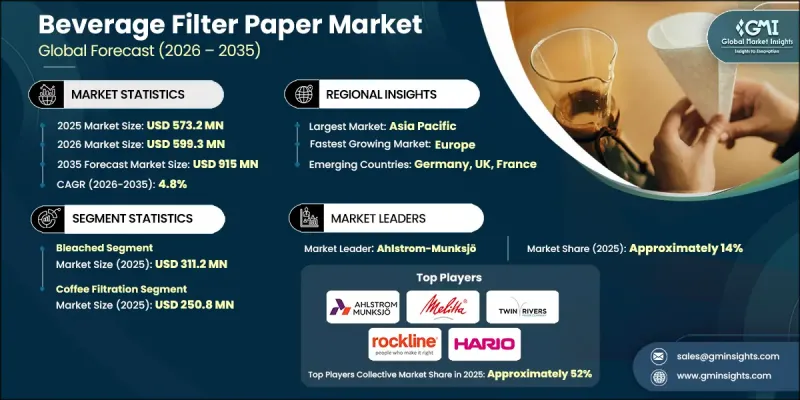
The Global Beverage Filter Paper Market was valued at USD 573.2 million in 2025 and is estimated to grow at a CAGR of 4.8% to reach USD 915 million by 2035.
The rising demand for premium and specialty beverages, including coffee, tea, and alcoholic drinks, is fueling the need for high-quality filter paper. Consumers increasingly seek refined and clean drinking experiences, pushing manufacturers to adopt superior filtration solutions that enhance taste, clarity, and overall beverage quality. Sustainability trends are also driving growth, as eco-conscious consumers and businesses demand environmentally friendly alternatives to plastic and synthetic filtration methods. Beverage filter papers are now essential in both commercial and household settings, enabling producers to meet evolving consumer expectations for wellness, quality, and responsible production practices. As the global beverage industry grows, the adoption of filter papers continues to expand in response to the increasing demand for filtered, high-quality beverages.
| Market Scope | |
|---|---|
| Start Year | 2025 |
| Forecast Year | 2026-2035 |
| Start Value | $573.2 Million |
| Forecast Value | $915 Million |
| CAGR | 4.8% |
The bleached filter papers segment accounted for USD 311.2 million in 2025. The beverage filter paper industry primarily consists of bleached, unbleached, and semi-bleached grades to meet diverse consumer preferences and regulatory standards. Bleached paper is preferred for its uniform appearance, clean finish, and compatibility with automated brewing equipment, making it ideal for both commercial and domestic applications. This grade provides consistent filtration performance, meeting the growing consumer demand for high-quality beverages and refined drinking experiences.
The coffee filtration segment generated USD 250.8 million in 2025, reflecting the widespread consumption of coffee and the popularity of drip and single-serve brewing methods. Beverage filter paper use varies across coffee, tea, fruit juices, and alcoholic beverages, each requiring specific performance characteristics to preserve flavor, aroma, and clarity. The increasing number of specialty cafes and household brewing systems has strengthened the coffee filtration segment, making it one of the leading contributors to market growth.
North America Beverage Filter Paper Market accounted for USD 156.9 million in 2025. The region benefits from high per-capita consumption of specialty beverages, mature retail infrastructure, and growing demand for industrial beverage processing. The United States contributes the largest share, driven by a well-established coffee and tea market. Meanwhile, Canada is also influencing regional expansion as consumers increasingly seek high-quality, specialty beverages. Industrial use and household consumption collectively bolster North America's position in the global beverage filter paper market.
Key players operating in the Global Beverage Filter Paper Market include Ahlstrom-Munksjo, Melitta Group, Hario Co., Ltd, Twin Rivers Paper Company, Rockline Industries, Finum GmbH, Terranova Papers, Hebei Amusen Filter Paper Co., Ltd, and Purico Group. Companies in the Beverage Filter Paper Market are strengthening their market presence by investing in research and development to improve filtration efficiency, product uniformity, and sustainability. Strategic collaborations with coffee and tea brands, along with partnerships with machinery manufacturers, enable integration with automated brewing systems. Firms are expanding production capacities and diversifying grades of filter papers to meet evolving consumer and commercial needs. Marketing campaigns emphasizing eco-friendly and high-performance features help attract environmentally conscious buyers. Companies are also focusing on regional distribution expansion and digital commerce channels to ensure product availability, improve customer engagement, and reinforce brand loyalty across both household and industrial markets.
Table of Contents
Chapter 1 Methodology & Scope
- 1.1 Market scope and definition
- 1.2 Research design
- 1.2.1 Research approach
- 1.2.2 Data collection methods
- 1.3 Data mining sources
- 1.3.1 Global
- 1.3.2 Regional/Country
- 1.4 Base estimates and calculations
- 1.4.1 Base year calculation
- 1.4.2 Key trends for market estimation
- 1.5 Primary research and validation
- 1.5.1 Primary sources
- 1.6 Forecast model
- 1.7 Research assumptions and limitations
Chapter 2 Executive Summary
- 2.1 Industry 360° synopsis
- 2.2 Key market trends
- 2.2.1 Regional
- 2.2.2 Grade
- 2.2.3 Application
- 2.3 TAM Analysis, 2026-2035
- 2.4 CXO perspectives: Strategic imperatives
- 2.4.1 Executive decision points
- 2.4.2 Critical success factors
- 2.5 Future Outlook and Strategic Recommendations
Chapter 3 Industry Insights
- 3.1 Industry ecosystem analysis
- 3.1.1 Supplier Landscape
- 3.1.2 Profit Margin
- 3.1.3 Value addition at each stage
- 3.1.4 Factor affecting the value chain
- 3.1.5 Disruptions
- 3.2 Industry impact forces
- 3.2.1 Growth drivers
- 3.2.1.1 Increasing demand for filtered beverages.
- 3.2.1.2 Technological advancements in beverage filtration.
- 3.2.1.3 Growing demand for sustainable products.
- 3.2.2 Industry pitfalls and challenges
- 3.2.2.1 Competition from synthetic filter papers.
- 3.2.2.2 High cost of raw materials.
- 3.2.3 Market opportunities
- 3.2.3.1 Premium & Specialty Coffee Expansion Driving High-Performance Filters
- 3.2.3.2 Sustainability-Driven Shift Toward Biodegradable & Compostable Filtration Media
- 3.2.1 Growth drivers
- 3.3 Growth potential analysis
- 3.4 Regulatory landscape
- 3.4.1 North America
- 3.4.2 Europe
- 3.4.3 Asia Pacific
- 3.4.4 Latin America
- 3.4.5 Middle East & Africa
- 3.5 Porter's analysis
- 3.6 PESTEL analysis
- 3.7 Price trends
- 3.7.1 By region
- 3.7.2 Product type
- 3.8 Future market trends
- 3.9 Technology and Innovation Landscape
- 3.9.1 Current technological trends
- 3.9.2 Emerging technologies
- 3.10 Patent Landscape
- 3.11 Trade statistics (HS code) (Note: the trade statistics will be provided for key countries only)
- 3.11.1 Major importing countries
- 3.11.2 Major exporting countries
- 3.12 Sustainability and environmental aspects
- 3.12.1 Sustainable practices
- 3.12.2 Waste reduction strategies
- 3.12.3 Energy efficiency in production
- 3.12.4 Eco-friendly initiatives
- 3.13 Carbon footprint considerations
Chapter 4 Competitive Landscape, 2024
- 4.1 Introduction
- 4.2 Company market share analysis
- 4.2.1 By region
- 4.2.1.1 North America
- 4.2.1.2 Europe
- 4.2.1.3 Asia Pacific
- 4.2.1.4 LATAM
- 4.2.1.5 MEA
- 4.2.1 By region
- 4.3 Company matrix analysis
- 4.4 Competitive analysis of major market players
- 4.5 Competitive positioning matrix
- 4.6 Key developments
- 4.6.1 Mergers & acquisitions
- 4.6.2 Partnerships & collaborations
- 4.6.3 New product launches
- 4.6.4 Expansion plans
Chapter 5 Market Estimates and Forecast, By Grade, 2022 - 2035 (USD million) (Kilo Tons)
- 5.1 Key trends
- 5.2 Bleached
- 5.3 Unbleached
- 5.4 Semi-Bleached
Chapter 6 Market Estimates and Forecast, By Application, 2022 - 2035 (USD million) (Kilo Tons)
- 6.1 Key trends
- 6.2 Coffee filtration
- 6.3 Tea filtration
- 6.4 Alcoholic beverages
- 6.5 Specialty beverages
- 6.6 Others
Chapter 7 Market Estimates and Forecast, By Region, 2022 - 2035 (USD million) (Kilo Tons)
- 7.1 Key trends
- 7.2 North America
- 7.2.1 U.S.
- 7.2.2 Canada
- 7.3 Europe
- 7.3.1 Germany
- 7.3.2 UK
- 7.3.3 France
- 7.3.4 Spain
- 7.3.5 Italy
- 7.3.6 Rest of Europe
- 7.4 Asia Pacific
- 7.4.1 China
- 7.4.2 India
- 7.4.3 Japan
- 7.4.4 Australia
- 7.4.5 South Korea
- 7.4.6 Rest of Asia Pacific
- 7.5 Latin America
- 7.5.1 Brazil
- 7.5.2 Mexico
- 7.5.3 Rest of Latin America
- 7.6 Middle East and Africa
- 7.6.1 Saudi Arabia
- 7.6.2 South Africa
- 7.6.3 UAE
- 7.6.4 Rest of Middle East and Africa
Chapter 8 Company Profiles
- 8.1 Ahlstrom-Munksjo
- 8.2 Melitta Group
- 8.3 Hario Co., Ltd
- 8.4 Twin Rivers Paper Company
- 8.5 Rockline Industries
- 8.6 Finum GmbH
- 8.7 Hebei Amusen Filter Paper Co., Ltd
- 8.8 Purico Group
- 8.9 Terranova Papers

