PUBLISHER: Global Market Insights Inc. | PRODUCT CODE: 1998858

PUBLISHER: Global Market Insights Inc. | PRODUCT CODE: 1998858
Asia Pacific Nail Guns Market Opportunity, Growth Drivers, Industry Trend Analysis, and Forecast 2026 - 2035
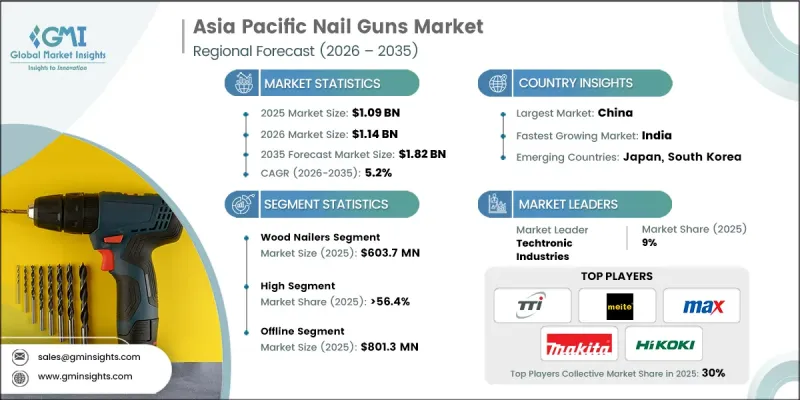
Asia Pacific Nail Guns Market was valued at USD 1.09 billion in 2025 and is estimated to grow at a CAGR of 5.2% to reach USD 1.82 billion by 2035.
Increasing urbanization across Asia Pacific is creating sustained demand for housing developments, structural upgrades, and the modernization of existing buildings. As cities expand and construction timelines become tighter, builders and contractors are turning to advanced fastening equipment that improves efficiency while maintaining consistent build quality. The evolving construction environment requires tools that can support higher project volumes while minimizing manual effort and reducing installation time. Nail guns are increasingly becoming essential within this environment because they deliver accurate and repeatable fastening performance that supports large-scale structural assembly and prefabricated construction methods. Additionally, the growing adoption of modern building practices and automated installation techniques is encouraging greater use of professional-grade fastening equipment across the region. As construction processes become more streamlined and productivity-focused, the Asia Pacific nail guns market is expected to benefit from rising demand among professional contractors, construction firms, and industrial users seeking reliable fastening solutions that improve workflow efficiency and operational consistency.
| Market Scope | |
|---|---|
| Start Year | 2025 |
| Forecast Year | 2026-2035 |
| Start Value | $1.09 Billion |
| Forecast Value | $1.82 Billion |
| CAGR | 5.2% |
Growing urban density throughout Asia Pacific is also driving ongoing redevelopment and renovation projects, which are creating additional demand for efficient construction tools. Buildings are frequently upgraded to comply with evolving design requirements, safety regulations, and structural standards, resulting in consistent activity in renovation and remodeling projects. Contractors engaged in interior finishing work, repair tasks, and modular construction are increasingly adopting equipment that improves fastening precision while reducing operator fatigue during repetitive tasks. As construction cycles in large metropolitan regions become shorter and project deadlines become more demanding, the need for tools capable of accelerating repetitive installation work has intensified. Nail guns support this requirement by allowing construction teams to maintain consistent fastening quality while working across multiple structures within tight project timelines.
The wood nailers segment generated USD 603.7 million in 2025. These tools play a crucial role in fastening wooden components used across residential construction, interior finishing, and furniture manufacturing activities that remain widespread throughout the region. As demand for wooden structures, decorative interior elements, trim installations, and modular furnishing solutions continues to increase across several Asia Pacific economies, wood nailers are becoming increasingly essential for improving assembly efficiency and fastening consistency. Their ability to provide accurate and repeatable nail placement supports both structural and aesthetic applications where precision is critical. In fast-paced construction environments and renovation projects, these tools allow professionals to accelerate production timelines while maintaining uniform build quality. As residential construction, interior finishing work, and furniture manufacturing continue to expand throughout the region, wood nailers are expected to remain a key contributor to the overall growth of the Asia Pacific nail guns market.
The offline distribution segment reached USD 801.3 million in 2025. Physical retail outlets remain a preferred purchasing channel because they provide customers with direct interaction with tools before making a buying decision. Professional users often prefer evaluating equipment in person to assess factors such as durability, balance, grip comfort, and overall usability. The ability to physically inspect a product allows buyers to make more confident purchasing decisions, particularly when investing in professional-grade tools that must perform reliably in demanding environments. Offline distribution also offers the advantage of immediate product availability, which is highly valuable for professionals who require tools quickly to continue ongoing projects. This accessibility allows construction contractors, woodworking professionals, and installation specialists to obtain equipment without waiting for shipping or delivery timelines, reinforcing the continued importance of traditional retail channels in the Asia Pacific nail guns market.
China Nail Guns Market held 35.8% share, generating USD 392 million during 2026-2035. The country's strong position in the market is supported by extensive construction activity combined with a large and well-established manufacturing ecosystem. Continuous development of residential and commercial infrastructure across urban areas is generating sustained demand for efficient construction equipment. At the same time, the country's large-scale furniture manufacturing sector contributes to steady demand for precision fastening tools used in production and assembly operations. As construction, woodworking, and manufacturing activities continue to expand across both major urban centers and developing regions, nail guns are expected to remain an important tool category supporting large-scale building and fabrication processes throughout China.
Major companies operating in the Asia Pacific Nail Guns Market include Basso Industry, Central Fastener, Chongqing Hongyuan/Hybest Tools Group, Everwin Pneumatic, Guangdong Meite Mechanical, Ideal Power Tools, Jiangsu Dongcheng Power Tools, Koki Holdings, Makita, Max, Panrex Industrial, Robert Bosch Tool, Sumake Industrial, Techtronic Industries, and Zhejiang Rongpeng Air Tools. Companies participating in the Asia Pacific Nail Guns Market are implementing several strategic initiatives to strengthen their market presence and maintain competitive advantages. Manufacturers are increasing investments in product innovation by developing more efficient, lightweight, and ergonomically designed fastening tools that improve user productivity and comfort. Many companies are also expanding their regional manufacturing capabilities to improve supply chain efficiency and respond quickly to rising demand across major construction markets. Strategic partnerships with distributors and tool retailers are helping companies expand their offline sales networks while improving accessibility for professional users.
Table of Contents
Chapter 1 Methodology and Scope
- 1.1 Market scope and definition
- 1.2 Research design
- 1.2.1 Research approach
- 1.2.2 Data collection methods
- 1.3 Data mining sources
- 1.3.1 Country
- 1.4 Base estimates and calculations
- 1.4.1 Base year calculation
- 1.4.2 Key trends for market estimation
- 1.5 Primary research and validation
- 1.5.1 Primary sources
- 1.6 Forecast model
- 1.7 Research assumptions and limitations
Chapter 2 Executive Summary
- 2.1 Industry 360° synopsis
- 2.2 Key market trends
- 2.2.1 Country
- 2.2.2 Product type & source
- 2.2.3 Price
- 2.2.4 Application
- 2.2.5 End user
- 2.2.6 Distribution channel
Chapter 3 Industry Insights
- 3.1 Industry ecosystem analysis
- 3.1.1 Supplier landscape
- 3.1.2 Profit margin
- 3.1.3 Value addition at each stage
- 3.1.4 Factor affecting the value chain
- 3.2 Industry impact forces
- 3.2.1 Growth drivers
- 3.2.1.1 Rapid urbanization & housing demand
- 3.2.1.2 Strong construction & infrastructure expansion
- 3.2.1.3 Shift toward mechanization & productivity tools
- 3.2.2 Industry pitfalls & challenges
- 3.2.2.1 Price sensitivity
- 3.2.2.2 Safety concerns & skill gap
- 3.2.3 Opportunities
- 3.2.3.1 Expansion of prefabrication & modular construction
- 3.2.3.2 Cordless & smart nail guns
- 3.2.1 Growth drivers
- 3.3 Growth potential analysis
- 3.4 Future market trends
- 3.5 Technology and innovation landscape
- 3.5.1 Current technological trends
- 3.5.2 Emerging technologies
- 3.6 Price trends
- 3.6.1 By region
- 3.6.2 By product type & source
- 3.7 Regulatory landscape
- 3.7.1 Standards and compliance requirements
- 3.7.2 Regional regulatory frameworks
- 3.7.3 Certification standards
- 3.8 Porter's analysis
- 3.9 PESTEL analysis
Chapter 4 Competitive Landscape, 2025
- 4.1 Introduction
- 4.2 Company market share analysis
- 4.2.1 By country
- 4.2.1.1 China
- 4.2.1.2 Japan
- 4.2.1.3 India
- 4.2.1.4 South Korea
- 4.2.1.5 Australia
- 4.2.1 By country
- 4.3 Company matrix analysis
- 4.4 Competitive analysis of major market players
- 4.5 Competitive positioning matrix
- 4.6 Key developments
- 4.6.1 Mergers & acquisitions
- 4.6.2 Partnerships & collaborations
- 4.6.3 New product launches
- 4.6.4 Expansion plans
Chapter 5 Market Estimates and Forecast, By Product Type & Source, 2022 - 2035 (USD Million) (Thousand Units)
- 5.1 Key trends
- 5.2 Wood nailers
- 5.2.1 Pneumatic
- 5.2.2 Gas-powered
- 5.2.3 Battery powered
- 5.2.4 Corded electric
- 5.3 Concrete nailers
- 5.3.1 Powder-actuated concrete nailers
- 5.3.2 Gas-powered concrete nailers
- 5.3.3 Battery-powered concrete nailers
- 5.4 Specialty nailers
- 5.4.1 Pneumatic
- 5.4.2 Gas-powered
- 5.4.3 Battery powered
- 5.4.4 Corded electric
- 5.5 Staplers
- 5.5.1 Pneumatic
- 5.5.2 Gas-powered
- 5.5.3 Battery powered
- 5.5.4 Corded electric
Chapter 6 Market Estimates and Forecast, By Price, 2022 - 2035 (USD Million) (Thousand Units)
- 6.1 Key trends
- 6.2 Low
- 6.3 Medium
- 6.4 High
Chapter 7 Market Estimates and Forecast, By Application, 2022 - 2035 (USD Million) (Thousand Units)
- 7.1 Key trends
- 7.2 Residential construction
- 7.2.1 New home construction
- 7.2.2 Home renovation and remodeling
- 7.2.3 DIY home projects
- 7.3 Commercial construction
- 7.3.1 Office buildings
- 7.3.2 Retail spaces
- 7.3.3 Hospitality projects
- 7.3.4 Others
- 7.4 Industrial Construction
- 7.4.1 Manufacturing facilities
- 7.4.2 Warehouses and distribution centers
- 7.4.3 Infrastructure projects
- 7.5 Specialty application
- 7.5.1 Marine construction
- 7.5.2 Automotive assembly
- 7.5.3 Furniture manufacturing
Chapter 8 Market Estimates and Forecast, By End User, 2022 - 2035 (USD Million) (Thousand Units)
- 8.1 Key trends
- 8.2 Professional contractors
- 8.2.1 General contractors
- 8.2.2 Specialty contractors
- 8.2.3 Framing contractors
- 8.2.4 Finish carpenters
- 8.3 DIT enthusiasts
- 8.3.1 Homeowners
- 8.3.2 Hobbyist woodworkers
- 8.3.3 Small project contractors
- 8.4 Industrial users
- 8.4.1 Manufacturing companies
- 8.4.2 Maintenance teams
- 8.4.3 Assembly line workers
Chapter 9 Market Estimates and Forecast, By Distribution Channel, 2022 - 2035 (USD Million) (Thousand Units)
- 9.1 Key trends
- 9.2 Online
- 9.2.1 Home improvement centers
- 9.2.2 Specialty tool stores
- 9.2.3 Hardware stores
- 9.2.4 Industrial distributors
- 9.3 Offline
- 9.3.1 E-commerce platforms
- 9.3.2 Manufacturer direct sales
- 9.3.3 B2B online portals
- 9.3.4 Hybrid distribution models
Chapter 10 Market Estimates and Forecast, By Region, 2022 - 2035 (USD Million) (Thousand Units)
- 10.1 Key trends
- 10.2 China
- 10.3 Japan
- 10.4 India
- 10.5 South Korea
- 10.6 Australia
Chapter 11 Company Profiles
- 11.1 Basso Industry
- 11.2 Central Fastener
- 11.3 Chongqing Hongyuan/Hybest Tools Group
- 11.4 Everwin Pneumatic
- 11.5 Guangdong Meite Mechanical
- 11.6 Ideal Power Tools
- 11.7 Jiangsu Dongcheng Power Tools
- 11.8 Koki Holdings
- 11.9 Makita
- 11.10 Max
- 11.11 Panrex Industrial
- 11.12 Robert Bosch Tool
- 11.13 Sumake Industrial
- 11.14 Techtronic Industries
- 11.15 Zhejiang Rongpeng Air Tools

