PUBLISHER: Global Market Insights Inc. | PRODUCT CODE: 2019017

PUBLISHER: Global Market Insights Inc. | PRODUCT CODE: 2019017
Photo Printer Market Opportunity, Growth Drivers, Industry Trend Analysis, and Forecast 2026 - 2035
The Global Photo Printer Market was valued at USD 29.8 billion in 2025 and is estimated to grow at a CAGR of 5.2% to reach USD 48.8 billion by 2035.
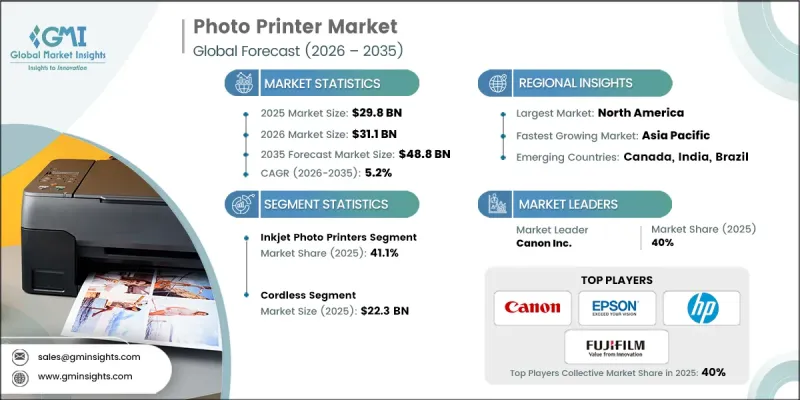
The growth of the photo printer market is driven by continuous advancements across imaging technologies, mobile integration, and instant printing capabilities, which are reshaping how consumers and professionals interact with printed media. Increasing industry consolidation is also contributing to market expansion by enhancing operational efficiencies and strengthening competitive positioning. The transition from traditional photo printing methods to modern, mobile-enabled, and on-demand solutions has significantly transformed user expectations, enabling greater convenience and faster output. Advanced printing technologies now support enhanced personalization, creativity, and immediate results, making them highly appealing across various user groups. Innovations such as seamless multi-device connectivity, intelligent image processing, and integrated cloud-based workflows are improving both print quality and overall user experience. In addition, the adoption of advanced image optimization tools and automated enhancement technologies is enabling real-time improvements in photo output, reinforcing the value proposition of modern photo printing solutions.
| Market Scope | |
|---|---|
| Start Year | 2025 |
| Forecast Year | 2026-2035 |
| Start Value | $29.8 Billion |
| Forecast Value | $48.8 Billion |
| CAGR | 5.2% |
The inkjet photo printers segment held 41.1% share in 2025 and generated USD 12.2 billion. This segment continues to lead due to its adaptability, wide color reproduction capabilities, and cost efficiency across both personal and professional use cases.
The cordless photo printer segment is expected to grow at a CAGR of 5.3% through 2035. The rising demand for mobile-centric printing solutions is driving this growth, as consumers increasingly prefer flexible and portable devices that integrate seamlessly with smartphones. Features such as wireless functionality, compact form factors, and ease of use are enhancing adoption. The growing preference for instant printing and convenient access to physical photo outputs is further supporting segment expansion, particularly among digitally engaged users seeking quick and accessible printing solutions.
North America Photo Printer Market reached USD 9.24 billion in 2025 and is projected to grow at a CAGR of 5.1% through 2035. The region benefits from strong demand for portable and advanced photo printing devices, supported by widespread adoption across entertainment, retail, and personal documentation applications. A well-established consumer electronics ecosystem and the presence of leading manufacturers are enabling faster adoption of advanced technologies, including intelligent image processing and cloud-enabled printing solutions.
Key companies operating in the Global Photo Printer Market include Brother Industries, Canon Inc., Citizen Systems, DNP (Dai Nippon Printing), Epson Corporation, Fujifilm Holdings, HiTi Digital, Inc., HP Inc., Kodak Alaris, Lifeprint, Mitsubishi Electric, Polaroid, Prinics (Kodak Brand), Ricoh Company, and Sinfonia Technology. Companies in the Global Photo Printer Market are reinforcing their competitive position through continuous innovation and strategic expansion initiatives. They are investing in advanced printing technologies to improve image quality, speed, and device efficiency. Businesses are also focusing on developing compact, wireless-enabled products that align with evolving consumer preferences for mobility and convenience. Strategic collaborations and partnerships are being leveraged to enhance product portfolios and expand market reach. In addition, firms are integrating smart features such as cloud connectivity and intelligent image processing to deliver enhanced user experiences. Companies are also strengthening distribution networks and optimizing supply chains to improve accessibility, while aligning their offerings with changing consumer behavior to maintain a strong foothold in the market.
Table of Contents
Chapter 1 Methodology and Scope
- 1.1 Market scope and definition
- 1.2 Research design
- 1.2.1 Research approach
- 1.2.2 Data collection methods
- 1.3 Data mining sources
- 1.3.1 Global
- 1.3.2 Regional/Country
- 1.4 Base estimates and calculations
- 1.4.1 Base year calculation
- 1.4.2 Key trends for market estimation
- 1.5 Primary research and validation
- 1.5.1 Primary sources
- 1.6 Forecast model
- 1.7 Research assumptions and limitations
Chapter 2 Executive Summary
- 2.1 Industry 360° synopsis
- 2.2 Key market trends
- 2.2.1 Regional
- 2.2.2 Type
- 2.2.3 Connectivity
- 2.2.4 Price
- 2.2.5 End User
- 2.2.6 Distribution Channel
- 2.3 CXO perspectives: Strategic imperatives
- 2.3.1 Key decision points for industry executives
- 2.3.2 Critical success factors for market players
- 2.4 Future outlook and strategic recommendations
Chapter 3 Industry Insights
- 3.1 Industry ecosystem analysis
- 3.1.1 Supplier landscape
- 3.1.2 Profit margin
- 3.1.3 Value addition at each stage
- 3.1.4 Factor affecting the value chain
- 3.2 Industry impact forces
- 3.2.1 Growth drivers
- 3.2.1.1 Social Media & "Instant Gratification"
- 3.2.1.2 AI-Assisted Personalization
- 3.2.1.3 AR (Augmented Reality) Integration
- 3.2.2 Industry pitfalls & challenges
- 3.2.2.1 High Consumable Cost Burn
- 3.2.2.2 Increasing Digital Dominance
- 3.2.3 Opportunities
- 3.2.3.1 Increasing growth of Printing-as-a-Service (PaaS)
- 3.2.3.2 Growth in Electronics & Smart Packaging
- 3.2.1 Growth drivers
- 3.3 Growth potential analysis
- 3.4 Future market trends
- 3.5 Technology and innovation landscape
- 3.5.1 Current technological trends
- 3.5.2 Emerging technologies
- 3.6 Pricing Analysis (Driven by Primary Research)
- 3.6.1 Historical Price Trend Analysis (Driven by Primary Research)
- 3.6.2 Pricing Strategy by Player Type (Premium / Value / Cost-Plus) (Driven by Primary Research)
- 3.7 Regulatory landscape
- 3.7.1 Standards and compliance requirements
- 3.7.2 Regional regulatory frameworks
- 3.7.3 Certification standards
- 3.8 Porter's analysis
- 3.9 PESTEL analysis
- 3.10 Trade Data Analysis (Driven by Primary Research)
- 3.10.1 Import/Export Volume & Value Trends (Driven by Primary Research)
- 3.10.2 Key Trade Corridors & Tariff Impact (Driven by Primary Research)
- 3.11 Impact of AI & Generative AI on the Market
- 3.11.1 AI-Driven Print Management & Predictive Maintenance
- 3.11.2 GenAI Use Cases & Adoption Roadmap by Segment
- 3.11.3 Risks, Limitations & Regulatory Considerations
- 3.12 Infrastructure & Deployment Landscape (Driven by Primary Research)
- 3.12.1 Deployment Penetration by Region & Buyer Segment (Driven by Primary Research)
- 3.12.2 Scalability Constraints & Infrastructure Investment Trends (Driven by Primary Research)
Chapter 4 Competitive Landscape, 2025
- 4.1 Introduction
- 4.2 Company market share analysis
- 4.2.1 By region
- 4.2.1.1 North America
- 4.2.1.2 Europe
- 4.2.1.3 Asia Pacific
- 4.2.1.4 Latin America
- 4.2.1.5 Middle East and Africa
- 4.2.1 By region
- 4.3 Company matrix analysis
- 4.4 Competitive analysis of major market players
- 4.5 Competitive positioning matrix
- 4.6 Key developments
- 4.6.1 Mergers & acquisitions
- 4.6.2 Partnerships & collaborations
- 4.6.3 New product launches
- 4.6.4 Expansion plans
Chapter 5 Market Estimates and Forecast, By Type, 2022 - 2035 (USD Billion) (Thousand units)
- 5.1 Key trends
- 5.2 Inkjet Photo Printers
- 5.3 Dye-Sublimation Printers
- 5.4 Thermal Dye
- 5.5 Transfer Printers
- 5.6 Others (Piezoelectric Inkjet Printers, Laser Photo Printers, etc.)
Chapter 6 Market Estimates and Forecast, By Connectivity, 2022 - 2035 (USD Billion) (Thousand units)
- 6.1 Key trends
- 6.2 Corded
- 6.3 Cordless
Chapter 7 Market Estimates and Forecast, By Price, 2022 - 2035 (USD Billion) (Thousand units)
- 7.1 Key trends
- 7.2 Low
- 7.3 Medium
- 7.4 High
Chapter 8 Market Estimates and Forecast, By End User, 2022 - 2035 (USD Billion) (Thousand units)
- 8.1 Key trends
- 8.2 Professional Photographers
- 8.3 Home Users
- 8.4 Photography Studios
- 8.5 Event Planners
- 8.6 Others (Educational Institutions, small business owners, etc.)
Chapter 9 Market Estimates & Forecast, By Distribution Channel, 2022 - 2035, (USD Billion) (Thousand units)
- 9.1 Key trends
- 9.2 Online
- 9.2.1 E-commerce
- 9.2.2 Company website
- 9.3 Offline
- 9.3.1 Consumer Electronics Stores
- 9.3.2 Specialty Photography Stores
- 9.3.3 Others
Chapter 10 Market Estimates and Forecast, By Region, 2022 - 2035 (USD Billion) (Thousand Units)
- 10.1 Key trends
- 10.2 North America
- 10.2.1 U.S.
- 10.2.2 Canada
- 10.3 Europe
- 10.3.1 Germany
- 10.3.2 UK
- 10.3.3 France
- 10.3.4 Italy
- 10.3.5 Spain
- 10.4 Asia Pacific
- 10.4.1 China
- 10.4.2 Japan
- 10.4.3 India
- 10.4.4 Australia
- 10.4.5 South Korea
- 10.5 Latin America
- 10.5.1 Brazil
- 10.5.2 Mexico
- 10.5.3 Argentina
- 10.6 Middle East and Africa
- 10.6.1 South Africa
- 10.6.2 Saudi Arabia
- 10.6.3 UAE
Chapter 11 Company Profiles
- 11.1 Brother Industries
- 11.2 Canon Inc.
- 11.3 Citizen Systems
- 11.4 DNP (Dai Nippon Printing)
- 11.5 Epson Corporation
- 11.6 Fujifilm Holdings
- 11.7 HiTi Digital, Inc.
- 11.8 HP Inc.
- 11.9 Kodak Alaris
- 11.10 Lifeprint
- 11.11 Mitsubishi Electric
- 11.12 Polaroid
- 11.13 Prinics (Kodak Brand)
- 11.14 Ricoh Company
- 11.15 Sinfonia Technology

