PUBLISHER: Global Market Insights Inc. | PRODUCT CODE: 2019139

PUBLISHER: Global Market Insights Inc. | PRODUCT CODE: 2019139
Mobile Photo Printer Market Opportunity, Growth Drivers, Industry Trend Analysis, and Forecast 2026 - 2035
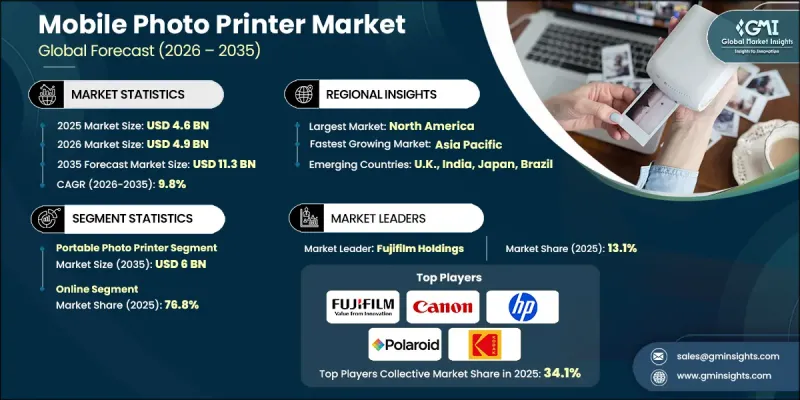
The Global Mobile Photo Printer Market was valued at USD 4.6 billion in 2025 and is estimated to grow at a CAGR of 9.8% to reach USD 11.3 billion by 2035.
Rising consumer engagement with smartphone photography is a key factor supporting this growth, as individuals increasingly capture and store moments digitally while seeking convenient ways to convert them into physical formats. The growing influence of social media platforms has significantly shaped user behavior, encouraging real-time image sharing and increasing the appeal of instant printing solutions. Mobile photo printers address this demand by offering a seamless way to transform digital images into tangible keepsakes. In addition, widespread smartphone adoption and improving digital awareness continue to strengthen the market foundation. Manufacturers are focusing on compact, user-friendly devices that integrate with mobile applications, enabling enhanced customization and convenience. Continuous product innovation and evolving consumer preferences for personalized content are further accelerating the adoption of mobile photo printing solutions across global markets.
| Market Scope | |
|---|---|
| Start Year | 2025 |
| Forecast Year | 2026-2035 |
| Start Value | $4.6 Billion |
| Forecast Value | $11.3 Billion |
| CAGR | 9.8% |
Increasing smartphone usage and advancements in digital ecosystems are reinforcing market growth, encouraging companies to introduce technologically enhanced devices that align with modern consumer expectations. Many brands are developing compact and efficient printing solutions designed to deliver convenience, portability, and improved user experience. These devices are designed to be lightweight, easy to operate, and compatible with mobile platforms, making them highly appealing to tech-savvy users.
The portable photo printer segment generated USD 2.6 billion in 2025 and is projected to reach USD 6 billion by 2035. This segment leads the market due to its ability to offer flexible, on-the-go printing capabilities that align with modern lifestyles. Consumers increasingly prefer portable solutions that allow them to print images instantly in various settings. Technological improvements have enhanced print quality, enabling compact devices to deliver results comparable to larger systems while maintaining convenience and efficiency. The balance between portability and performance continues to drive strong demand within this segment.
The online distribution channels accounted for 76.8% share in 2025, maintaining a dominant position due to the rapid expansion of digital retail platforms. Consumers benefit from the convenience of browsing a wide variety of products, comparing features and prices, and completing purchases from any location. The ease of access and availability of detailed product information contribute to the growing preference for online purchasing. Expanding digital infrastructure and increasing consumer trust in e-commerce platforms further strengthen this segment's growth.
United States Mobile Photo Printer Market held a 75.3% share in 2025. Market growth in this region is supported by strong adoption of smartphones and increasing interest in instant image printing. Consumer preference for personalized and tangible photo products continues to drive demand, while the popularity of lifestyle-focused electronic devices enhances market penetration. The presence of advanced printing technologies and strong retail support further contributes to sustained growth across the region.
Key companies operating in the Global Mobile Photo Printer Market include Fujifilm Holdings, Canon Inc., HP Inc., Seiko Epson, Sony Corporation, LG Corporation, Kodak, Polaroid, Hiti Digital, Prinics, Phomemo, Lifeprint, Liene, HPRT, and TOMY (KiiPix). Companies in the mobile photo printer market are strengthening their market position by focusing on innovation, product differentiation, and strategic expansion. They are investing in advanced printing technologies to enhance image quality and device performance. Many players are expanding their product portfolios to cater to diverse consumer preferences and usage scenarios. Strategic partnerships and collaborations are being utilized to increase brand visibility and market reach. Companies are also prioritizing seamless mobile integration and user-friendly applications to improve customer experience. Additionally, investments in e-commerce platforms and digital marketing strategies are helping brands connect with a wider audience, while continuous improvements in portability and design are driving product adoption.
Table of Contents
Chapter 1 Methodology & Scope
- 1.1 Research approach
- 1.2 Quality Commitments
- 1.3 GMI AI policy & data integrity commitment
- 1.3.1 Source consistency protocol
- 1.4 Research Trail & Confidence Scoring
- 1.4.1 Research Trail Components
- 1.4.2 Scoring Components
- 1.5 Data Collection
- 1.5.1 Partial list of primary sources
- 1.6 Data mining sources
- 1.7 Paid sources
- 1.7.1 Sources, by region
- 1.8 Base estimates and calculations
- 1.8.1 Base year calculation for any one approach
- 1.9 Forecast model
- 1.9.1 Quantified market impact analysis
- 1.9.1.1 Mathematical impact of growth parameters on forecast
- 1.9.1 Quantified market impact analysis
- 1.10 Research transparency addendum
- 1.10.1 Source attribution framework
- 1.10.2 Quality assurance metrics
- 1.10.3 Our commitment to trust
Chapter 2 Executive Summary
- 2.1 Industry 360° synopsis
- 2.2 Key market trends
- 2.2.1 Regional
- 2.2.2 Product
- 2.2.3 Technology
- 2.2.4 Connectivity
- 2.2.5 Printer Output
- 2.2.6 Price
- 2.2.7 End Use
- 2.2.8 Distribution Channel
Chapter 3 Industry Insights
- 3.1 Industry ecosystem analysis
- 3.1.1 Supplier landscape
- 3.1.2 Profit margin
- 3.1.3 Value addition at each stage
- 3.1.4 Factor affecting the value chain
- 3.2 Industry impact forces
- 3.2.1 Growth drivers
- 3.2.1.1 Increase in adoption of smartphones
- 3.2.1.2 Increasing need for instant gratification
- 3.2.1.3 Portability and convenience
- 3.2.2 Industry pitfalls & challenges
- 3.2.2.1 Limited print size and quality
- 3.2.2.2 Competition from digital alternatives
- 3.2.3 Opportunities
- 3.2.3.1 Growth in on-the-go content creation & social commerce
- 3.2.3.2 Expansion into travel, events & experience-based retail
- 3.2.1 Growth drivers
- 3.3 Growth potential analysis
- 3.4 Future market trends
- 3.5 Technology and innovation landscape
- 3.5.1 Current technological trends
- 3.5.2 Emerging technologies
- 3.6 Regulatory landscape
- 3.6.1 Standards and compliance requirements
- 3.6.2 Regional regulatory frameworks
- 3.6.3 Certification standards
- 3.7 Trade data analysis
- 3.7.1 Import/export volume & value trends
- 3.7.2 Key trade corridors & tariff impact
- 3.8 Impact of AI & generative AI on the market
- 3.8.1 AI-driven disruption of existing business models
- 3.8.2 Gen AI use cases & adoption roadmap by segment
- 3.8.3 Risks, limitations & regulatory considerations
- 3.9 Porter's analysis
- 3.10 PESTEL analysis
- 3.11 Consumer behaviour analysis
- 3.11.1 Purchasing patterns
- 3.11.2 Preference analysis
- 3.11.3 Regional variations in consumer behaviour
- 3.11.4 Impact of e-commerce on buying decisions
Chapter 4 Competitive Landscape, 2025
- 4.1 Introduction
- 4.2 Company market share analysis
- 4.2.1 By region
- 4.2.1.1 North America
- 4.2.1.2 Europe
- 4.2.1.3 Asia Pacific
- 4.2.1.4 Latin America
- 4.2.1.5 Middle East and Africa
- 4.2.1 By region
- 4.3 Company matrix analysis
- 4.4 Competitive analysis of major market players
- 4.5 Competitive positioning matrix
- 4.6 Key developments
- 4.6.1 Mergers & acquisitions
- 4.6.2 Partnerships & collaborations
- 4.6.3 New product launches
- 4.6.4 Expansion plans
Chapter 5 Market Estimates & Forecast, By Product, 2022 - 2035, (USD Billion) (Thousand Units)
- 5.1 Key trends
- 5.2 Portable photo printer
- 5.3 Compact photo printer
- 5.4 Desktop photo printer
Chapter 6 Market Estimates & Forecast, By Technology, 2022 - 2035, (USD Billion) (Thousand Units)
- 6.1 Key trends
- 6.2 Inkjet
- 6.3 Dye sublimation
- 6.4 Zink
- 6.5 Laser
- 6.6 Thermal
Chapter 7 Market Estimates & Forecast, By Connectivity, 2022 - 2035, (USD Billion) (Thousand Units)
- 7.1 Key trends
- 7.2 Wireless
- 7.3 Bluetooth
- 7.4 Wi-Fi
- 7.5 NFC
- 7.6 Wired
Chapter 8 Market Estimates & Forecast, By Printer Output, 2022 - 2035, (USD Billion) (Thousand Units)
- 8.1 Key trends
- 8.2 Monochrome
- 8.3 Colour
Chapter 9 Market Estimates & Forecast, By Price, 2022 - 2035, (USD Billion) (Thousand Units)
- 9.1 Key trends
- 9.2 Low
- 9.3 Medium
- 9.4 High
Chapter 10 Market Estimates & Forecast, By End Use, 2022 - 2035, (USD Billion) (Thousand Units)
- 10.1 Key trends
- 10.2 Individual
- 10.3 Businesses
Chapter 11 Market Estimates & Forecast, By Distribution Channel, 2022-2035 (USD Billion) (Million Units)
- 11.1 Key trends
- 11.2 Online
- 11.2.1 E-Commerce
- 11.2.2 Company website
- 11.3 Offline
- 11.3.1 Supermarkets/Hypermarkets
- 11.3.2 Specialty Stores
- 11.3.3 Others (Individual stores, Departmental stores, etc.)
Chapter 12 Market Estimates & Forecast, By Region, 2022-2035 (USD Billion) (Million Units)
- 12.1 Key trends
- 12.2 North America
- 12.2.1 U.S.
- 12.2.2 Canada
- 12.3 Europe
- 12.3.1 Germany
- 12.3.2 France
- 12.3.3 UK
- 12.3.4 Italy
- 12.3.5 Spain
- 12.4 Asia Pacific
- 12.4.1 China
- 12.4.2 India
- 12.4.3 Japan
- 12.4.4 South Korea
- 12.4.5 Australia
- 12.5 Latin America
- 12.5.1 Brazil
- 12.5.2 Mexico
- 12.5.3 Argentina
- 12.6 MEA
- 12.6.1 South Africa
- 12.6.2 Saudi Arabia
- 12.6.3 UAE
Chapter 13 Company Profiles
- 13.1 Canon Inc.
- 13.2 Fujifilm Holdings
- 13.3 Hiti Digital
- 13.4 HP Inc.
- 13.5 HPRT
- 13.6 Kodak
- 13.7 LG Corporation
- 13.8 Liene
- 13.9 Lifeprint
- 13.10 Phomemo
- 13.11 Polaroid
- 13.12 Prinics
- 13.13 Seiko Epson
- 13.14 Sony Corporation
- 13.15 TOMY (KiiPix)

