PUBLISHER: Global Market Insights Inc. | PRODUCT CODE: 2019019

PUBLISHER: Global Market Insights Inc. | PRODUCT CODE: 2019019
Smart Bandage with Sensor Technology Market Opportunity, Growth Drivers, Industry Trend Analysis, and Forecast 2026 - 2035
The Global Smart Bandage with Sensor Technology Market was valued at USD 965 million in 2025 and is estimated to grow at a CAGR of 10.8% to reach USD 2.6 billion by 2035.
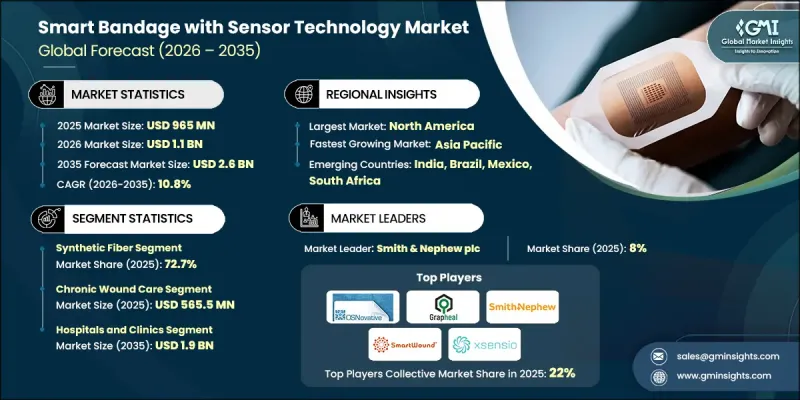
Growth is supported by the increasing burden of chronic conditions, continuous innovation in sensor integration and advanced materials, and a strong shift toward remote monitoring and home-based care solutions. In addition, the rising elderly population is contributing to higher demand for efficient wound management technologies. Smart bandage with sensor technology systems are transforming wound care by enabling real-time tracking of healing progress across clinical and non-clinical environments. These solutions combine embedded sensors, flexible electronics, and wireless connectivity to capture and transmit critical physiological data directly from the wound site. This data-driven approach enhances treatment accuracy, supports personalized care plans, and improves patient outcomes. Ongoing advancements in miniaturization, AI-powered analytics, IoMT integration, and cloud platforms continue to strengthen the capabilities of these solutions while enabling seamless integration with digital health systems.
| Market Scope | |
|---|---|
| Start Year | 2025 |
| Forecast Year | 2026-2035 |
| Start Value | $965 Million |
| Forecast Value | $2.6 Billion |
| CAGR | 10.8% |
Smart bandage with sensor technology products are increasingly utilized in modern wound management due to their ability to monitor healing conditions. These advanced dressings incorporate embedded sensing components and connected systems that provide real-time insights into wound status. They are designed to capture essential physiological indicators such as moisture levels, temperature variations, pH balance, oxygen saturation, and early signs of infection. Their application spans a wide range of wound care needs, including acute injuries, long-term conditions, recovery support, and specialized treatments. Continuous innovation in flexible materials and sensor technologies is enhancing device performance, while digital integration allows collected data to be incorporated into electronic health systems. This enables healthcare providers to deliver more precise and responsive treatment strategies based on real-time information.
The synthetic fiber segment accounted for 72.7% share in 2025, highlighting its critical role in product development. Synthetic materials provide the necessary strength, adaptability, and compatibility required for integrating advanced sensing technologies into wound dressings. These fibers support the development of lightweight, breathable, and stretchable solutions that maintain consistent functionality across various care settings. Their structural stability ensures accurate sensor positioning and reliable data collection. Additionally, synthetic fiber-based designs enable the integration of multiple sensing capabilities within a single bandage, supporting continuous monitoring and improving overall performance in clinical applications.
The hospitals and clinics segment held a 71.5% share in 2025 and is projected to reach USD 1.9 billion by 2035. This segment continues to drive demand for smart bandage with sensor technology solutions as healthcare providers increasingly adopt advanced wound care approaches supported by data insights. The growing need to improve healing outcomes, minimize complications, and enhance operational efficiency is encouraging the adoption of sensor-enabled dressings. Healthcare facilities are leveraging these technologies to optimize care delivery, reduce readmission rates, and improve patient satisfaction, making them a key end-user group in this evolving market landscape.
North America Smart Bandage with Sensor Technology Market captured 38.4% share in 2025. The region's growth is supported by a high prevalence of chronic health conditions and a strong focus on advanced healthcare solutions. According to international health data, the region includes 56 million adults aged 20-79 living with diabetes, creating a substantial demand for improved wound monitoring solutions. The increasing emphasis on early detection and proactive care is driving the adoption of sensor-integrated bandages across healthcare facilities. This trend is further supported by the region's advanced healthcare infrastructure and strong investment in digital health technologies.
Key companies operating in the Global Smart Bandage with Sensor Technology Market include Grapheal, Healables Digital Health, NexLife, OSNovative Systems, Inc., SmartWound Ltd, Smith & Nephew plc, WINDGO Inc., and Xsensio SA. Companies in the smart bandage with sensor technology market are strengthening their market position through continuous innovation, strategic collaborations, and expansion of product portfolios. They are investing heavily in research and development to enhance sensor accuracy, improve material flexibility, and enable seamless connectivity with digital health platforms. Partnerships with healthcare providers and technology firms help accelerate product adoption and integration into clinical workflows. Many players are also focusing on regulatory approvals and commercialization strategies to expand their geographic presence. Additionally, the use of AI-driven analytics and cloud-based platforms is enabling companies to deliver value-added solutions, improve patient outcomes, and differentiate their offerings in a competitive market.
Table of Contents
Chapter 1 Methodology and Scope
- 1.1 Research approach
- 1.2 Quality commitments
- 1.2.1 GMI AI policy & data integrity commitment
- 1.2.1.1 Source consistency protocol
- 1.2.1 GMI AI policy & data integrity commitment
- 1.3 Research trail & confidence scoring
- 1.3.1 Research trail components
- 1.3.2 Scoring components
- 1.4 Data collection
- 1.4.1 Partial list of primary sources
- 1.5 Data mining sources
- 1.5.1 Paid sources
- 1.5.1.1 Sources, by region
- 1.5.1 Paid sources
- 1.6 Base estimates and calculations
- 1.6.1 Base year calculation for any one approach
- 1.7 Forecast model
- 1.7.1 Quantified market impact analysis
- 1.7.1.1 Mathematical impact of growth parameters on forecast
- 1.7.2 Research transparency addendum
- 1.7.3 Source attribution framework
- 1.7.4 Quality assurance metrics
- 1.7.1 Quantified market impact analysis
- 1.8 Our commitment to trust
Chapter 2 Executive Summary
- 2.1 Industry 360° synopsis
- 2.2 Key market trends
- 2.2.1 Regional trends
- 2.2.2 Product trends
- 2.2.3 Application trends
- 2.2.4 End use trends
- 2.3 CXO perspectives: Strategic imperatives
Chapter 3 Industry Insights
- 3.1 Industry ecosystem analysis
- 3.2 Industry impact forces
- 3.2.1 Growth drivers
- 3.2.1.1 Rising prevalence of diabetes
- 3.2.1.2 Advancements in sensor and material technologies
- 3.2.1.3 Shift toward remote patient monitoring and homecare
- 3.2.1.4 Growing aging population
- 3.2.2 Industry Pitfalls and Challenges
- 3.2.2.1 High cost of smart bandages
- 3.2.2.2 Stringent regulatory scenario
- 3.2.3 Market Opportunities
- 3.2.3.1 Integration with advanced digital health and AI platforms
- 3.2.3.2 Growth potential in emerging markets
- 3.2.1 Growth drivers
- 3.3 Growth potential analysis
- 3.4 Regulatory landscape (Driven by Primary Research)
- 3.4.1 North America
- 3.4.2 Europe
- 3.4.3 Asia Pacific
- 3.5 Technological advancements
- 3.5.1 Current technological trends
- 3.5.2 Emerging technologies
- 3.6 Future market trends
- 3.7 Porter's analysis
- 3.8 PESTEL analysis
Chapter 4 Competitive Landscape, 2025
- 4.1 Introduction
- 4.2 Company market share analysis
- 4.3 Company matrix analysis
- 4.4 Competitive analysis of major market players
- 4.5 Competitive positioning matrix
- 4.6 Key developments
- 4.6.1 Mergers and acquisitions
- 4.6.2 Partnerships and collaborations
- 4.6.3 New product launches
- 4.6.4 Expansion plans
Chapter 5 Market Estimates and Forecast, By Product, 2022 - 2035 ($ Mn)
- 5.1 Key trends
- 5.2 Graphene
- 5.3 Synthetic fiber
Chapter 6 Market Estimates and Forecast, By Application, 2022 - 2035 ($ Mn)
- 6.1 Key trends
- 6.2 Chronic wound care
- 6.3 Sports injuries and rehabilitation
- 6.4 Surgical and post-operative wounds
- 6.5 Other applications
Chapter 7 Market Estimates and Forecast, By End Use, 2022 - 2035 ($ Mn)
- 7.1 Key trends
- 7.2 Hospitals and clinics
- 7.3 Ambulatory surgical centers
- 7.4 Homecare settings
Chapter 8 Market Estimates and Forecast, By Region, 2022 - 2035 ($ Mn)
- 8.1 Key trends
- 8.2 North America
- 8.2.1 U.S.
- 8.2.2 Canada
- 8.3 Europe
- 8.3.1 Germany
- 8.3.2 UK
- 8.3.3 France
- 8.3.4 Spain
- 8.3.5 Italy
- 8.3.6 Netherlands
- 8.4 Asia Pacific
- 8.4.1 China
- 8.4.2 India
- 8.4.3 Japan
- 8.4.4 Australia
- 8.4.5 South Korea
- 8.5 Latin America
- 8.5.1 Brazil
- 8.5.2 Mexico
- 8.5.3 Argentina
- 8.6 Middle East and Africa
- 8.6.1 Saudi Arabia
- 8.6.2 South Africa
- 8.6.3 UAE
Chapter 9 Company Profiles
- 9.1 Grapheal
- 9.2 Healables Digital Health
- 9.3 NexLife
- 9.4 OSNovative Systems, Inc.
- 9.5 SmartWound Ltd
- 9.6 Smith & Nephew plc
- 9.7 WINDGO Inc.
- 9.8 Xsensio SA

