PUBLISHER: Global Market Insights Inc. | PRODUCT CODE: 2019021

PUBLISHER: Global Market Insights Inc. | PRODUCT CODE: 2019021
North America Maternity Apparel Market Opportunity, Growth Drivers, Industry Trend Analysis, and Forecast 2026 - 2035
North America Maternity Apparel Market was valued at USD 3.4 billion in 2025 and is estimated to grow at a CAGR of 4.5% to reach USD 5.2 billion by 2035.
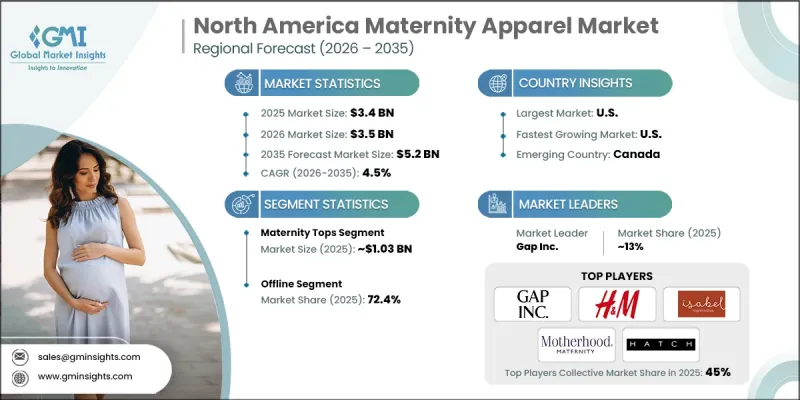
Demand is rising as pregnant women increasingly seek apparel that adapts to changing body shapes while maintaining a modern and fashionable appearance. Contemporary maternity wear is being preferred over conventional options due to its affordability, versatility, and improved design features. Greater awareness around maternal well-being and self-care is further supporting product adoption. Flexible and stretchable garments are becoming essential as they provide ease across different stages of pregnancy. Additionally, the growing number of working women is encouraging demand for clothing suitable for both professional and social settings. Shifting lifestyles across North America are also influencing purchasing behavior, as consumers expect diverse product offerings that cater to daily wear, fitness routines, and active lifestyles. Retailers are responding by expanding product assortments to meet these dynamic needs.
| Market Scope | |
|---|---|
| Start Year | 2025 |
| Forecast Year | 2026-2035 |
| Start Value | $3.4 Billion |
| Forecast Value | $5.2 Billion |
| CAGR | 4.5% |
The maternity tops segment generated USD 1.03 billion in 2025 and is forecast to grow at a CAGR of 4.9% between 2026 and 2035. This segment continues to lead the market due to its necessity as a daily wardrobe staple and the requirement for multiple purchases throughout pregnancy and after childbirth. These garments cater to a wide range of usage scenarios and offer adaptable styling choices. Their popularity is driven by their practicality, seasonal suitability, and ability to combine comfort with contemporary fashion preferences. Increasing demand for versatile, work-friendly, and functional clothing solutions is further strengthening segment growth.
The offline distribution channel accounted for 72.4% share in 2025 and is expected to grow at a CAGR of 4.6% through 2035. Physical retail remains dominant as consumers prefer to evaluate garment fit, fabric quality, and overall comfort before making a purchase. In-store experiences allow for better size selection and personalized assistance, which is particularly important given the continuous body changes during pregnancy. Established retail networks and consistent consumer reliance on traditional shopping formats continue to support the growth of this segment.
Key companies operating in the North America Maternity Apparel Market include A Pea in the Pod, Blanqi, Bumpsuit, Cake Maternity, Gap Inc, H&M, Hatch Collection LLC, Ingrid & Isabel, LLC, Kindred Bravely, Latched Mama, Motherhood Maternity, Nike, Inc., Old Navy, PinkBlush Maternity, and Target (Isabel Maternity by Ingrid & Isabel). Companies in the North America Maternity Apparel Market are focusing on product innovation, expanding inclusive size ranges, and incorporating sustainable materials to strengthen their competitive position. Many brands are enhancing omnichannel strategies by integrating online platforms with physical retail to improve customer engagement and accessibility. Collaborations and brand extensions are being used to reach wider audiences and build stronger brand recognition. Firms are also investing in marketing campaigns that emphasize comfort, style, and functionality to align with evolving consumer preferences. Additionally, leveraging data analytics to understand buying patterns and optimize inventory is becoming increasingly important. These strategies collectively help companies improve customer loyalty and maintain a strong foothold in a competitive market landscape.
Table of Contents
Chapter 1 Methodology and Scope
- 1.1 Market scope and definition
- 1.2 Research design
- 1.2.1 Research approach
- 1.2.2 Data collection methods
- 1.3 Data mining sources
- 1.3.1 Global
- 1.3.2 Regional/Country
- 1.4 Base estimates and calculations
- 1.4.1 Base year calculation
- 1.4.2 Key trends for market estimation
- 1.5 Primary research and validation
- 1.5.1 Primary sources
- 1.6 Forecast model
- 1.7 Research assumptions and limitations
Chapter 2 Executive Summary
- 2.1 Industry 360° synopsis
- 2.2 Key market trends
- 2.2.1 Product Type
- 2.2.2 Material
- 2.2.3 Price Range
- 2.2.4 Distribution Channel
- 2.3 CXO perspectives: Strategic imperatives
- 2.3.1 Key decision points for industry executives
- 2.3.2 Critical success factors for market players
- 2.4 Future outlook and strategic recommendations
Chapter 3 Industry Insights
- 3.1 Industry ecosystem analysis
- 3.1.1 Supplier landscape
- 3.1.2 Profit margin
- 3.1.3 Value addition at each stage
- 3.1.4 Factor affecting the value chain
- 3.2 Industry impact forces
- 3.2.1 Growth drivers
- 3.2.1.1 Growing demand for fashionable and comfortable maternity clothing
- 3.2.1.2 Increasing adoption of athleisure and activewear for pregnant women
- 3.2.1.3 Rising focus on sustainable and organic fabric materials
- 3.2.2 Industry pitfalls & challenges
- 3.2.2.1 Limited wearing period reduces purchase willingness
- 3.2.2.2 Competition from regular clothing with stretch features
- 3.2.3 Opportunities
- 3.2.3.1 Expansion of nursing-friendly designs for postpartum use
- 3.2.3.2 Increasing adoption of rental and resale maternity clothing models
- 3.2.1 Growth drivers
- 3.3 Growth potential analysis
- 3.4 Future market trends
- 3.5 Technology and innovation landscape
- 3.5.1 Current technological trends
- 3.5.2 Emerging technologies
- 3.6 Pricing analysis - North America (Driven by Primary Research)
- 3.6.1 Historical Price Trend Analysis- North America (Driven by Primary Research)
- 3.6.2 Pricing Strategy by Player Type (Premium/Value/Cost-plus) (Driven by Primary Research)
- 3.7 Regulatory landscape
- 3.7.1 Standards and compliance requirements
- 3.7.2 Regional regulatory frameworks
- 3.7.3 Certification standards
- 3.8 Porter's analysis
- 3.9 PESTEL analysis
- 3.10 Trade Data Analysis- North America (Driven by Paid Database)
- 3.10.1 U.S. Import/Export Volume & Value Trends (Driven by Primary Research)
- 3.10.2 Canada Import/Export Volume & Value Trends (Driven by Primary Research)
- 3.10.3 Key Trade Corridors & Tariff Impact (Driven by Primary Research)
- 3.11 Impact of AI & Generative AI on the Market
- 3.11.1 AI-Driven Disruption of Existing Business Models
- 3.11.2 GenAI Use Cases & Adoption Roadmap by Segment
- 3.11.3 Risks, Limitations & Regulatory Considerations
- 3.12 Distribution Infrastructure & Channel Penetration Landscape (Driven by Primary Research)
- 3.12.1 Channel Coverage by Region & Format (Modern vs. Traditional Retail) (Driven by Primary Research)
- 3.12.2 Last-Mile Infrastructure Gaps & Emerging Channel Shifts (Driven by Primary Research)
Chapter 4 Competitive Landscape, 2025
- 4.1 Introduction
- 4.2 Company market share analysis
- 4.2.1 U.S.
- 4.2.2 Canada
- 4.3 Company matrix analysis
- 4.4 Competitive analysis of major market players
- 4.5 Competitive positioning matrix
- 4.6 Key developments
- 4.6.1 Mergers & acquisitions
- 4.6.2 Partnerships & collaborations
- 4.6.3 New product launches
- 4.6.4 Expansion plans
Chapter 5 Estimates & Forecast, By Product Type, 2022 - 2035 (USD Billion) (Thousand Units)
- 5.1 Maternity Tops
- 5.1.1 T-shirts
- 5.1.2 Blouses
- 5.1.3 Others (Tunics, etc)
- 5.2 Maternity Bottoms
- 5.2.1 Pants
- 5.2.2 leggings
- 5.2.3 Skirts
- 5.2.4 Shorts
- 5.3 Maternity Outerwear
- 5.3.1 Jackets
- 5.3.2 Coats
- 5.3.3 Others (Sweaters, etc)
- 5.4 Maternity Intimates
- 5.4.1 Nursing bras
- 5.4.2 Lingerie
- 5.4.3 Others (Camisoles, etc)
- 5.5 Maternity sleepwear
- 5.5.1 Nightgowns
- 5.5.2 Sleep Shirts
- 5.5.3 Lounge Pants
- 5.5.4 Others (Pajama Sets, robes, etc)
Chapter 6 Estimates & Forecast, By Material, 2022 - 2035 (USD Billion) (Thousand Units)
- 6.1 Cotton
- 6.2 Polyester
- 6.3 Spandex
- 6.4 Modal
- 6.5 Others
Chapter 7 Estimates & Forecast, By Price range, 2022 - 2035 (USD Billion) (Thousand Units)
- 7.1 Low (Upto $50)
- 7.2 Medium ($50 - $100)
- 7.3 High (Above $100)
Chapter 8 Estimates & Forecast, By Distribution Channel, 2022 - 2035 (USD Billion) (Thousand Units)
- 8.1 Online
- 8.1.1 E-Commerce
- 8.1.2 Company Website
- 8.2 Offline
- 8.2.1 Wholesales/Distributors
- 8.2.2 Hypermarkets/Supermarkets
- 8.2.3 Specialty Stores
- 8.2.4 Multi-Brand Stores
Chapter 9 Market Estimates and Forecast, By Country, 2022 - 2035 (USD Billion) (Thousand Unit)
- 9.1 Key trends
- 9.2 U.S.
- 9.3 Canada
Chapter 10 Company Profiles
- 10.1 A Pea in the Pod
- 10.2 Blanqi
- 10.3 Bumpsuit
- 10.4 Cake Maternity
- 10.5 Gap Inc
- 10.6 H&M
- 10.7 Hatch Collection LLC
- 10.8 Ingrid & Isabel, LLC
- 10.9 Kindred Bravely
- 10.10 Latched Mama
- 10.11 Motherhood Maternity
- 10.12 Nike, Inc.
- 10.13 Old Navy
- 10.14 PinkBlush Maternity
- 10.15 Target (Isabel Maternity by Ingrid & Isabel)

