PUBLISHER: Global Market Insights Inc. | PRODUCT CODE: 2019163

PUBLISHER: Global Market Insights Inc. | PRODUCT CODE: 2019163
Maternity Apparel Market Opportunity, Growth Drivers, Industry Trend Analysis, and Forecast 2026 - 2035
The Global Maternity Apparel Market was valued at USD 10.4 billion in 2025 and is estimated to grow at a CAGR of 4.2% to reach USD 15.6 billion by 2035.
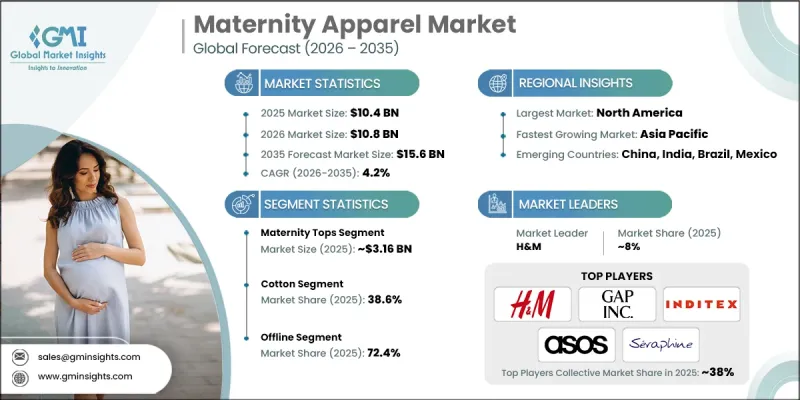
Growth in the maternity clothing industry is driven by a rising preference for apparel that blends comfort with modern styling during pregnancy. Increasing workforce participation among pregnant women, along with a strong desire to maintain personal fashion identity, is supporting steady demand across regions. Expectant mothers are actively seeking garments that adapt to changing body shapes while remaining suitable for everyday wear and professional settings. Product categories are evolving to meet diverse lifestyle needs, including options for daily use, workwear, and wellness-related activities. Advancements in textile innovation are enabling brands to deliver flexible, breathable, and supportive fabrics that enhance overall comfort. Additionally, the growing influence of body positivity and evolving perceptions around pregnancy-related fashion are strengthening market momentum. The expansion of digital retail platforms and organized offline channels is further improving product accessibility. A wide assortment of maternity clothing options, including tops, bottoms, sleepwear, and intimates, continues to support consistent consumer engagement and sustained market growth.
| Market Scope | |
|---|---|
| Start Year | 2025 |
| Forecast Year | 2026-2035 |
| Start Value | $10.4 Billion |
| Forecast Value | $15.6 Billion |
| CAGR | 4.2% |
The maternity tops segment generated USD 3.16 billion in 2025 and is anticipated to grow at a CAGR of 4.6% through 2035. This segment maintains a leading position due to its versatility, cost-effectiveness, and frequent replacement cycle. These garments are designed to accommodate physical changes during pregnancy through adaptive features such as stretchable materials and flexible fits. Consumers require multiple wardrobe options for different occasions, which increases repeat purchases. The ability to pair these tops with existing clothing further enhances their practicality. Continuous innovation in design, including varied cuts and styles, supports strong consumer interest and ongoing demand.
The cotton segment accounted for 38.6% share in 2025 and is expected to grow at a CAGR of 4.6% through 2035. Cotton remains the preferred material due to its softness, breathability, and natural composition. It offers comfort for sensitive skin and supports temperature regulation, making it suitable for extended wear. Demand is further supported by growing awareness of fabric safety and increasing interest in natural and organic materials. Blended cotton fabrics also provide elasticity while maintaining comfort, strengthening their adoption across product categories.
United States Maternity Apparel Market reached USD 2.80 billion in 2025 and is projected to grow at a CAGR of 4.8% between 2026 and 2035. Market expansion is supported by strong participation of pregnant women in the workforce, evolving fashion preferences, and a well-established retail ecosystem. Demand for functional yet stylish apparel continues to rise, particularly in workwear and athleisure segments. Consumers are increasingly seeking products that combine comfort with contemporary design. The presence of advanced retail networks, along with expanding e-commerce platforms, is enhancing product availability. Manufacturers are focusing on improved fit, inclusive sizing, and fabric innovation to meet evolving consumer expectations.
Key companies operating in the Global Maternity Apparel Market include Adidas AG, ASOS Maternity, Cake Maternity, Gap Inc, H&M, Hatch Collection LLC, Inditex (Zara), Ingrid & Isabel, LLC, Isabella Oliver Limited, JoJo Maman Bebe, Maternal America, Inc., Nike, Inc., Old Navy (Gap Inc), PinkBlush Maternity, and Seraphine. Companies in the maternity apparel market are strengthening their market position through product innovation, digital expansion, and brand differentiation strategies. Many manufacturers are investing in advanced fabric technologies that enhance stretchability, breathability, and comfort while maintaining style. Businesses are expanding their online presence through direct-to-consumer platforms and partnerships with e-commerce retailers to improve reach and customer engagement. Brands are also focusing on inclusive sizing and versatile designs that cater to diverse body types and lifestyle needs. Collaborations with influencers and targeted marketing campaigns are increasing brand visibility. Additionally, companies are introducing sustainable materials and eco-friendly production methods to align with evolving consumer preferences and regulatory expectations, reinforcing long-term competitiveness.
Table of Contents
Chapter 1 Methodology and Scope
- 1.1 Market scope and definition
- 1.2 Research design
- 1.2.1 Research approach
- 1.2.2 Data collection methods
- 1.3 Data mining sources
- 1.3.1 Global
- 1.3.2 Regional/Country
- 1.4 Base estimates and calculations
- 1.4.1 Base year calculation
- 1.4.2 Key trends for market estimation
- 1.5 Primary research and validation
- 1.5.1 Primary sources
- 1.6 Forecast model
- 1.7 Research assumptions and limitations
Chapter 2 Executive Summary
- 2.1 Industry 360° synopsis
- 2.2 Key market trends
- 2.2.1 Regional
- 2.2.2 Product Type
- 2.2.3 Material
- 2.2.4 Price Range
- 2.2.5 Distribution Channel
- 2.3 CXO perspectives: Strategic imperatives
- 2.3.1 Key decision points for industry executives
- 2.3.2 Critical success factors for market players
- 2.4 Future outlook and strategic recommendations
Chapter 3 Industry Insights
- 3.1 Industry ecosystem analysis
- 3.1.1 Supplier landscape
- 3.1.2 Profit margin
- 3.1.3 Value addition at each stage
- 3.1.4 Factor affecting the value chain
- 3.2 Industry impact forces
- 3.2.1 Growth drivers
- 3.2.1.1 Growing workforce participation of pregnant women
- 3.2.1.2 Rising awareness of comfort and wellness during pregnancy
- 3.2.1.3 Expansion of e-commerce and online maternity retail
- 3.2.2 Industry pitfalls & challenges
- 3.2.2.1 Short product usage period and limited wardrobe investment
- 3.2.2.2 Competition from regular clothing with stretch features
- 3.2.3 Opportunities
- 3.2.3.1 Growing demand for sustainable and organic maternity fabrics
- 3.2.3.2 Expansion of plus-size and inclusive maternity fashion
- 3.2.1 Growth drivers
- 3.3 Growth potential analysis
- 3.4 Future market trends
- 3.5 Technology and innovation landscape
- 3.5.1 Current technological trends
- 3.5.2 Emerging technologies
- 3.6 Pricing Analysis (Driven by Primary Research)
- 3.6.1 Historical Price Trend Analysis (Driven by Primary Research)
- 3.6.2 Pricing Strategy by Player Type (Premium/Value/Cost-plus) (Driven by Primary Research)
- 3.7 Regulatory landscape
- 3.7.1 Standards and compliance requirements
- 3.7.2 Regional regulatory frameworks
- 3.7.3 Certification standards
- 3.8 Porter's analysis
- 3.9 PESTEL analysis
- 3.10 Trade Data Analysis (Driven by Primary Research)
- 3.10.1 Import/Export Volume & Value Trends (Driven by Primary Research)
- 3.10.2 Key Trade Corridors & Tariff Impact (Driven by Primary Research)
- 3.10.3 HS Code Classification & Trade Flow Analysis
- 3.11 Impact of AI & Generative AI on the Market
- 3.11.1 AI-Driven Disruption of Existing Business Models
- 3.11.2 GenAI Use Cases & Adoption Roadmap by Segment
- 3.11.3 Risks, Limitations & Regulatory Considerations
- 3.12 Distribution Infrastructure & Channel Penetration Landscape (Driven by Primary Research)
- 3.12.1 Channel Coverage by Region & Format (Modern vs. Traditional Trade) (Driven by Primary Research)
- 3.12.2 Last-Mile Infrastructure Gaps & Emerging Channel Shifts (Driven by Primary Research)
Chapter 4 Competitive Landscape, 2025
- 4.1 Introduction
- 4.2 Company market share analysis
- 4.2.1 By region
- 4.2.1.1 North America
- 4.2.1.2 Europe
- 4.2.1.3 Asia Pacific
- 4.2.1.4 Latin America
- 4.2.1.5 Middle East and Africa
- 4.2.1 By region
- 4.3 Company matrix analysis
- 4.4 Competitive analysis of major market players
- 4.5 Competitive positioning matrix
- 4.6 Key developments
- 4.6.1 Mergers & acquisitions
- 4.6.2 Partnerships & collaborations
- 4.6.3 New product launches
- 4.6.4 Expansion plans
Chapter 5 Estimates & Forecast, By Product Type, 2022 - 2035 (USD Billion) (Thousand Units)
- 5.1 Maternity Tops
- 5.1.1 T-shirts
- 5.1.2 Blouses
- 5.1.3 Others (Tunics, etc)
- 5.2 Maternity Bottoms
- 5.2.1 Pants
- 5.2.2 Leggings
- 5.2.3 Skirts
- 5.2.4 Shorts
- 5.3 Maternity Outerwear
- 5.3.1 Jackets
- 5.3.2 Coats
- 5.3.3 Others (Sweaters, etc)
- 5.4 Maternity Intimates
- 5.4.1 Nursing bras
- 5.4.2 Lingerie
- 5.4.3 Others (Camisoles, etc)
- 5.5 Maternity sleepwear
- 5.5.1 Nightgowns
- 5.5.2 Sleep Shirts
- 5.5.3 Lounge Pants
- 5.5.4 Others (Pajama Sets, robes, etc)
Chapter 6 Estimates & Forecast, By Material, 2022 - 2035 (USD Billion) (Thousand Units)
- 6.1 Cotton
- 6.2 Polyester
- 6.3 Spandex
- 6.4 Modal
- 6.5 Others
Chapter 7 Estimates & Forecast, By Price range, 2022 - 2035 (USD Billion) (Thousand Units)
- 7.1 Low (Upto $50)
- 7.2 Medium ($50 - $100)
- 7.3 High (Above $100)
Chapter 8 Estimates & Forecast, By Distribution Channel, 2022 - 2035 (USD Billion) (Thousand Units)
- 8.1 Online
- 8.1.1 E-Commerce
- 8.1.2 Company Website
- 8.2 Offline
- 8.2.1 Wholesales/Distributors
- 8.2.2 Hypermarkets/Supermarkets
- 8.2.3 Specialty Stores
- 8.2.4 Multi-Brand Stores
Chapter 9 Market Estimates and Forecast, By Region, 2022 - 2035 (USD Billion) (Thousand Units)
- 9.1 Key trends
- 9.2 North America
- 9.2.1 U.S.
- 9.2.2 Canada
- 9.3 Europe
- 9.3.1 Germany
- 9.3.2 UK
- 9.3.3 France
- 9.3.4 Italy
- 9.3.5 Spain
- 9.4 Asia Pacific
- 9.4.1 China
- 9.4.2 Japan
- 9.4.3 India
- 9.4.4 Australia
- 9.4.5 South Korea
- 9.5 Latin America
- 9.5.1 Brazil
- 9.5.2 Mexico
- 9.5.3 Argentina
- 9.6 Middle East and Africa
- 9.6.1 South Africa
- 9.6.2 Saudi Arabia
- 9.6.3 UAE
Chapter 10 Company Profiles
- 10.1 Adidas AG
- 10.2 ASOS Maternity
- 10.3 Cake Maternity
- 10.4 Gap Inc
- 10.5 H&M
- 10.6 Hatch Collection LLC
- 10.7 Inditex (Zara)
- 10.8 Ingrid & Isabel, LLC
- 10.9 Isabella Oliver Limited
- 10.10 JoJo Maman Bebe
- 10.11 Maternal America, Inc.
- 10.12 Nike, Inc.
- 10.13 Old Navy (Gap Inc)
- 10.14 PinkBlush Maternity
- 10.15 Seraphine

