PUBLISHER: Global Market Insights Inc. | PRODUCT CODE: 2019025

PUBLISHER: Global Market Insights Inc. | PRODUCT CODE: 2019025
Bedding Market Opportunity, Growth Drivers, Industry Trend Analysis, and Forecast 2026 - 2035
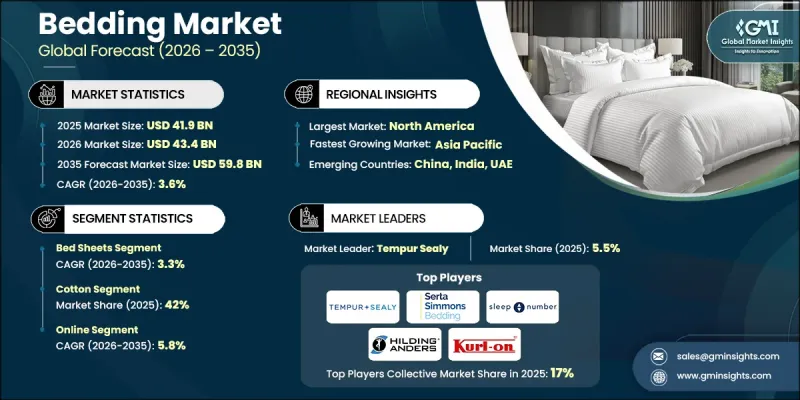
The Global Bedding Market was valued at USD 41.9 billion in 2025 and is estimated to grow at a CAGR of 3.6% to reach USD 59.8 billion by 2035.
Increasing disposable income levels are encouraging consumers to invest more in home furnishings, particularly products that enhance sleep quality and interior aesthetics. The growing emphasis on home decor is further influencing purchasing behavior, with bedding becoming an integral part of lifestyle upgrades. In addition, the expansion of the hospitality sector is contributing significantly to demand, as accommodation providers prioritize high-quality bedding solutions to enhance guest satisfaction. The rapid development of e-commerce platforms is also playing a crucial role in market expansion by offering consumers access to a broad range of products, competitive pricing, and convenient delivery options. Furthermore, evolving consumer expectations around comfort, durability, and design continue to shape product innovation, supporting long-term growth in the global bedding industry.
| Market Scope | |
|---|---|
| Start Year | 2025 |
| Forecast Year | 2026-2035 |
| Start Value | $41.9 Billion |
| Forecast Value | $59.8 Billion |
| CAGR | 3.6% |
Advancements in bedding materials are further transforming the market landscape, with innovations focused on improving comfort and sustainability. Manufacturers are introducing enhanced fabric technologies that cater to the growing demand for eco-friendly and skin-friendly products. These developments align with increasing consumer awareness regarding healthy sleep environments and the importance of quality rest. Additionally, rising interest in sleep wellness is driving the adoption of ergonomically designed and specialized bedding solutions that support overall health and well-being.
The bed sheets segment generated USD 14.1 billion in 2025 and is expected to grow at a CAGR of 3.3% during 2026-2035. This segment continues to lead the market, driven by strong demand for premium materials and sustainable fabric options. Consumers are increasingly seeking customization in home decor, which is encouraging the adoption of diverse designs, textures, and finishes. The combination of functionality and aesthetic appeal is reinforcing the segment's dominant position.
The cotton segment accounted for 42% share in 2025 and is projected to grow at a CAGR of 4% from 2026 to 2035. This segment is gaining traction due to its inherent properties, including comfort, breathability, and long-lasting performance. Increasing consumer preference for natural and organic materials is further supporting demand. The shift toward environmentally conscious purchasing decisions is also contributing to the expansion of cotton-based bedding products.
United States Bedding Market 76% share, generating USD 11.4 billion in 2025, driven by diverse consumer preferences and favorable economic conditions that support spending on home improvement products. Continuous demand for high-quality and innovative bedding solutions is further strengthening the market position.
Key companies operating in the Global Bedding Market include Tempur Sealy, Serta Simmons Bedding, Hastens, Hilding Anders, Sleep Number, King Koil, Spring Air International, Silentnight, Magniflex, Pikolin, Recticel, Corsicana Bedding, A.H. Beard, Sleepwell (Sheela Foam), and Kurlon Enterprise. Companies in the bedding market are strengthening their market position through product innovation, premiumization, and expansion of distribution channels. They are focusing on developing advanced materials that enhance comfort, durability, and sustainability to meet evolving consumer expectations. Many brands are expanding their online presence and adopting direct-to-consumer models to improve accessibility and customer engagement. Strategic collaborations and partnerships are being used to broaden product portfolios and reach new customer segments. Companies are also investing in branding and marketing initiatives to highlight product quality and sleep benefits. Additionally, customization options and eco-friendly offerings are being emphasized to align with changing consumer preferences, helping businesses maintain a competitive edge in the market.
Table of Contents
Chapter 1 Methodology and scope
- 1.1 Research approach
- 1.2 Quality Commitments
- 1.2.1 GMI AI policy & data integrity commitment
- 1.2.1.1 Source consistency protocol
- 1.2.1 GMI AI policy & data integrity commitment
- 1.3 Research Trail & Confidence Scoring
- 1.3.1 Research Trail Components
- 1.3.2 Scoring Components
- 1.4 Data Collection
- 1.4.1 Partial list of primary sources
- 1.5 Data mining sources
- 1.5.1 Paid sources
- 1.5.1.1 Sources, by region
- 1.5.1 Paid sources
- 1.6 Base estimates and calculations
- 1.6.1 Base year calculation for any one approach
- 1.7 Forecast model
- 1.7.1 Quantified market impact analysis
- 1.7.1.1 Mathematical impact of growth parameters on forecast
- 1.7.1 Quantified market impact analysis
- 1.8 Research transparency addendum
- 1.8.1 Source attribution framework
- 1.8.2 Quality assurance metrics
- 1.8.3 Our commitment to trust
Chapter 2 Executive summary
- 2.1 Industry 360° synopsis
- 2.2 Key market trends
- 2.2.1 Regional trends
- 2.2.2 Product type trends
- 2.2.3 Material type trends
- 2.2.4 Price trends
- 2.2.5 Distribution channel trends
Chapter 3 Industry insights
- 3.1 Industry ecosystem analysis
- 3.1.1 Supplier landscape
- 3.1.2 Profit margin
- 3.1.3 Value addition at each stage
- 3.1.4 Factor affecting the value chain
- 3.1.5 Disruptions
- 3.2 Industry impact forces
- 3.2.1 Growth drivers
- 3.2.2 Industry pitfalls & challenges
- 3.2.3 Opportunities
- 3.3 Growth potential analysis
- 3.4 Future market trends
- 3.5 Technology and innovation landscape
- 3.5.1 Smart textiles & sleep-tech integration
- 3.5.2 Sustainable & eco-friendly manufacturing technologies
- 3.5.3 Antimicrobial & performance fabric innovations
- 3.5.4 Digital printing & customization technologies
- 3.6 Pricing analysis (Driven by Primary Research)
- 3.6.1 Historical price trend analysis (Driven by Primary Research)
- 3.6.2 Pricing strategy by player type (Premium / Value / Cost-plus) (Driven by Primary Research)
- 3.7 Regulatory framework
- 3.7.1 Textile Labeling & Flammability Standards
- 3.7.2 Chemical Safety Regulations (OEKO-TEX, CPSIA)
- 3.7.3 Organic & Sustainability Certifications (GOTS, Fair Trade)
- 3.7.4 Import/Export Regulations & Tariffs
- 3.8 Trade data analysis (Driven by Paid Database) (HS Code 6302: Bed Linen)
- 3.8.1 Import/export volume & value trends (Driven by Primary Research)
- 3.8.2 Key trade corridors & tariff impact (Driven by Primary Research)
- 3.9 Impact of AI & generative ai on the market
- 3.9.1 AI-driven disruption of traditional business models
- 3.9.2 GenAI use cases & adoption roadmap by customer segment
- 3.9.3 Risks, limitations & regulatory considerations
- 3.9.4 AI-enabled smart home ecosystem integration
- 3.10 Porter's five forces analysis
- 3.11 PESTEL analysis
- 3.12 Consumer behavior analysis
- 3.12.1 Purchasing patterns
- 3.12.2 Preference analysis
- 3.12.3 Regional variations in consumer behavior
- 3.12.4 Impact of e-commerce on buying decisions
Chapter 4 Competitive landscape, 2025
- 4.1 Introduction
- 4.2 Company market share analysis
- 4.2.1 North America
- 4.2.2 Europe
- 4.2.3 Asia Pacific
- 4.2.4 Latin America
- 4.2.5 MEA
- 4.3 Company matrix analysis
- 4.4 Competitive analysis of major market players
- 4.5 Competitive positioning matrix
- 4.6 Key developments
- 4.6.1 Mergers & acquisitions
- 4.6.2 Partnerships & collaborations
- 4.6.3 New product launches
- 4.6.4 Expansion plans
Chapter 5 Market Estimates & Forecast, By Product Type, 2022 - 2035 ($Billion, Thousand Units)
- 5.1 Key trends
- 5.2 Bed sheets
- 5.3 Pillowcases & shams
- 5.4 Comforters & duvets
- 5.5 Blankets & throws
- 5.6 Quilts
- 5.7 Others (bed skirts & pillows etc.)
Chapter 6 Market Estimates & Forecast, By Material Type, 2022 - 2035 ($Billion, Thousand Units)
- 6.1 Key trends
- 6.2 Cotton
- 6.3 Polyester & synthetic
- 6.4 Linen
- 6.5 Silk
- 6.6 Others (bamboo, wool etc.)
Chapter 7 Market Estimates & Forecast, By Price Range, 2022 - 2035 ($Billion, Thousand Units)
- 7.1 Key trends
- 7.2 Under $50
- 7.3 $51 to $100
- 7.4 $101 and above
Chapter 8 Market Estimates & Forecast, By End User, 2022 - 2035 ($Billion, Thousand Units)
- 8.1 Key trends
- 8.2 Residential
- 8.3 Commercial
- 8.3.1 Hospitality
- 8.3.2 Healthcare
- 8.3.3 Others (institutional & others etc.)
Chapter 9 Market Estimates & Forecast, By Distribution Channel, 2022 - 2035 ($Billion, Thousand Units)
- 9.1 Key trends
- 9.2 Online
- 9.2.1 E-commerce
- 9.2.2 Company websites
- 9.3 Offline
- 9.3.1 Supermarkets/hypermarket
- 9.3.2 Specialty retail stores
- 9.3.3 Others (independent retailer etc.)
Chapter 10 Market Estimates & Forecast, By Region, 2022 - 2035 ($Billion, Thousand Units)
- 10.1 Key trends
- 10.2 North America
- 10.2.1 U.S.
- 10.2.2 Canada
- 10.3 Europe
- 10.3.1 Germany
- 10.3.2 UK
- 10.3.3 France
- 10.3.4 Spain
- 10.3.5 Italy
- 10.3.6 Netherlands
- 10.4 Asia Pacific
- 10.4.1 China
- 10.4.2 Japan
- 10.4.3 India
- 10.4.4 Australia
- 10.4.5 South Korea
- 10.5 Latin America
- 10.5.1 Brazil
- 10.5.2 Mexico
- 10.5.3 Argentina
- 10.6 MEA
- 10.6.1 South Africa
- 10.6.2 Saudi Arabia
- 10.6.3 UAE
Chapter 11 Company Profiles
- 11.1 A.H. Beard
- 11.2 Corsicana Bedding
- 11.3 Hastens
- 11.4 Hilding Anders
- 11.5 King Koil
- 11.6 Kurlon Enterprise
- 11.7 Magniflex
- 11.8 Pikolin
- 11.9 Recticel
- 11.10 Serta Simmons Bedding
- 11.11 Silentnight
- 11.12 Sleep Number
- 11.13 Sleepwell (Sheela Foam)
- 11.14 Spring Air International
- 11.15 Tempur Sealy

