
PUBLISHER: Global Market Insights Inc. | PRODUCT CODE: 2019034

PUBLISHER: Global Market Insights Inc. | PRODUCT CODE: 2019034
Asia Pacific Hair Care Market Opportunity, Growth Drivers, Industry Trend Analysis, and Forecast 2026 - 2035
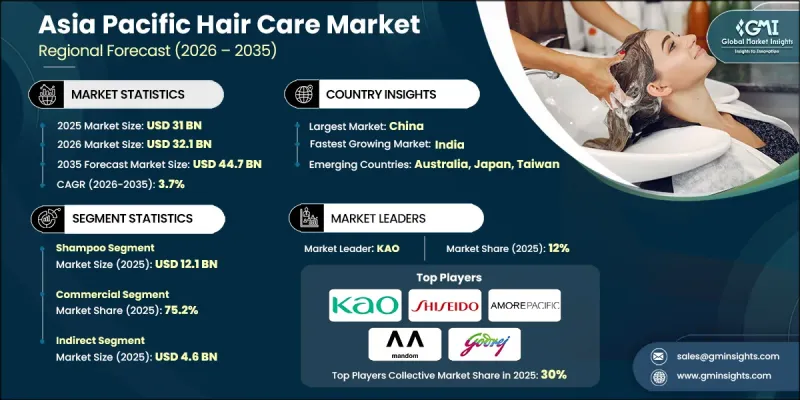
Asia Pacific Hair Care Market was valued at USD 31 billion in 2025 and is estimated to grow at a CAGR of 3.7% to reach USD 44.7 billion by 2035.
Rising awareness around personal appearance is reshaping consumer behavior, as individuals increasingly associate grooming with confidence, identity, and social perception. Rapid urban development and greater access to global beauty influences have significantly contributed to this shift. Consumers, particularly younger demographics, are embracing experimentation with styling, treatments, and premium formulations, transforming hair care into a form of personal expression rather than a basic routine. This evolution is pushing brands to develop more innovative, trend-aligned, and performance-driven offerings tailored to a digitally engaged audience. At the same time, the growing influence of lifestyle changes and increased spending capacity is supporting demand for advanced formulations. Despite gradual growth compared to other beauty segments, the market continues to evolve through product diversification, ingredient innovation, and expanding consumer expectations, positioning the Asia Pacific hair care market as a dynamic and competitive landscape.
| Market Scope | |
|---|---|
| Start Year | 2025 |
| Forecast Year | 2026-2035 |
| Start Value | $31 Billion |
| Forecast Value | $44.7 Billion |
| CAGR | 3.7% |
At the same time, the expansion of grooming habits among male consumers has significantly widened the target audience for hair care products across the region. What was once a category largely associated with women has now gained universal acceptance across genders and age groups. Men are increasingly incorporating styling solutions, scalp-focused treatments, and hair maintenance products into their routines. This shift has created strong demand for specialized formulations designed to address diverse hair types, textures, and individual preferences, encouraging brands to broaden their portfolios accordingly.
In 2025, the shampoo segment reached USD 12.1 billion. It remains a fundamental component of daily hair care, designed to cleanse the scalp and hair by removing buildup from environmental exposure and routine use of styling products. Modern formulations have evolved to address a wide range of hair concerns while delivering additional functional benefits beyond cleansing. Advances in cosmetic science and heightened awareness of ingredient safety have contributed to the development of more refined and performance-oriented products, enhancing both scalp health and overall hair quality.
The commercial segment held a 75.2% share in 2025. Professional users rely on consistent, high-performing formulations as part of their daily service offerings, making product quality and reliability essential. These end-users typically require products that can withstand frequent use while maintaining effectiveness and safety standards. Due to the nature of their operations, they tend to purchase in larger quantities and prioritize cost efficiency alongside ease of application, while maintaining strict expectations regarding product performance.
China Hair Care Market held a 38.1% share, generating USD 11.8 billion in 2025. Increasing urbanization, heightened awareness of personal care, and evolving grooming habits are key factors driving market growth. Consumers are placing greater emphasis on maintaining scalp condition and preventing damage, particularly in response to changing lifestyles and environmental exposure. This has led to increased demand for a wide range of hair care solutions designed to address specific concerns. Additionally, evolving consumer preferences and rising expectations for product effectiveness are encouraging continuous innovation within the market.
Major companies operating in the Asia Pacific Hair Care Market include Amorepacific, Coty, Dabur India, Godrej Consumer Products, Henkel, John Paul Mitchell Systems, KAO, Kenvue, L'Oreal, Mandom, Marico, Procter & Gamble, Shiseido Company, The Estee Lauder, and Unilever. Companies in the Asia Pacific Hair Care Market are focusing on product innovation and formulation advancements to meet evolving consumer expectations and diverse hair care needs. They are expanding their portfolios with specialized solutions targeting different hair concerns, textures, and usage preferences. Strategic investments in research and development are enabling the introduction of high-performance and ingredient-conscious products. Brands are also strengthening their distribution networks across both online and offline channels to improve accessibility and visibility. In addition, companies are leveraging digital marketing strategies to engage consumers and build brand loyalty. Partnerships, regional expansions, and localized product development are further supporting market penetration, while competitive pricing and premiumization strategies are helping capture a broader consumer base.
Table of Contents
Chapter 1 Methodology and Scope
- 1.1 Market scope and definition
- 1.2 Research design
- 1.2.1 Research approach
- 1.2.2 Data collection methods
- 1.3 Data mining sources
- 1.3.1 Country
- 1.4 Base estimates and calculations
- 1.4.1 Base year calculation
- 1.4.2 Key trends for market estimation
- 1.5 Primary research and validation
- 1.5.1 Primary sources
- 1.6 Forecast model
- 1.7 Research assumptions and limitations
Chapter 2 Executive Summary
- 2.1 Industry 360° synopsis
- 2.2 Key market trends
- 2.2.1 Country
- 2.2.2 Product type
- 2.2.3 Ingredient
- 2.2.4 Hair type
- 2.2.5 Consumer group
- 2.2.6 Price
- 2.2.7 End use
- 2.2.8 Distribution channel
- 2.3 CXO perspectives: Strategic imperatives
- 2.3.1 Key decision points for industry executives
- 2.3.2 Critical success factors for market players
- 2.4 Future outlook and strategic recommendations
Chapter 3 Industry Insights
- 3.1 Industry ecosystem analysis
- 3.1.1 Supplier landscape
- 3.1.2 Profit margin
- 3.1.3 Value addition at each stage
- 3.1.4 Factor affecting the value chain
- 3.2 Industry impact forces
- 3.2.1 Growth drivers
- 3.2.1.1 Growing beauty awareness & grooming culture
- 3.2.1.2 Shift toward natural & herbal hair care
- 3.2.1.3 Salon and spas industry expansion
- 3.2.2 Industry pitfalls & challenges
- 3.2.2.1 Supply chain complexity
- 3.2.2.2 Raw material price volatility
- 3.2.3 Opportunities
- 3.2.3.1 Scalp health & clinical hair treatments
- 3.2.3.2 Natural, herbal & clean beauty haircare
- 3.2.1 Growth drivers
- 3.3 Growth potential analysis
- 3.4 Future market trends
- 3.5 Technology and innovation landscape
- 3.5.1 Current technological trends
- 3.5.2 Emerging technologies
- 3.6 Price trends
- 3.6.1 By country
- 3.6.2 By product type
- 3.7 Regulatory landscape
- 3.7.1 Standards and compliance requirements
- 3.7.2 Regional regulatory frameworks
- 3.7.3 Certification standards
- 3.8 Porter's analysis
- 3.9 PESTEL analysis
- 3.10 Pricing analysis (driven by primary research)
- 3.10.1 Historical price trend analysis (2022-2025)
- 3.10.2 Pricing strategy by player type (economy/premium/luxury)
- 3.10.3 Price elasticity & consumer willingness to pay
- 3.11 Trade data analysis (driven by primary research)
- 3.11.1 Import/export volume & value trends by country
- 3.11.2 Key trade corridors & tariff impact
- 3.12 Impact of AI & generative AI on the market
- 3.12.1 AI-driven disruption of existing business models
- 3.12.2 GenAI use cases & adoption roadmap by segment
- 3.12.2.1 Predictive maintenance & condition monitoring
- 3.12.2.2 Design optimization & generative engineering
- 3.12.2.3 Supply chain optimization & demand forecasting
- 3.12.3 Risks, limitations & regulatory considerations
- 3.13 Distribution infrastructure & channel penetration landscape (driven by primary research)
- 3.13.1 Channel coverage by region & format (modern vs. traditional trade)
- 3.13.2 Last-mile infrastructure gaps & emerging channel shifts
Chapter 4 Competitive Landscape, 2025
- 4.1 Introduction
- 4.2 Company market share analysis
- 4.2.1 By country
- 4.2.1.1 China
- 4.2.1.2 India
- 4.2.1.3 Japan
- 4.2.1.4 South Korea
- 4.2.1.5 Australia
- 4.2.1.6 Taiwan
- 4.2.1 By country
- 4.3 Company matrix analysis
- 4.4 Competitive analysis of major market players
- 4.5 Competitive positioning matrix
- 4.6 Key developments
- 4.6.1 Mergers & acquisitions
- 4.6.2 Partnerships & collaborations
- 4.6.3 New product launches
- 4.6.4 Expansion plans
Chapter 5 Market Estimates and Forecast, By Product Type, 2022 - 2035 (USD Billion) (Thousand Units)
- 5.1 Key trends
- 5.2 Shampoo
- 5.2.1 Anti-dandruff shampoo
- 5.2.2 Moisturizing shampoo
- 5.2.3 Volumizing shampoo
- 5.2.4 Dry shampoo
- 5.2.5 Others (Clarifying, Color-Safe, etc.)
- 5.3 Conditioner
- 5.3.1 Rinse-out conditioner
- 5.3.2 Leave-in conditioner
- 5.3.3 Deep conditioner
- 5.4 Hair styling products
- 5.4.1 Hair mousse
- 5.4.2 Hair spray
- 5.4.3 Hair serums
- 5.4.3.1 Anti-frizz serum
- 5.4.3.2 Shine-enhancing serum
- 5.4.3.3 Heat protection serum
- 5.4.3.4 Anti-hair loss serum
- 5.5 Hair oil
- 5.5.1 Coconut oil
- 5.5.2 Argan oil
- 5.5.3 Castor oil
- 5.5.4 Herbal oil blends
- 5.6 Others (hair gel etc.)
- 5.7 Hair colour
- 5.7.1 Permanent hair dye
- 5.7.2 Semi-permanent hair dye
- 5.7.3 Temporary hair colour
- 5.8 Others (hair mask etc.)
Chapter 6 Market Estimates and Forecast, By Ingredient, 2022 - 2035 (USD Billion) (Thousand Units)
- 6.1 Key trends
- 6.2 Organic
- 6.3 Synthetic
- 6.4 Hybrid
Chapter 7 Market Estimates and Forecast, By Hair Type, 2022 - 2035 (USD Billion) (Thousand Units)
- 7.1 Key trends
- 7.2 Normal hair
- 7.3 Dry/damaged hair
- 7.4 Oily hair
- 7.5 Curly/wavy hair
- 7.6 Colored/treated hair
- 7.7 Thinning hair/hair loss
Chapter 8 Market Estimates and Forecast, By Consumer Group, 2022 - 2035 (USD Billion) (Thousand Units)
- 8.1 Key trends
- 8.2 Men
- 8.3 Women
- 8.4 Kids
Chapter 9 Market Estimates and Forecast, By Price, 2022 - 2035 (USD Billion) (Thousand Units)
- 9.1 Key trends
- 9.2 Low
- 9.3 Medium
- 9.4 High
Chapter 10 Market Estimates and Forecast, By End Use, 2022 - 2035 (USD Billion) (Thousand Units)
- 10.1 Key trends
- 10.2 Individual
- 10.3 Commercial
- 10.3.1 Salons and spas
- 10.3.2 Hotels and resorts
- 10.3.3 Other (cosmetology institutes, etc.)
Chapter 11 Market Estimates and Forecast, By Distribution Channel, 2022 - 2035 (USD Billion) (Thousand Units)
- 11.1 Key trends
- 11.2 Online
- 11.2.1 E-commerce
- 11.2.2 Company owned website
- 11.3 Offline
- 11.3.1 Supermarkets & hypermarkets
- 11.3.2 Specialty stores
- 11.3.3 Others (department stores etc.)
Chapter 12 Market Estimates and Forecast, By Country, 2022 - 2035 (USD Billion) (Thousand Units)
- 12.1 Key trends
- 12.2 China
- 12.3 India
- 12.4 Japan
- 12.5 South Korea
- 12.6 Australia
- 12.7 Taiwan
Chapter 13 Company Profiles
- 13.1 Amorepacific
- 13.2 Coty
- 13.3 Dabur India
- 13.4 Godrej Consumer Products
- 13.5 Henkel
- 13.6 John Paul Mitchell Systems
- 13.7 KAO
- 13.8 Kenvue
- 13.9 L'Oreal
- 13.10 Mandom
- 13.11 Marico Limited
- 13.12 Procter & Gamble
- 13.13 Shiseido Company
- 13.14 The Estee Lauder
- 13.15 Unilever

