
PUBLISHER: Global Market Insights Inc. | PRODUCT CODE: 2045663

PUBLISHER: Global Market Insights Inc. | PRODUCT CODE: 2045663
North America Hair Care Market Opportunity, Growth Drivers, Industry Trend Analysis, and Forecast 2026 - 2035
North America Hair Care Market was valued at USD 37 billion in 2025 and is estimated to grow at a CAGR of 3% to reach USD 50 billion by 2035.
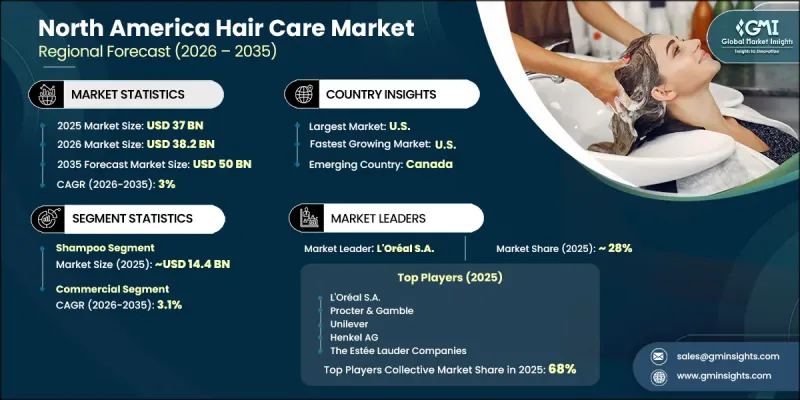
The growth of the North America hair care industry is supported by increasing consumer awareness regarding personal grooming, scalp wellness, and overall hair maintenance. Consumers are actively seeking high-quality products that deliver effective results while maintaining hair strength, texture, and long-term health. Growing attention toward appearance and self-care routines has encouraged greater spending on advanced hair care solutions across the region. In addition, rising demand for preventive hair treatment products is contributing significantly to market expansion as consumers focus on maintaining healthy hair rather than addressing damage after it occurs. Modern hair care formulations are designed to support multiple hair concerns, including hydration, repair, scalp nourishment, and styling protection, which continues to strengthen product adoption. Increased expenditure on personal care and beauty products, along with greater awareness regarding wellness and hygiene, is further accelerating industry growth. The market is also benefiting from rising demand for natural and organic formulations as consumers increasingly prefer clean-label and ingredient-focused hair care products.
| Market Scope | |
|---|---|
| Start Year | 2025 |
| Forecast Year | 2026-2035 |
| Start Value | $37 Billion |
| Forecast Value | $50 Billion |
| CAGR | 3% |
The shampoo segment generated USD 14.4 billion in 2025 and is expected to grow at a CAGR of 3.5% between 2026 and 2035. Shampoo continues to represent the leading category within the North America hair care market due to the consistent demand for routine hair cleansing and scalp maintenance products. Consumers increasingly prefer formulations that address a wide range of hair conditions while supporting overall hair health and styling needs. The category offers extensive product diversity with formulations tailored for different hair textures, moisture requirements, and treatment preferences. Advanced shampoos are increasingly developed with specialized ingredient combinations, balanced formulations, and performance-focused technologies that enhance cleansing efficiency while supporting hair protection and nourishment. Continued innovation in formulation development is further strengthening the segment's position in the market.
The commercial segment accounted for 62.2% share in 2025 and is anticipated to register a CAGR of 3.1% through 2035. Strong demand from professional beauty service providers continues to support growth across the commercial segment. Businesses operating within the professional hair care industry prioritize premium-quality products that deliver reliable and consistent performance. Commercial-grade hair care products are designed with concentrated formulations and professional-use technologies that enhance treatment effectiveness and service quality. The availability of advanced product systems and salon-focused solutions enables professional establishments to deliver improved customer experiences and specialized hair treatment services. Consistent product performance and professional application standards remain key factors driving demand across the commercial segment.
United States Hair Care Market held 79.8% share in 2025 and is forecast to grow at a CAGR of 3.3% from 2026 to 2035. The country continues to lead the regional industry due to strong consumer spending on beauty and personal care products combined with high awareness regarding grooming and hair wellness. Consumers across the U.S. increasingly seek comprehensive hair care solutions that support maintenance, styling, and long-term hair health. The large consumer base across the country supports broad retail distribution networks, extensive product availability, and continued product innovation within the hair care industry. Established relationships between consumers and leading hair care brands further contribute to sustained demand by ensuring access to new product launches, quality assurance, and ongoing advancements in hair care technologies.
Key companies operating in the North America Hair Care Market include Amway Corporation, Beiersdorf AG, Function of Beauty, Henkel AG, Kao Corporation, Kenvue Inc., Living Proof, L'Oreal S.A., Olaplex Holdings, Pattern Beauty, Procter & Gamble, Revlon Inc., Shiseido Company, The Estee Lauder Companies, and Unilever. Companies operating in the North America hair care industry are adopting several strategic initiatives to strengthen their market presence and improve competitive positioning. Leading manufacturers are heavily investing in product innovation focused on clean-label formulations, plant-based ingredients, and advanced scalp and hair treatment technologies to address changing consumer preferences. Businesses are also expanding their digital and e-commerce capabilities to improve customer engagement and enhance product accessibility across online retail platforms. Strategic partnerships with salons, beauty professionals, and retail distributors are helping companies increase brand visibility and strengthen distribution networks. In addition, companies are introducing personalized hair care solutions and premium product lines to target evolving consumer demands.
Table of Contents
Chapter 1 Methodology and Scope
- 1.1 Market scope and definition
- 1.2 Research design
- 1.2.1 Research approach
- 1.2.2 Data collection methods
- 1.3 Data mining sources
- 1.3.1 Global
- 1.3.2 Regional/Country
- 1.4 Base estimates and calculations
- 1.4.1 Base year calculation
- 1.4.2 Key trends for market estimation
- 1.5 Primary research and validation
- 1.5.1 Primary sources
- 1.6 Forecast model
- 1.7 Research assumptions and limitations
Chapter 2 Executive Summary
- 2.1 Industry 360° synopsis
- 2.2 Key market trends
- 2.2.1 Country trends
- 2.2.2 Product type trends
- 2.2.3 Ingredient trends
- 2.2.4 Hair type trends
- 2.2.5 Consumer group trends
- 2.2.6 Price trends
- 2.2.7 End use trends
- 2.2.8 Distribution channel trends
- 2.3 Strategic Recommendations
Chapter 3 Industry Insights
- 3.1 Hair care industry ecosystem analysis
- 3.1.1 Raw material suppliers
- 3.1.2 Distributors & Retailers
- 3.1.3 End-Users
- 3.1.4 Value addition at each stage
- 3.1.5 Factor affecting the value chain
- 3.2 Industry impact forces
- 3.2.1 Growth drivers
- 3.2.1.1 Growing demand for specialized hair care solutions
- 3.2.1.2 Increasing adoption of premium and natural products
- 3.2.1.3 Rising salon services and professional treatments
- 3.2.2 Industry pitfalls & challenges
- 3.2.2.1 Price sensitivity in consumer segments
- 3.2.2.2 Complex formulation and regulatory requirements
- 3.2.3 Market opportunities
- 3.2.1 Growth drivers
- 3.3 Growth potential analysis
- 3.4 Regulatory landscape
- 3.5 Major market trends and disruptions
- 3.6 Technological and innovation landscape
- 3.7 Pricing analysis, 2025
- 3.7.1 Historical price trend analysis (driven by primary research)
- 3.7.2 Pricing strategy by player type (economy/premium/luxury) (driven by primary research)
- 3.7.3 Price elasticity & consumer willingness to pay
- 3.8 Future market trends
- 3.9 Supply chain analysis
- 3.10 Porter's analysis
- 3.11 PESTEL analysis
- 3.12 Consumer buying behaviour
- 3.12.1 Purchasing patterns
- 3.12.2 Preference Analysis
- 3.12.3 Regional Variations in Consumer Behaviour
- 3.12.4 Impact of E-Commerce on Buying Decisions
- 3.12.5 Salon & Professional Channel Influence
- 3.13 Trade data analysis (driven by paid database) (HS code - 330510)
- 3.13.1 Import/export volume & value trends(Driven by Primary Research)
- 3.13.2 Key trade corridors & tariff impact(Driven by Primary Research)
- 3.13.3 Trump Administration Tariffs Impact Analysis
- 3.14 Impact of AI & generative AI on the market
- 3.14.1 AI-driven disruption of existing business models
- 3.14.2 Gen AI use cases & adoption roadmap by segment
- 3.14.3 Risks, limitations & regulatory considerations
- 3.15 Distribution infrastructure & channel penetration landscape (driven by primary research)
- 3.15.1 Channel Coverage by Region & Format (Modern vs. Traditional Trade) (Driven by Primary Research)
- 3.15.2 Last-Mile Infrastructure Gaps & Emerging Channel Shifts (Driven by Primary Research)
- 3.15.3 E-commerce Penetration & Livestreaming Commerce Dynamics (Driven by Primary Research)
Chapter 4 Competitive Landscape, 2025
- 4.1 Company market share analysis
- 4.2 Company matrix analysis
- 4.3 Competitive analysis of major market players
- 4.4 Competitive positioning matrix
- 4.5 Key developments
- 4.5.1 Mergers & acquisitions
- 4.5.2 Partnerships & collaborations
- 4.5.3 New product launches
- 4.5.4 Expansion plan
Chapter 5 Market Estimates & Forecast, By Product Type, 2022-2035 (USD Billion) (Million Units)
- 5.1 Key trends
- 5.2 Shampoo
- 5.3 Conditioner
- 5.4 Hair styling products
- 5.4.1 Hair mousse
- 5.4.2 Hair spray
- 5.4.3 Hair serums
- 5.4.4 Hair oil
- 5.4.5 Others (hair gel etc.)
- 5.5 Hair color
- 5.6 Others (hair mask etc.)
Chapter 6 Market Estimates & Forecast, By Ingredient, 2022-2035 (USD Billion) (Million Units)
- 6.1 Key trends
- 6.2 Organic
- 6.3 Synthetic
Chapter 7 Market Estimates & Forecast, By Hair Type, 2022-2035 (USD Billion) (Million Units)
- 7.1 Key trends
- 7.2 Straight hair
- 7.3 Curly hair
- 7.4 Wavy hair
- 7.5 Others (thick hair etc.)
Chapter 8 Market Estimates & Forecast, By Consumer Group, 2022-2035 (USD Billion) (Million Units)
- 8.1 Key trends
- 8.2 Men
- 8.3 Women
- 8.4 Kids
Chapter 9 Market Estimates & Forecast, By Price, 2022-2035 (USD Billion) (Million Units)
- 9.1 Key trends
- 9.2 Low
- 9.3 Medium
- 9.4 High
Chapter 10 Market Estimates & Forecast, By End Use, 2022-2035 (USD Billion) (Million Units)
- 10.1 Key trends
- 10.2 Individual
- 10.3 Commercial
- 10.3.1 Salons and spas
- 10.3.2 Hotels and resorts
- 10.3.3 Other (cosmetology institutes, etc.)
Chapter 11 Market Estimates & Forecast, By Distribution Channel, 2022-2035 (USD Billion) (Million Units)
- 11.1 Key trends
- 11.2 Online
- 11.2.1 E-commerce
- 11.2.2 Company owned website
- 11.3 Offline
- 11.3.1 Supermarkets & hypermarkets
- 11.3.2 Specialty stores
- 11.3.3 Others (department stores etc.)
Chapter 12 Market Estimates & Forecast, By Region, 2022-2035 (USD Billion, Million Units)
- 12.1 Key trends
- 12.2 North America
- 12.2.1 U.S.
- 12.2.2 Canada
Chapter 13 Company Profiles
- 13.1 Top Global Players
- 13.1.1 L'Oreal S.A.
- 13.1.2 Procter & Gamble
- 13.1.3 Unilever
- 13.1.4 Henkel AG
- 13.1.5 The Estee Lauder Companies
- 13.1.6 Kao Corporation
- 13.2 Regional Players
- 13.2.1 Kenvue Inc.
- 13.2.2 Beiersdorf AG
- 13.2.3 Amway Corporation
- 13.2.4 Shiseido Company
- 13.2.5 Revlon Inc.
- 13.3 Emerging Players
- 13.3.1 Olaplex Holdings
- 13.3.2 Living Proof
- 13.3.3 Function of Beauty
- 13.3.4 Pattern Beauty

