PUBLISHER: Global Market Insights Inc. | PRODUCT CODE: 2019036

PUBLISHER: Global Market Insights Inc. | PRODUCT CODE: 2019036
Industrial Solar Power System Market Opportunity, Growth Drivers, Industry Trend Analysis, and Forecast 2026 - 2035
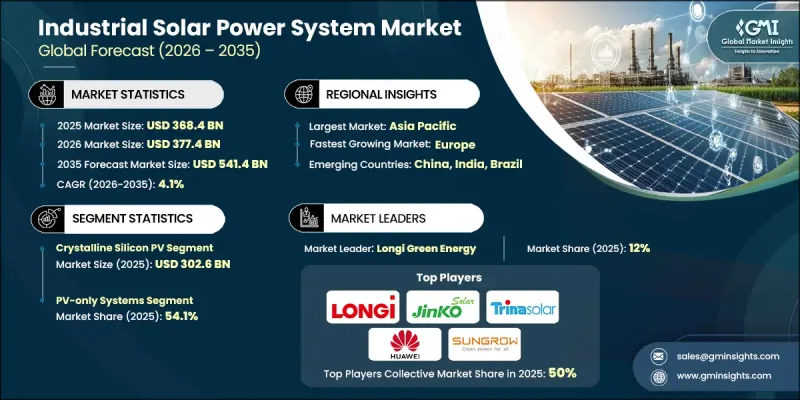
The Global Industrial Solar Power System Market was valued at USD 368.4 billion in 2025 and is estimated to grow at a CAGR of 4.1% to reach USD 541.4 billion by 2035.
Companies are steadily redefining their approach to energy sourcing, increasingly prioritizing solar solutions as part of long-term operational planning rather than treating them as temporary sustainability measures. This evolving perspective is being shaped by escalating energy prices, mounting regulatory and corporate pressure to meet renewable energy targets, and the growing need for stable and resilient power infrastructure. Industrial players are recognizing solar energy as a strategic investment that supports both financial efficiency and environmental responsibility. As a result, adoption is accelerating across industries seeking to reduce dependence on conventional energy sources while ensuring predictable and cost-effective power generation. The market continues to expand as organizations align sustainability goals with operational efficiency, positioning solar energy as a central component of future-ready industrial ecosystems.
| Market Scope | |
|---|---|
| Start Year | 2025 |
| Forecast Year | 2026-2035 |
| Start Value | $368.4 Billion |
| Forecast Value | $541.4 Billion |
| CAGR | 4.1% |
Modern industrial solar power systems are designed to integrate seamlessly with existing infrastructure, offering flexibility through grid-connected and hybrid configurations. These adaptable systems can be deployed across a wide range of industrial environments. In addition, the integration of energy storage and advanced energy management solutions ensures consistent power availability. Ongoing technological progress, including improvements in panel efficiency and intelligent monitoring capabilities, enhances system reliability and minimizes operational disruptions caused by component failures.
The crystalline silicon photovoltaic technology segment generated USD 302.6 billion in 2025. This segment continues to lead due to its technological maturity, cost efficiency, and strong performance metrics. Both monocrystalline and polycrystalline modules benefit from decades of development, large-scale manufacturing, and well-established global supply networks. These advantages translate into dependable performance and extended operational life, making them highly suitable for industrial applications where reliability and return on investment are critical considerations.
The PV-only systems segment accounted for 54.1% share in 2025. Its leadership is driven by its straightforward design, lower upfront investment, and proven efficiency. By directly converting sunlight into electricity without requiring additional components, these systems maintain reduced installation and maintenance costs. A robust global supply chain for modules and inverters further supports accessibility and competitive pricing. Their ability to deliver strong returns during peak energy demand periods, along with easy scalability and compatibility with existing infrastructure, reinforces their widespread adoption.
North America Industrial Solar Power System Market held an 80% share, generating USD 121.7 billion in 2025. Favorable policy frameworks, financial incentives, and corporate sustainability initiatives support growth in this region. Industrial sectors are increasingly deploying solar solutions to optimize operational costs and lower emissions. The adoption of combined solar and storage systems is also expanding, enabling efficient energy management and improved grid stability. Canada's progress in this market is largely influenced by its clean energy policies and commitment to renewable energy development.
Key participants in the Global Industrial Solar Power System Market include Longi Green Energy Technology Co., Ltd., Jinko Solar Holding Co., Ltd., JA Solar Technology Co., Ltd., Trina Solar Co., Ltd., Tongwei Solar Co., Ltd., Canadian Solar Inc., Aiko Solar, First Solar, Inc., Huawei Technologies Co., Ltd. (Digital Power Business), Sungrow Power Supply Co., Ltd., SMA Solar Technology AG, Fronius International GmbH, GoodWe Technologies Co., Ltd., Nextracker Inc., and Array Technologies, Inc. Companies operating in the Global Industrial Solar Power System Market are strengthening their positions through a combination of technological innovation, strategic partnerships, and global expansion initiatives. They are investing heavily in research and development to improve module efficiency, enhance durability, and integrate smart monitoring solutions. Many firms are also focusing on expanding their production capacities and optimizing supply chains to reduce costs and improve delivery timelines. Collaborations with industrial clients and energy solution providers are helping companies offer customized and scalable systems.
Table of Contents
Chapter 1 Methodology and Scope
- 1.1 Market scope and definition
- 1.2 Research design
- 1.2.1 Research approach
- 1.2.2 Data collection methods
- 1.3 Data mining sources
- 1.3.1 Global
- 1.3.2 Regional/Country
- 1.4 Base estimates and calculations
- 1.4.1 Base year calculation
- 1.4.2 Key trends for market estimation
- 1.5 Primary research and validation
- 1.5.1 Primary sources
- 1.6 Forecast model
- 1.7 Research assumptions and limitations
Chapter 2 Executive Summary
- 2.1 Industry 360° synopsis
- 2.2 Key market trends
- 2.2.1 Regional
- 2.2.2 Technology type
- 2.2.3 System configuration
- 2.2.4 Grid connection status
- 2.2.5 System scale
- 2.2.6 End scale
- 2.2.7 Distribution channel
- 2.3 CXO perspectives: Strategic imperatives
- 2.3.1 Key decision points for industry executives
- 2.3.2 Critical success factors for market players
- 2.4 Future outlook and strategic recommendations
Chapter 3 Industry Insights
- 3.1 Industry ecosystem analysis
- 3.1.1 Supplier landscape
- 3.1.2 Profit margin
- 3.1.3 Value addition at each stage
- 3.1.4 Factor affecting the value chain
- 3.2 Industry impact forces
- 3.2.1 Growth drivers
- 3.2.1.1 Growing focus on sustainability and carbon reduction
- 3.2.1.2 Rising energy costs and need for cost optimization
- 3.2.1.3 Advancements in solar technology and integration
- 3.2.2 Industry pitfalls & challenges
- 3.2.2.1 High initial investment and financing barriers
- 3.2.2.2 Space and infrastructure limitations
- 3.2.3 Opportunities
- 3.2.3.1 Integration with energy storage and smart grids
- 3.2.3.2 Government incentives and policy support
- 3.2.1 Growth drivers
- 3.3 Growth potential analysis
- 3.4 Major market trends and Disruptions
- 3.5 Future market trends
- 3.6 Risk and mitigation Analysis
- 3.7 Technology and innovation landscape
- 3.7.1 Current technological trends
- 3.7.2 Emerging technologies
- 3.8 Price trends
- 3.8.1 By region
- 3.8.2 by technology type
- 3.9 Regulatory landscape
- 3.9.1 Standards and compliance requirement
- 3.9.2 Certification standards
- 3.10 Consumer buying behaviour analysis
- 3.10.1 Purchasing patterns
- 3.10.2 Preference analysis
- 3.10.3 Regional variations in consumer behavior
- 3.10.4 Impact of e-commerce on buying decisions
- 3.11 Porter's analysis
- 3.12 PESTEL analysis
Chapter 4 Competitive Landscape, 2025
- 4.1 Introduction
- 4.2 Company market share analysis
- 4.2.1 By region
- 4.2.1.1 North America
- 4.2.1.2 Europe
- 4.2.1.3 Asia Pacific
- 4.2.1.4 Latin America
- 4.2.1.5 Middle East and Africa
- 4.2.1 By region
- 4.3 Company matrix analysis
- 4.4 Competitive analysis of major market players
- 4.5 Competitive positioning matrix
- 4.6 Key developments
- 4.6.1 Mergers & acquisitions
- 4.6.2 Partnerships & collaborations
- 4.6.3 New product launches
- 4.6.4 Expansion plans
Chapter 5 Market Estimates & Forecast, By Technology Type, 2022-2035 (USD Billion) (Tons)
- 5.1 Key trends
- 5.2 Crystalline silicon PV
- 5.3 Thin-film PV
- 5.4 Solar thermal (ship)
- 5.5 Others
Chapter 6 Market Estimates & Forecast, By System Configuration, 2022-2035 (USD Billion) (Tons)
- 6.1 Key trends
- 6.2 Pv-only systems
- 6.3 Hybrid pv+storage
Chapter 7 Market Estimates & Forecast, By Grid Connection Status, 2022-2035 (USD Billion) (Tons)
- 7.1 Key trends
- 7.2 Grid-connected (on-grid)
- 7.3 Off-grid (standalone)
Chapter 8 Market Estimates & Forecast, By System Scale, 2022-2035 (USD Billion) (Tons)
- 8.1 Key trends
- 8.2 Small industrial
- 8.3 Medium industrial
- 8.4 Large industrial/utility-scale
Chapter 9 Market Estimates & Forecast, By End Use Industry, 2022-2035 (USD Billion) (Tons)
- 9.1 Key trends
- 9.2 Heavy manufacturing
- 9.3 Process industries
- 9.4 Mining & metals
- 9.5 Food & beverage
- 9.6 Textiles & apparel
- 9.7 Data centers & IT
- 9.8 Building materials
- 9.9 Pulp & paper
- 9.10 Others
Chapter 10 Market Estimates & Forecast, By End Use Industry, 2022-2035 (USD Billion) (Tons)
- 10.1 Key trends
- 10.2 Direct sales
- 10.3 Indirect sales
Chapter 11 Market Estimates and Forecast, By Region, 2022 - 2035 (USD Billion) (Tons)
- 11.1 Key trends
- 11.2 North America
- 11.2.1 U.S.
- 11.2.2 Canada
- 11.3 Europe
- 11.3.1 Germany
- 11.3.2 UK
- 11.3.3 France
- 11.3.4 Italy
- 11.3.5 Spain
- 11.4 Asia Pacific
- 11.4.1 China
- 11.4.2 Japan
- 11.4.3 India
- 11.4.4 South Korea
- 11.4.5 Australia
- 11.4.6 Malaysia
- 11.4.7 Indonesia
- 11.5 Latin America
- 11.5.1 Brazil
- 11.5.2 Mexico
- 11.6 Middle East and Africa
- 11.6.1 South Africa
- 11.6.2 Saudi Arabia
- 11.6.3 UAE
Chapter 12 Company Profiles
- 12.1 Longi Green Energy Technology Co., Ltd.
- 12.2 Jinko Solar Holding Co., Ltd.
- 12.3 JA Solar Technology Co., Ltd.
- 12.4 Trina Solar Co., Ltd.
- 12.5 Tongwei Solar Co., Ltd.
- 12.6 Canadian Solar Inc.
- 12.7 Aiko Solar
- 12.8 First Solar, Inc.
- 12.9 Huawei Technologies Co., Ltd. (Digital Power Business)
- 12.10 Sungrow Power Supply Co., Ltd.
- 12.11 SMA Solar Technology AG
- 12.12 Fronius International GmbH
- 12.13 GoodWe Technologies Co., Ltd.
- 12.14 Nextracker Inc.
- 12.15 Array Technologies, Inc.

