PUBLISHER: Global Market Insights Inc. | PRODUCT CODE: 2019051

PUBLISHER: Global Market Insights Inc. | PRODUCT CODE: 2019051
Companion Animal Drugs Market Opportunity, Growth Drivers, Industry Trend Analysis, and Forecast 2026 - 2035
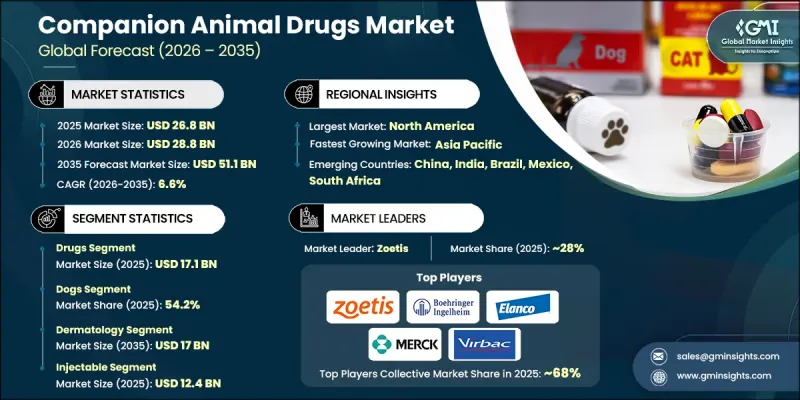
The Global Companion Animal Drugs Market was valued at USD 26.8 billion in 2025 and is estimated to grow at a CAGR of 6.6% to reach USD 51.1 billion by 2035.
The expansion is driven by the rising adoption of companion animals, an increasing prevalence of chronic and infectious diseases in pets, and the growing willingness of owners to invest in advanced veterinary care. Pet owners increasingly consider their animals as family members, fueling demand for preventive medications, vaccinations, and specialized treatments. The market growth is further supported by the expanding veterinary healthcare infrastructure and increased public awareness of pet health and wellness. Chronic conditions like arthritis, diabetes, cardiovascular disorders, and parasitic infections are common in companion animals, emphasizing the need for effective pharmaceuticals. As veterinary practices embrace innovative therapeutic solutions and preventive care approaches, the demand for companion animal drugs continues to rise globally.
| Market Scope | |
|---|---|
| Start Year | 2025 |
| Forecast Year | 2026-2035 |
| Start Value | $26.8 Billion |
| Forecast Value | $51.1 Billion |
| CAGR | 6.6% |
Companion animal drugs include pharmaceuticals, vaccines, and medicated feed additives formulated to prevent, treat, or manage health conditions in pets. These drugs are essential in addressing chronic illnesses, infections, and dermatological conditions, as well as in controlling the spread of contagious diseases among animals.
In 2025, the drugs segment accounted for USD 17.1 billion, driven by increasing cases of chronic illnesses and infections such as arthritis, cancer, and skin conditions. The rising trend of pet humanization has further encouraged investment in advanced veterinary medicines, including antibiotics, anti-inflammatory agents, and parasiticides, to enhance animal well-being.
The dermatology segment is expected to reach USD 17 billion by 2035. High incidence of skin conditions, including allergic dermatitis, parasitic infestations, and bacterial or fungal infections, fuels demand for dermatological treatments. Pets are often susceptible to environmental allergens, food sensitivities, and parasites, which have made anti-allergy medications, antifungals, antibiotics, and parasiticides a vital category within the market.
North America Companion Animal Drugs Market held a 42.9% share in 2025 and is projected to grow at a CAGR of 6.3% through 2035. The regional growth is supported by high pet ownership, advanced veterinary infrastructure, and strong expenditure on pet healthcare. The U.S. contributes significantly to this market due to the rising humanization of pets and increased adoption of preventive and therapeutic treatments.
Key players in the Global Companion Animal Drugs Market include Boehringer Ingelheim International, Zoetis, Elanco Animal Health Incorporated, Vetoquinol, Ceva Sante Animale, Dechra Pharmaceuticals, HIPRA, Indian Immunologicals, Agrolabo, Chanelle Pharma, Endovac Animal Health, Merck, Symrise, Norbrook, and Virbac. Key strategies adopted by companies in the Global Companion Animal Drugs Market include investing heavily in research and development to create innovative and effective pharmaceuticals targeting specific diseases and preventive care solutions. Firms focus on expanding product portfolios across therapeutic areas such as dermatology, cardiology, and endocrinology to meet diverse pet healthcare needs. Partnerships with veterinary clinics, hospitals, and distributors help strengthen market reach and ensure the timely availability of products. Companies also emphasize regulatory compliance, quality assurance, and education programs for veterinarians to enhance adoption. Geographic expansion and targeted marketing campaigns are employed to build brand recognition and boost market share in emerging regions.
Table of Contents
Chapter 1 Methodology and Scope
- 1.1 Market scope and definition
- 1.2 Research approach
- 1.3 Quality commitments
- 1.3.1 GMI AI policy and data integrity commitment
- 1.3.1.1 Source consistency protocol
- 1.3.1 GMI AI policy and data integrity commitment
- 1.4 Research trail and confidence scoring
- 1.4.1 Research trail components
- 1.4.2 Scoring components
- 1.5 Data collection
- 1.5.1 Partial list of primary sources
- 1.6 Data mining sources
- 1.6.1 Paid sources
- 1.6.1.1 Sources, by region
- 1.6.1 Paid sources
- 1.7 Base estimates and calculations
- 1.7.1 Revenue share analysis
- 1.7.2 Base year calculation
- 1.8 Forecast model
- 1.9 Research transparency addendum
- 1.9.1 Source attribution framework
- 1.9.2 Quality assurance metrics
- 1.9.3 Our commitment to trust
Chapter 2 Executive Summary
- 2.1 Industry 360° synopsis
- 2.2 Key market trends
- 2.2.1 Regional trends
- 2.2.2 Product trends
- 2.2.3 Animal type trends
- 2.2.4 Indication trends
- 2.2.5 Route of administration trends
- 2.2.6 Distribution channel trends
- 2.3 CXO perspectives: Strategic imperatives
Chapter 3 Industry Insights
- 3.1 Industry ecosystem analysis
- 3.2 Industry impact forces
- 3.2.1 Growth drivers
- 3.2.1.1 Rising companion animal population
- 3.2.1.2 Increasing prevalence of animal diseases
- 3.2.1.3 Advancements in veterinary pharmaceuticals
- 3.2.1.4 Expansion of veterinary healthcare infrastructure
- 3.2.2 Industry pitfalls and challenges
- 3.2.2.1 High cost of veterinary drugs and treatments
- 3.2.2.2 Limited access to veterinary services in developing regions
- 3.2.3 Market opportunities
- 3.2.3.1 Development of novel biologics and immunotherapies
- 3.2.3.2 Expansion of e-commerce veterinary pharmacies
- 3.2.1 Growth drivers
- 3.3 Growth potential analysis
- 3.4 Regulatory landscape (Driven by Primary Research)
- 3.4.1 North America
- 3.4.1.1 U.S.
- 3.4.1.2 Canada
- 3.4.2 Europe
- 3.4.3 Asia Pacific
- 3.4.1 North America
- 3.5 Pipeline/clinical trial landscape (Driven by Primary Research)
- 3.6 Pricing analysis (Driven by Primary Research)
- 3.7 Pet population statistics, by country (Driven by Primary Research)
- 3.8 Future market trends
- 3.9 Impact of AI & generative AI on the market
- 3.10 Porter's analysis
- 3.11 PESTEL analysis
Chapter 4 Competitive Landscape, 2025
- 4.1 Introduction
- 4.2 Company market share analysis
- 4.2.1 North America
- 4.2.2 Europe
- 4.2.3 Asia Pacific
- 4.3 Company matrix analysis
- 4.4 Competitive analysis of major market players
- 4.5 Competitive positioning matrix
- 4.6 Key developments
- 4.6.1 Merger and acquisition
- 4.6.2 Partnership and collaboration
- 4.6.3 New product launches
- 4.6.4 Expansion plans
Chapter 5 Market Estimates and Forecast, By Product, 2022 - 2035 ($ Mn)
- 5.1 Key trends
- 5.2 Drugs
- 5.2.1 Antiparasitic
- 5.2.2 Anti-inflammatory
- 5.2.3 Anti-infectives
- 5.2.4 Corticosteroids
- 5.2.5 Tranquilizers
- 5.2.6 Cardiovascular drugs
- 5.2.7 Gastrointestinal drugs
- 5.2.8 Other drugs
- 5.3 Vaccines
- 5.3.1 Modified live vaccines (MLV)
- 5.3.2 Killed inactivated vaccines
- 5.3.3 Recombinant vaccines
- 5.4 Medicated feed additives
- 5.4.1 Antibiotics
- 5.4.2 Vitamins
- 5.4.3 Amino acids
- 5.4.4 Enzymes
- 5.4.5 Antioxidants
- 5.4.6 Prebiotics and probiotics
- 5.4.7 Minerals
- 5.4.8 Other medicated feed additives
Chapter 6 Market Estimates and Forecast, By Indication, 2022 - 2035 ($ Mn)
- 6.1 Key trends
- 6.2 Dermatology
- 6.3 Cardiovascular diseases
- 6.4 Gastrointestinal diseases
- 6.5 Respiratory diseases
- 6.6 Other indications
Chapter 7 Market Estimates and Forecast, By Animal Type, 2022 - 2035 ($ Mn)
- 7.1 Key trends
- 7.2 Dogs
- 7.3 Cats
- 7.4 Horses
- 7.5 Other animal types
Chapter 8 Market Estimates and Forecast, By Route of Administration, 2022 - 2035 ($ Mn)
- 8.1 Key trends
- 8.2 Oral
- 8.3 Injectable
- 8.4 Topical
- 8.5 Other routes of administration
Chapter 9 Market Estimates and Forecast, By Distribution Channel, 2022 - 2035 ($ Mn)
- 9.1 Key trends
- 9.2 Veterinary hospital pharmacies
- 9.3 E-commerce
- 9.4 Retail pharmacies
Chapter 10 Market Estimates and Forecast, By Region, 2022 - 2035 ($ Mn)
- 10.1 Key trends
- 10.2 North America
- 10.2.1 U.S.
- 10.2.2 Canada
- 10.3 Europe
- 10.3.1 Germany
- 10.3.2 UK
- 10.3.3 France
- 10.3.4 Spain
- 10.3.5 Italy
- 10.3.6 Poland
- 10.3.7 Netherlands
- 10.4 Asia Pacific
- 10.4.1 China
- 10.4.2 Japan
- 10.4.3 India
- 10.4.4 Australia
- 10.4.5 South Korea
- 10.4.6 Taiwan
- 10.5 Latin America
- 10.5.1 Brazil
- 10.5.2 Mexico
- 10.5.3 Argentina
- 10.6 Middle East and Africa
- 10.6.1 South Africa
- 10.6.2 GCC Countries
- 10.6.3 Israel
Chapter 11 Company Profiles
- 11.1 Agrolabo
- 11.2 Boehringer Ingelheim International
- 11.3 Ceva Sante Animale
- 11.4 Chanelle Pharma
- 11.5 Dechra Pharmaceuticals
- 11.6 Elanco Animal Health Incorporated
- 11.7 Endovac Animal Health
- 11.8 HIPRA
- 11.9 Indian Immunologicals
- 11.10 Merck
- 11.11 Norbrook
- 11.12 Symrise
- 11.13 Vetoquinol
- 11.14 Virbac
- 11.15 Zoetis

