
PUBLISHER: Global Market Insights Inc. | PRODUCT CODE: 2019056

PUBLISHER: Global Market Insights Inc. | PRODUCT CODE: 2019056
Asia Pacific Servo Motors and Drives Market Opportunity, Growth Drivers, Industry Trend Analysis, and Forecast 2026 - 2035
Asia Pacific Servo Motors and Drives Market was valued at USD 9.2 billion in 2025 and is estimated to grow at a CAGR of 5.8% to reach USD 16.3 billion by 2035.
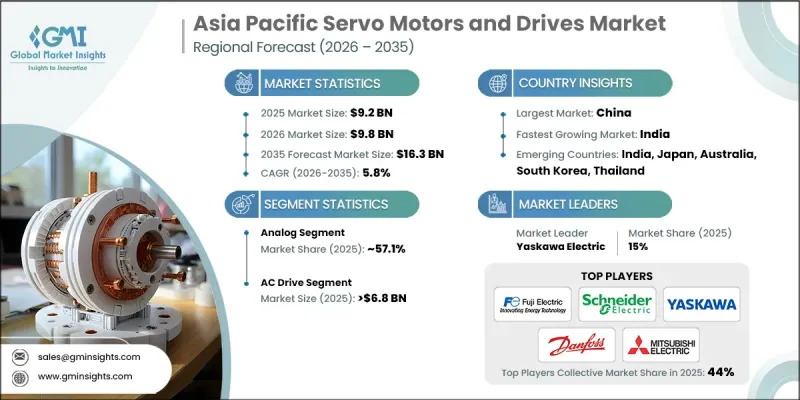
The growth of the market is driven by the rapid expansion of the electronics and semiconductor manufacturing sectors, which require precise, repeatable motion control and robust performance in testing, assembly, and material handling applications. The rising adoption of advanced manufacturing technologies, coupled with the increasing integration of automation and smart systems, further supports the demand for high-performance servo solutions. Industries including automotive, electronics, and general manufacturing are increasingly implementing servo systems to optimize operational efficiency, enhance production flexibility, and improve process control. Additionally, infrastructure development, foreign direct investment, and the ongoing push toward smart factories with digitalized control systems and robotics integration are positively influencing market dynamics. The ability of servo drives to ensure seamless communication between systems aligns with these industrial automation trends, driving widespread adoption across the region.
| Market Scope | |
|---|---|
| Start Year | 2025 |
| Forecast Year | 2026-2035 |
| Start Value | $9.2 Billion |
| Forecast Value | $16.3 Billion |
| CAGR | 5.8% |
The analog segment held a 57.1% share in 2025 and is expected to grow at a CAGR of 5.9% through 2035. Analog drives are valued for their reliable operation in high-load and harsh industrial environments, offering strong response characteristics and lower maintenance requirements. These features make them suitable for cost-sensitive production lines and legacy machinery. As industries expand and automation capabilities advance, analog drives continue to play a critical role in supporting reliable performance without requiring full digital connectivity, while gradually transitioning toward more sophisticated digital servo platforms.
The AC drive segment generated USD 6.8 billion in 2025. Growing demand for precision-based manufacturing environments in sectors such as automotive, electronics, food processing, and machine manufacturing is driving adoption. AC drives enable enhanced speed control, operational stability, and smoother system performance, complementing the shift from conventional motor control methods to advanced servo solutions. This transition toward high-accuracy automation is strengthening industry growth and supporting ongoing technological upgrades in production facilities.
China Servo Motors and Drives Market held a 43.6% share in 2025, generating USD 4 billion. The country's growth is fueled by rapid industrial expansion, adoption of advanced robotics, and the increasing digitalization of manufacturing lines. Government initiatives to improve local manufacturing capabilities, encourage smart facility development, and integrate automation technologies have further promoted market adoption. Emerging industries such as electric vehicles, semiconductor manufacturing, logistics automation, and renewable energy generation are also creating additional demand for high-performance servo motors and drives, strengthening market momentum throughout the region.
Key players operating in the Asia Pacific Servo Motors and Drives Market include Delta Electronics, Yaskawa Electric, Panasonic Industry, ABB, Fuji Electric, Mitsubishi Electric, Rockwell Automation, Schneider Electric, Hitachi Industrial Equipment, Danfoss, KEBA, Suzhou Veichi Electric, Kollmorgen, Sanyo Denki, Applied Motion Products, Festo, Moons, WEG, Xingtai, and Nidec Conversion. Companies in the Asia Pacific Servo Motors and Drives Market are adopting multiple strategies to solidify their market presence. They are investing in R&D to develop high-performance, energy-efficient, and digitally connected servo solutions. Collaborations with robotics and automation technology providers help expand integrated system offerings. Companies focus on diversifying product portfolios to meet the evolving needs of industries such as automotive, electronics, and renewable energy. Expansion of regional manufacturing facilities and after-sales service networks enhances operational reach and customer support. Market players emphasize customization, smart factory integration, and digital monitoring features to differentiate their solutions. Strategic marketing and training programs further increase adoption among industrial clients, strengthening overall market foothold.
Table of Contents
Chapter 1 Methodology & Scope
- 1.1 Research approach
- 1.2 Quality commitment
- 1.2.1 GMI AI policy & data integrity commitment
- 1.2.1.1 Source consistency protocol
- 1.2.1 GMI AI policy & data integrity commitment
- 1.3 Research Trail & Confidence Scoring
- 1.3.1 Research Trail Components
- 1.3.2 Scoring Components
- 1.4 Data Collection
- 1.4.1 Partial list of primary sources
- 1.5 Data mining sources
- 1.5.1 Paid sources
- 1.5.1.1 Sources, by country
- 1.5.1 Paid sources
- 1.6 Base estimates and calculations
- 1.6.1 Base year calculation for any one approach
- 1.7 Forecast model
- 1.8 Research transparency addendum
- 1.8.1 Source attribution framework
- 1.8.2 Quality assurance metrics
- 1.8.3 Our commitment to trust
- 1.9 Market definitions
Chapter 2 Executive Summary
- 2.1 Industry synopsis, 2022 - 2035
- 2.2 Business trends
- 2.3 Category trends
- 2.4 Driver trends
- 2.5 Application trends
- 2.6 Country trends
Chapter 3 Industry Insights
- 3.1 Industry ecosystem analysis
- 3.1.1 Raw material availability & sourcing analysis
- 3.1.2 Key factors affecting the value chain
- 3.1.3 Disruptions
- 3.2 Industry impact forces
- 3.2.1 Growth drivers
- 3.2.2 Industry pitfalls & challenges
- 3.3 Growth potential analysis
- 3.4 Regulatory landscape
- 3.5 Porter's analysis
- 3.5.1 Bargaining power of suppliers
- 3.5.2 Bargaining power of buyers
- 3.5.3 Threat of new entrants
- 3.5.4 Threat of substitutes
- 3.6 PESTEL analysis
- 3.6.1 Political factors
- 3.6.2 Economic factors
- 3.6.3 Social factors
- 3.6.4 Technological factors
- 3.6.5 Legal factors
- 3.6.6 Environmental factors
- 3.7 Price trend analysis, 2022-2035 (USD/Unit)
- 3.7.1 By drive
- 3.7.2 By country
- 3.8 Emerging opportunities & trends
- 3.8.1 Digital transformation with IoT technologies
- 3.8.2 Emerging market penetration
- 3.9 Investment analysis & future outlook
Chapter 4 Competitive Landscape, 2026
- 4.1 Introduction
- 4.2 Company market share analysis, by country, 2025
- 4.2.1 China
- 4.2.2 Japan
- 4.2.3 India
- 4.2.4 Australia
- 4.2.5 South Korea
- 4.2.6 Thailand
- 4.2.7 Malaysia
- 4.2.8 Philippines
- 4.2.9 Indonesia
- 4.3 Competitive positioning matrix
- 4.4 Key developments
- 4.4.1 Mergers & acquisitions
- 4.4.2 Partnerships & collaborations
- 4.4.3 New product launches
- 4.4.4 Expansion plans and funding
Chapter 5 Market Size and Forecast, By Category, 2022 - 2035, (USD Million, Units)
- 5.1 Key trends
- 5.2 Digital
- 5.3 Analog
Chapter 6 Market Size and Forecast, By Drive, 2022 - 2035, (USD Million, Units)
- 6.1 Key trends
- 6.2 AC
- 6.3 DC
Chapter 7 Market Size and Forecast, By Application, 2022 - 2035, (USD Million, Units)
- 7.1 Key trends
- 7.2 Oil & gas
- 7.3 Metal cutting & forming
- 7.4 Material handling equipment
- 7.5 Packaging and labeling machinery
- 7.6 Robotics
- 7.7 Medical robotics
- 7.8 Rubber & plastics machinery
- 7.9 Warehousing
- 7.10 Automation
- 7.11 Extreme environment applications
- 7.12 Semiconductor machinery
- 7.13 AGV
- 7.14 Electronics
- 7.15 Others
Chapter 8 Market Size and Forecast, By Country, 2022 - 2035, (USD Million, Units)
- 8.1 Key trends
- 8.2 China
- 8.3 Japan
- 8.4 India
- 8.5 Australia
- 8.6 South Korea
- 8.7 Thailand
- 8.8 Malaysia
- 8.9 Philippines
- 8.10 Indonesia
Chapter 9 Company Profiles
- 9.1 ABB
- 9.2 Applied Motion Products
- 9.3 Danfoss
- 9.4 Delta Electronics
- 9.5 Festo
- 9.6 Fuji Electric
- 9.7 Hitachi Industrial Equipment
- 9.8 KEBA
- 9.9 Kollmorgen
- 9.10 Mitsubishi Electric
- 9.11 Moons
- 9.12 Nidec Conversion
- 9.13 Panasonic Industry
- 9.14 Rockwell Automation
- 9.15 Sanyo Denki
- 9.16 Schneider Electric
- 9.17 Suzhou Veichi Electric
- 9.18 WEG
- 9.19 Xingtai
- 9.20 Yaskawa Electric

