
PUBLISHER: Global Market Insights Inc. | PRODUCT CODE: 2019060

PUBLISHER: Global Market Insights Inc. | PRODUCT CODE: 2019060
Isobutyric Acid Market Opportunity, Growth Drivers, Industry Trend Analysis, and Forecast 2026 - 2035
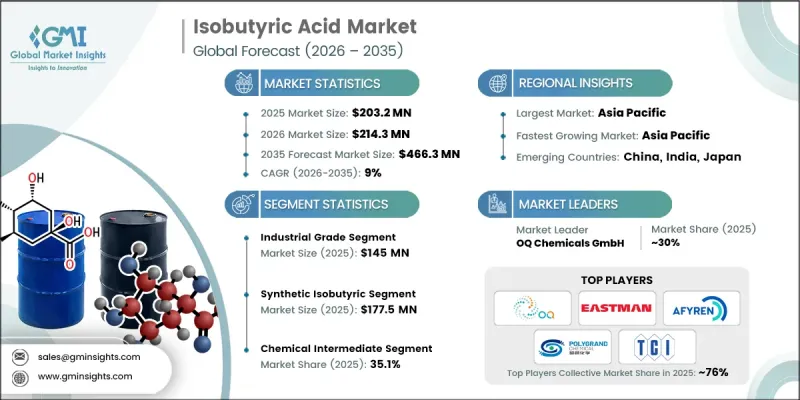
The Global Isobutyric Acid Market was valued at USD 203.2 million in 2025 and is estimated to grow at a CAGR of 9% to reach USD 466.3 million by 2035.
The market is expanding as high-purity isobutyric acid ensures consistent performance across diverse industrial processes, while its compatibility with a wide range of materials makes it an attractive choice for manufacturers seeking reliable chemical solutions. Industrial-scale production and the availability of standard-grade products support broad adoption across chemical, flavor, and rubber additive sectors. Simultaneously, the trend toward sustainable and bio-based chemical production is reshaping market dynamics, encouraging innovations in renewable feedstocks and greener manufacturing methods. Regulatory pressures and consumer preference for environmentally responsible solutions further drive growth. The animal feed industry also plays a critical role, as isobutyric acid enhances gut health and nutrient absorption in livestock, boosting feed efficiency and contributing to the expanding demand from the growing focus on animal health and productivity.
| Market Scope | |
|---|---|
| Start Year | 2025 |
| Forecast Year | 2026-2035 |
| Start Value | $203.2 Million |
| Forecast Value | $466.3 Million |
| CAGR | 9% |
The industrial grade segment reached USD 145 million in 2025 and is expected to grow at a CAGR of 9.5% through 2035. Industrial-grade isobutyric acid is essential for chemical intermediates, rubber additives, flavors, and animal nutrition applications. Manufacturers favor this segment for its cost-effectiveness, consistent supply, and stable quality, making it suitable for large-volume industrial use without the need for ultra-high purity. The segment benefits from its linkage to ester production and continues to gain traction as specialty chemical applications expand, and bio-based production methods are increasingly adopted.
The synthetic isobutyric acid segment was valued at USD 177.5 million in 2025 and is anticipated to grow at a CAGR of 9.2% from 2026 to 2035. Synthetic production, derived primarily from petrochemical methods, remains the mainstay for commercial supply due to its large-scale availability, cost-efficiency, and reliable performance. Industries depend on this segment to produce chemical intermediates, rubber additives, and flavor esters. Continued optimization of manufacturing processes enhances yields, operational efficiency, and overall product consistency, supporting the segment's sustained market relevance.
North America Isobutyric Acid Market accounted for USD 46.2 million in 2025 and is expected to witness robust growth over the forecast period. The region has a well-established chemical production infrastructure, fostering strong demand for isobutyric acid in industrial, flavoring, and pharmaceutical applications. The United States contributes a major share of revenue through specialized chemical, food flavoring, and pharmaceutical production. Market stability is maintained by consistent product quality, regulatory compliance, and efficient supply chain systems. Increasing adoption of bio-based chemicals and sustainability initiatives among industrial buyers is influencing procurement strategies, creating opportunities for eco-friendly isobutyric acid solutions.
Key players operating in the Global Isobutyric Acid Market include AFYREN, Eastman Chemical Company, OQ Chemicals GmbH, Central Drug House, Tokyo Chemical Industry (TCI), Nanjing Chemical Material Corp, Weifang Qiyi Chemical Co., Ltd., Shandong Luoheng Chemical Products Co., Ltd., Haihang Industry (GetChem Co., Ltd.), and others. Companies in the Global Isobutyric Acid Market strengthen their market position through a combination of innovation, sustainable product development, and strategic partnerships. Firms invest in R&D to improve production efficiency, purity, and yield, while also exploring bio-based feedstocks to meet environmental regulations and customer demand for sustainable chemicals. Partnerships with industrial end users ensure reliable supply chains and large-volume contracts. Companies expand geographic reach through mergers, acquisitions, and regional production facilities. Focusing on cost optimization, operational excellence, and eco-friendly production methods enhances competitiveness. Offering tailored solutions for animal feed, chemical intermediates, and flavor applications allows firms to capture diverse market segments and reinforce long-term presence.
Table of Contents
Chapter 1 Methodology
- 1.1 Market scope and definition
- 1.2 Research design
- 1.2.1 Research approach
- 1.2.2 Data collection methods
- 1.3 Data mining sources
- 1.3.1 Global
- 1.3.2 Regional/Country
- 1.4 Base estimates and calculations
- 1.4.1 Base year calculation
- 1.4.2 Key trends for market estimation
- 1.5 Primary research and validation
- 1.5.1 Primary sources
- 1.6 Forecast model
- 1.7 Research assumptions and limitations
Chapter 2 Executive Summary
- 2.1 Industry 360° synopsis
- 2.2 Key market trends
- 2.2.1 Regional
- 2.2.2 Grade
- 2.2.3 Type
- 2.2.4 Distribution Channel
- 2.2.5 End-Use Application
- 2.3 TAM Analysis, 2026-2035
- 2.4 CXO perspectives: Strategic imperatives
Chapter 3 Industry Insights
- 3.1 Industry ecosystem analysis
- 3.1.1 Supplier Landscape
- 3.1.2 Profit Margin
- 3.1.3 Value addition at each stage
- 3.1.4 Factor affecting the value chain
- 3.1.5 Disruptions
- 3.2 Industry impact forces
- 3.2.1 Growth drivers
- 3.2.2 Industry pitfalls and challenges
- 3.2.3 Market opportunities
- 3.3 Growth potential analysis
- 3.4 Regulatory landscape
- 3.4.1 North America
- 3.4.2 Europe
- 3.4.3 Asia Pacific
- 3.4.4 Latin America
- 3.4.5 Middle East & Africa
- 3.5 Porter's analysis
- 3.6 PESTEL analysis
- 3.7 Price trends
- 3.7.1 By region
- 3.7.2 By product
- 3.8 Future market trends
- 3.9 Technology and Innovation landscape
- 3.9.1 Current technological trends
- 3.9.2 Emerging technologies
- 3.10 Patent Landscape
- 3.11 Trade statistics
- 3.11.1 Major importing countries
- 3.11.2 Major exporting countries
- 3.12 Sustainability and Environmental Aspects
- 3.12.1 Sustainable Practices
- 3.12.2 Waste Reduction Strategies
- 3.12.3 Energy Efficiency in Production
- 3.12.4 Eco-friendly Initiatives
- 3.13 Carbon Footprint Considerations
Chapter 4 Competitive Landscape, 2025
- 4.1 Introduction
- 4.2 Company market share analysis
- 4.2.1 By region
- 4.2.1.1 North America
- 4.2.1.2 Europe
- 4.2.1.3 Asia Pacific
- 4.2.1.4 LATAM
- 4.2.1.5 MEA
- 4.2.1 By region
- 4.3 Company matrix analysis
- 4.4 Competitive analysis of major market players
- 4.5 Competitive positioning matrix
- 4.6 Key developments
- 4.6.1 Mergers & acquisitions
- 4.6.2 Partnerships & collaborations
- 4.6.3 New Product Launches
- 4.6.4 Expansion Plans
Chapter 5 Market Estimates and Forecast, By Grade, 2022- 2035 (USD Million, Kilo Tons)
- 5.1 Key trends
- 5.2 Industrial Grade
- 5.2.1 Standard Industrial Grade
- 5.2.2 High-Purity Industrial Grade
- 5.3 Reagent Grade
- 5.3.1 Analytical Reagent (AR) Grade
- 5.3.2 Laboratory Reagent (LR) Grade
Chapter 6 Market Estimates and Forecast, By Type, 2022- 2035 (USD Million, Kilo Tons)
- 6.1 Key trends
- 6.2 Synthetic Isobutyric Acid
- 6.2.1 Propylene-based Synthesis (Oxo Process)
- 6.2.2 Isobutyraldehyde Oxidation
- 6.2.3 Other Synthetic Routes
- 6.3 Renewable Isobutyric Acid
- 6.3.1 Bio-based (Fermentation)
- 6.3.2 Biomass-derived
Chapter 7 Market Estimates and Forecast, By Distribution Channel, 2022 - 2035 (USD Million, Kilo Tons)
- 7.1 Key trends
- 7.2 Direct Sales
- 7.3 Distributors & Traders
- 7.4 Online/E-commerce Platforms
Chapter 8 Market Estimates and Forecast, By End-Use Application, 2022 - 2035 (USD Million, Kilo Tons)
- 8.1 Key trends
- 8.2 Chemical Intermediate
- 8.2.1 Ester Production
- 8.2.2 Plasticizer Intermediates
- 8.2.3 Agrochemical Intermediates
- 8.2.4 Polymer Additives
- 8.3 Food & Flavor
- 8.3.1 Flavor Enhancers
- 8.3.2 Food Preservatives
- 8.3.3 Fragrance Components
- 8.4 Animal Feed
- 8.4.1 Feed Acidifiers
- 8.4.2 Feed Preservatives
- 8.4.3 Growth Promoters
- 8.5 Pharmaceutical
- 8.5.1 Active Pharmaceutical Ingredient (API) Intermediates
- 8.5.2 Excipients & Coatings
- 8.5.3 Drug Delivery Systems
- 8.6 Others
- 8.6.1 Cosmetics & Personal Care
- 8.6.2 Laboratory & Research Use
- 8.6.3 Industrial Cleaning Agents
- 8.6.4 Textile Processing
- 8.6.5 Emerging Applications
Chapter 9 Market Estimates and Forecast, By Region, 2022 - 2035 (USD Million, Kilo Tons)
- 9.1 Key trends
- 9.2 North America
- 9.2.1 U.S.
- 9.2.2 Canada
- 9.3 Europe
- 9.3.1 Germany
- 9.3.2 UK
- 9.3.3 France
- 9.3.4 Italy
- 9.3.5 Spain
- 9.3.6 Rest of Europe
- 9.4 Asia Pacific
- 9.4.1 China
- 9.4.2 India
- 9.4.3 Japan
- 9.4.4 Australia
- 9.4.5 South Korea
- 9.4.6 Rest of Asia Pacific
- 9.5 Latin America
- 9.5.1 Brazil
- 9.5.2 Mexico
- 9.5.3 Argentina
- 9.5.4 Rest of Latin America
- 9.6 Middle East & Africa
- 9.6.1 Saudi Arabia
- 9.6.2 South Africa
- 9.6.3 UAE
- 9.6.4 Rest of Middle East & Africa
Chapter 10 Company Profiles
- 10.1 AFYREN
- 10.2 Eastman Chemical Company
- 10.3 OQ Chemicals GmbH
- 10.4 Central Drug House
- 10.5 Tokyo Chemical Industry (TCI)
- 10.6 Nanjing Chemical Material Corp
- 10.7 Weifang Qiyi Chemical Co., Ltd.
- 10.8 Shandong Luoheng Chemical Products Co., Ltd.
- 10.9 Haihang Industry (GetChem Co., Ltd.)

