PUBLISHER: Global Market Insights Inc. | PRODUCT CODE: 2019063

PUBLISHER: Global Market Insights Inc. | PRODUCT CODE: 2019063
Small Forklift Market Opportunity, Growth Drivers, Industry Trend Analysis, and Forecast 2026 - 2035
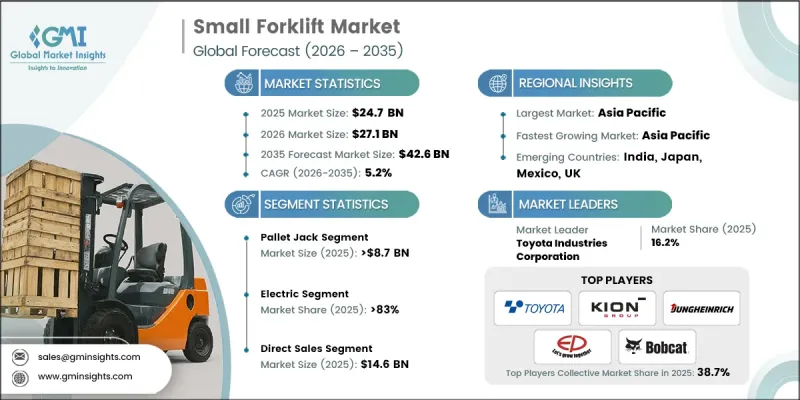
The Global Small Forklift Market was valued at USD 24.7 billion in 2025 and is estimated to grow at a CAGR of 5.2% to reach USD 42.6 billion by 2035.
The global small forklift market is evolving in response to increasing demand for energy-efficient equipment and environmentally responsible operations. Organizations are steadily transitioning toward battery-powered forklifts to reduce emissions and improve workplace conditions, including minimizing operational noise. This shift toward electrification is accelerating the replacement of conventional fuel-based equipment, strengthening overall market growth. At the same time, rising demand for compact and versatile equipment is supporting adoption across logistics and warehousing environments. Continuous innovation in battery technologies and equipment design is enabling improved performance and longer operational cycles. These advancements, combined with favorable regulatory support and the growing emphasis on sustainability, are positioning the small forklift market for sustained growth across multiple industrial sectors.
| Market Scope | |
|---|---|
| Start Year | 2025 |
| Forecast Year | 2026-2035 |
| Start Value | $24.7 Billion |
| Forecast Value | $42.6 Billion |
| CAGR | 5.2% |
The small forklift market is further supported by policy incentives and ongoing technological improvements that encourage the adoption of advanced equipment. Leading manufacturers are focusing on enhancing battery performance, operational efficiency, and user-centric designs to meet evolving industry requirements. In parallel, the expansion of modern distribution networks is increasing the need for compact and highly efficient lifting equipment that can support streamlined operations. These factors, along with continuous innovation and supportive regulatory frameworks, are creating a favorable environment for long-term market development.
In 2025, the pallet jack segment reached USD 8.7 billion, reflecting its strong adoption across material handling operations. These solutions are widely preferred due to their cost efficiency and user-friendly design, which supports improved workplace productivity. Electric variants further enhance operational efficiency by reducing physical strain and enabling smoother handling processes. The pallet stacker segment also represents a significant portion of the small forklift market, offering a balance between mobility and vertical lifting capability. Increasing demand for space optimization and efficient load management is driving the adoption of these solutions across modern facilities.
The electric segment accounted for 83% share in 2025, establishing itself as the dominant power type. The growing preference for electric forklifts is driven by their environmental advantages, reduced maintenance requirements, and suitability for indoor operations. These systems offer quieter performance, lower emissions, and improved operational stability, making them highly suitable for controlled environments. As sustainability becomes a key focus area, industries are increasingly integrating electric forklifts into their operations to align with environmental goals and improve overall efficiency.
United States Small Forklift Market held an 83.9% share in 2025. The country's dominance is supported by rapid expansion in warehousing and distribution infrastructure, along with increasing demand from logistics and retail sectors. High adoption of electric and advanced forklift systems is being driven by sustainability initiatives and investments in automation. Ongoing modernization across key industries is also contributing to consistent replacement cycles and sustained demand. Additionally, strong distribution networks and flexible financing models are improving accessibility, enabling wider adoption of small forklift solutions across businesses of varying sizes.
Key companies operating in the Global Small Forklift Market include Anhui Heli Co., Ltd., BYD Forklift, Crown Equipment Corporation, Doosan Bobcat, EP Equipment, Godrej & Boyce, Hangcha Group Co., Ltd., Hyster-Yale, Inc., Hyundai Material Handling, Jungheinrich AG, KION Group AG, Komatsu, Lonking Machinery, Mitsubishi Logisnext Co., Ltd., and Toyota Industries Corporation. Companies in the Global Small Forklift Market are strengthening their competitive position through innovation, electrification, and strategic expansion initiatives. They are investing in advanced battery technologies, including lithium-ion systems, to improve energy efficiency and extend operating cycles. Product development efforts are focused on enhancing ergonomics, safety features, and automation capabilities to meet evolving user expectations. Strategic partnerships and distribution network expansion are helping companies increase market reach and improve customer access. Additionally, manufacturers are offering flexible financing and leasing options to attract a broader customer base. Integration of smart technologies such as telematics and predictive maintenance solutions is further enabling companies to deliver value-added services, improve operational efficiency, and strengthen long-term customer relationships.
Table of Contents
Chapter 1 Methodology & Scope
- 1.1 Research approach
- 1.2 Quality Commitments
- 1.3 GMI AI policy & data integrity commitment
- 1.3.1 Source consistency protocol
- 1.4 Research Trail & Confidence Scoring
- 1.4.1 Research Trail Components
- 1.4.2 Scoring Components
- 1.5 Data Collection
- 1.5.1 Partial list of primary sources
- 1.6 Data mining sources
- 1.7 Paid sources
- 1.7.1 Sources, by region
- 1.8 Base estimates and calculations
- 1.8.1 Base year calculation for any one approach
- 1.9 Forecast model
- 1.9.1 Quantified market impact analysis
- 1.9.1.1 Mathematical impact of growth parameters on forecast
- 1.9.1 Quantified market impact analysis
- 1.10 Research transparency addendum
- 1.10.1 Source attribution framework
- 1.10.2 Quality assurance metrics
- 1.10.3 Our commitment to trust
Chapter 2 Executive Summary
- 2.1 Industry 360° synopsis
- 2.2 Key market trends
- 2.2.1 Regional
- 2.2.2 Component
- 2.2.3 Solution Type
- 2.2.4 Application
- 2.2.5 End User
Chapter 3 Industry Insights
- 3.1 Industry ecosystem analysis
- 3.1.1 Supplier landscape
- 3.1.2 Profit margin
- 3.1.3 Value addition at each stage
- 3.1.4 Factor affecting the value chain
- 3.2 Industry impact forces
- 3.2.1 Growth drivers
- 3.2.1.1 Technological advancements
- 3.2.1.2 Increasing consumer spending
- 3.2.1.3 Rising disposable income
- 3.2.2 Industry pitfalls & challenges
- 3.2.2.1 High competition and market saturation
- 3.2.2.2 Changing consumer preferences
- 3.2.3 Opportunities
- 3.2.3.1 Rapid growth of hybrid collaboration & smart workspace integrations
- 3.2.3.2 Expansion of digital experience infrastructure across retail, hospitality & public spaces
- 3.2.1 Growth drivers
- 3.3 Growth potential analysis
- 3.4 Future market trends
- 3.5 Component and innovation landscape
- 3.5.1 Current technological trends
- 3.5.2 Emerging technologies
- 3.6 Regulatory landscape
- 3.6.1 Standards and compliance requirements
- 3.6.2 Regional regulatory frameworks
- 3.6.3 Certification standards
- 3.7 Trade data analysis
- 3.7.1 Import/export volume & value trends
- 3.7.2 Key trade corridors & tariff impact
- 3.8 Impact of AI & generative AI on the market
- 3.8.1 AI-driven disruption of existing business models
- 3.8.2 Gen AI use cases & adoption roadmap by segment
- 3.8.3 Risks, limitations & regulatory considerations
- 3.9 Porter's analysis
- 3.10 PESTEL analysis
- 3.11 Consumer behaviour analysis
- 3.11.1 Purchasing patterns
- 3.11.2 Preference analysis
- 3.11.3 Regional variations in consumer behaviour
- 3.11.4 Impact of e-commerce on buying decisions
Chapter 4 Competitive Landscape, 2025
- 4.1 Introduction
- 4.2 Company market share analysis
- 4.2.1 By region
- 4.2.1.1 North America
- 4.2.1.2 Europe
- 4.2.1.3 Asia Pacific
- 4.2.1.4 Latin America
- 4.2.1.5 Middle East and Africa
- 4.2.1 By region
- 4.3 Company matrix analysis
- 4.4 Competitive analysis of major market players
- 4.5 Competitive positioning matrix
- 4.6 Key developments
- 4.6.1 Mergers & acquisitions
- 4.6.2 Partnerships & collaborations
- 4.6.3 New product launches
- 4.6.4 Expansion plans
Chapter 5 Market Estimates & Forecast, By Component, 2022-2035 (USD Billion)
- 5.1 Key trends
- 5.2 Hardware
- 5.2.1 Displays & projectors
- 5.2.2 Audio equipment
- 5.2.3 Video equipment
- 5.2.4 Control panels & interfaces
- 5.2.5 Cabling & connectivity infrastructure
- 5.3 Software
- 5.3.1 Control & management software
- 5.3.2 AV-over-IP platforms
- 5.3.3 Collaboration software
- 5.3.4 Room scheduling & booking software
- 5.3.5 Remote diagnostics & monitoring tools
- 5.4 Services
- 5.4.1 Consulting & design services
- 5.4.2 Installation & deployment services
- 5.4.3 Training & support services
- 5.4.4 Managed services & maintenance
- 5.4.5 System upgrade & migration services
Chapter 6 Market Estimates & Forecast, By Solution Type, 2022-2035 (USD Billion)
- 6.1 Key trends
- 6.2 Unified communications & collaboration (uc)
- 6.2.1 Integrated uc platforms
- 6.2.2 Standalone collaboration tools
- 6.3 Video conferencing solutions
- 6.3.1 Room-based systems
- 6.3.2 Personal video conferencing devices
- 6.3.3 Hybrid meeting solutions
- 6.4 Digital signage
- 6.4.1 Indoor digital signage
- 6.4.2 Outdoor digital signage
- 6.4.3 Interactive digital signage
- 6.5 Presentation systems
- 6.5.1 Projection-based systems
- 6.5.2 Display-based systems
- 6.5.3 Wireless presentation solutions
- 6.6 Control & automation systems
- 6.6.1 Centralized control platforms
- 6.6.2 Touch panel interfaces
- 6.6.3 Room automation solutions
- 6.7 Mass notification & emergency communication
- 6.7.1 Campus-wide notification systems
- 6.7.2 Building emergency alert systems
- 6.7.3 Integrated crisis management platforms
- 6.8 Other
Chapter 7 Market Estimates & Forecast, By Application, 2022-2035 (USD Billion)
- 7.1 Key trends
- 7.2 Corporate
- 7.3 Education
- 7.4 Government & Defense
- 7.5 Healthcare
- 7.6 Retail & Hospitality
- 7.7 Sports & Entertainment
- 7.8 Transportation
- 7.9 Others
Chapter 8 Market Estimates & Forecast, By End User, 2022-2035 (USD Billion)
- 8.1 Key trends
- 8.2 Large Enterprises
- 8.3 Small & Medium Businesses (SMBs)
Chapter 9 Market Estimates & Forecast, By Region, 2022-2035 (USD Billion)
- 9.1 Key trends
- 9.2 North America
- 9.2.1 U.S.
- 9.2.2 Canada
- 9.3 Europe
- 9.3.1 Germany
- 9.3.2 France
- 9.3.3 UK
- 9.3.4 Italy
- 9.3.5 Spain
- 9.4 Asia Pacific
- 9.4.1 China
- 9.4.2 India
- 9.4.3 Japan
- 9.4.4 South Korea
- 9.4.5 Australia
- 9.5 Latin America
- 9.5.1 Brazil
- 9.5.2 Mexico
- 9.5.3 Argentina
- 9.6 MEA
- 9.6.1 South Africa
- 9.6.2 Saudi Arabia
- 9.6.3 UAE
Chapter 10 Company Profiles
- 10.1 Barco
- 10.2 Biamp Systems
- 10.3 Cisco Systems
- 10.4 Crestron Electronics
- 10.5 Extron Electronics
- 10.6 Google
- 10.7 Logitech
- 10.8 Microsoft
- 10.9 Panasonic
- 10.10 Poly
- 10.11 QSC Audio Products
- 10.12 Samsung
- 10.13 Shure Incorporated
- 10.14 Sony Professional Solutions
- 10.15 Zoom Video Communications

