PUBLISHER: Global Market Insights Inc. | PRODUCT CODE: 2019064

PUBLISHER: Global Market Insights Inc. | PRODUCT CODE: 2019064
Automotive Fuel Transfer Pumps Market Opportunity, Growth Drivers, Industry Trend Analysis, and Forecast 2026 - 2035
The Global Automotive Fuel Transfer Pumps Market was valued at USD 18.9 billion in 2025 and is estimated to grow at a CAGR of 6.2% to reach USD 33.9 billion by 2035.
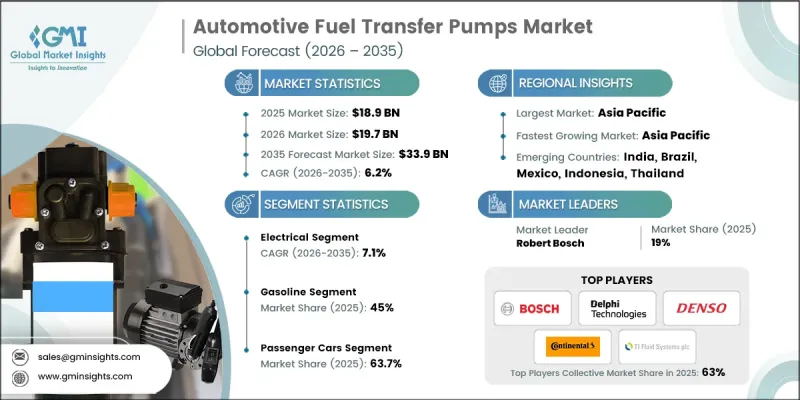
The automotive fuel transfer pumps market is driven by the continued reliance on internal combustion engine vehicles, where efficient fuel delivery systems remain essential. Increasing production of passenger and commercial vehicles is creating sustained demand for fuel transfer pumps across original equipment and replacement channels. The automotive fuel transfer pumps market is also benefiting from the rapid growth of logistics and freight transportation, which is expanding the global fleet of commercial vehicles. These vehicles require durable and efficient fuel systems to support extended operational cycles. As a result, demand for high-performance fuel transfer pumps continues to rise. In addition, manufacturers are focusing on improving system reliability and operational efficiency, which is further supporting the expansion of the automotive fuel transfer pumps market across multiple vehicle categories.
| Market Scope | |
|---|---|
| Start Year | 2025 |
| Forecast Year | 2026-2035 |
| Start Value | $18.9 Billion |
| Forecast Value | $33.9 Billion |
| CAGR | 6.2% |
The automotive fuel transfer pumps market is also influenced by the increasing age of the global vehicle fleet, which is driving demand for replacement components. As vehicles accumulate higher usage over time, the need for maintenance and replacement of essential fuel system parts continues to grow. Exposure to operational stress and prolonged usage contributes to increased wear, further strengthening aftermarket demand. This trend is particularly significant in regions with large vehicle populations, where long-term usage cycles support consistent demand for replacement fuel transfer pumps.
The electric segment accounted for 58% share in 2025 and is expected to grow at a CAGR of 7.1% from 2026 to 2035. This segment is gaining prominence as modern vehicles increasingly incorporate electronic fuel delivery systems that require precise flow control and consistent pressure. The automotive fuel transfer pumps market is benefiting from advancements in electric pump design, including improvements in durability, resistance to wear, and lightweight construction. These developments are supporting compliance with efficiency standards while enhancing overall vehicle performance.
The gasoline segment held a 45% share in 2025 and is projected to grow at a CAGR of 6.1% through 2035. This dominance is supported by the widespread presence of gasoline-powered vehicles, which continue to require reliable fuel delivery systems. The automotive fuel transfer pumps market is sustained by strong production volumes and ongoing replacement demand, ensuring continued growth across both OEM and aftermarket segments.
U.S. Automotive Fuel Transfer Pumps Market reached USD 4.3 billion in 2025. The automotive fuel transfer pumps market in the United States is expanding due to strong demand for vehicles equipped with durable fuel systems and high operational performance. The market is supported by a large vehicle base and extended usage cycles, which contribute to consistent replacement demand. Well-established service networks and a strong aftermarket ecosystem are further driving growth, as maintenance requirements for fuel system components continue to rise over time.
Key players operating in the Global Automotive Fuel Transfer Pumps Market include Robert Bosch, Denso, Continental Automotive, Delphi Technologies, Aisin Seiki, Mitsubishi Electric, TI Fluid Systems, Carter Fuel Systems, and Pierburg (Rheinmetall). Companies in the Global Automotive Fuel Transfer Pumps Market are strengthening their competitive position through continuous innovation and strategic expansion initiatives. Many players are investing in advanced pump technologies to improve efficiency, durability, and performance under demanding conditions. Collaborations with automotive manufacturers are enabling better integration of fuel systems within modern vehicle architectures. Companies are also expanding production capacities to meet rising global demand while optimizing cost structures. In addition, a strong focus on aftermarket services and distribution networks is helping companies capture long-term revenue opportunities.
Table of Contents
Chapter 1 Methodology
- 1.1 Research approach
- 1.2 Quality commitments
- 1.3 GMI AI policy & data integrity commitment
- 1.4 Research trail & confidence scoring
- 1.4.1 Research trail components
- 1.4.2 Scoring components
- 1.5 Data collection
- 1.5.1 Partial list of primary sources
- 1.6 Data mining sources
- 1.6.1 Paid sources
- 1.7 Base estimates and calculations
- 1.7.1 Base year calculation
- 1.8 Forecast model
- 1.9 Research transparency addendum
Chapter 2 Executive Summary
- 2.1 Industry 360° synopsis
- 2.2 Key market trends
- 2.2.1 Regional
- 2.2.2 Type
- 2.2.3 Vehicle
- 2.2.4 Fuel
- 2.2.5 Sales channel
- 2.3 TAM analysis, 2026-2035
- 2.4 CXO perspectives: Strategic imperatives
Chapter 3 Industry Insights
- 3.1 Industry ecosystem analysis
- 3.1.1 Supplier landscape
- 3.1.2 Profit margin
- 3.1.3 Cost structure
- 3.1.4 Value addition at each stage
- 3.1.5 Factor affecting the value chain
- 3.1.6 Disruptions
- 3.2 Industry impact forces
- 3.2.1 Growth drivers
- 3.2.1.1 Rising global vehicle production
- 3.2.1.2 Growing commercial vehicle and logistics fleet
- 3.2.1.3 Expansion of automotive aftermarket demand
- 3.2.1.4 Increasing fuel injection system adoption
- 3.2.2 Industry pitfalls and challenges
- 3.2.2.1 Rapid shift toward electric vehicles
- 3.2.2.2 Fuel price volatility affecting vehicle usage
- 3.2.3 Market opportunities
- 3.2.3.1 Growth in emerging automotive markets
- 3.2.3.2 Development of high-efficiency electric fuel pumps
- 3.2.3.3 Expansion of biofuel and alternative fuel vehicles
- 3.2.3.4 Increasing demand from off-road and industrial vehicles
- 3.2.1 Growth drivers
- 3.3 Growth potential analysis
- 3.4 Regulatory landscape
- 3.4.1 North America
- 3.4.1.1 EPA Fuel System Regulations
- 3.4.1.2 CARB (California Air Resources Board) Standards
- 3.4.2 Europe
- 3.4.2.1 Euro 6 / Euro 7 Emission Standards
- 3.4.2.2 ECE R67 / R110 Fuel System Regulations
- 3.4.3 Asia Pacific
- 3.4.3.1 China VI Emission Standards
- 3.4.3.2 Japan JIS Fuel System Standards / JARI Guidelines
- 3.4.4 Latin America
- 3.4.4.1 Brazil PROCONVE
- 3.4.4.2 ABNT NBR Fuel System Standards
- 3.4.5 Middle East & Africa
- 3.4.5.1 UAE ESMA Fuel System & Emission Standards
- 3.4.5.2 South Africa SABS Fuel System Regulations
- 3.4.1 North America
- 3.5 Porter's analysis
- 3.6 PESTEL analysis
- 3.7 Technology and innovation landscape
- 3.7.1 Current technological trends
- 3.7.2 Emerging technologies
- 3.8 Pricing analysis (Driven by primary research)
- 3.8.1 Historical price trend analysis
- 3.8.2 Pricing strategy by player type (premium / value / cost-plus)
- 3.9 Cost breakdown analysis
- 3.10 Patent analysis (Driven by primary research)
- 3.11 Sustainability and environmental aspects
- 3.11.1 Sustainable practices
- 3.11.2 Waste reduction strategies
- 3.11.3 Energy efficiency in production
- 3.11.4 Eco-friendly initiatives
- 3.11.5 Carbon footprint considerations
- 3.12 Impact of AI & Generative AI on the Market
- 3.12.1 AI-driven disruption of existing business models
- 3.12.2 Gen AI use cases & adoption roadmap by segment
- 3.12.3 Risks, limitations & regulatory considerations
- 3.13 Capacity & production landscape (Driven by primary research)
- 3.13.1 Installed capacity by region & key producer
- 3.13.2 Capacity utilization rates & expansion pipelines
- 3.14 Trade data analysis (Driven by paid database)
- 3.14.1 Import/export volume & value trends
- 3.14.2 Key trade corridors & tariff impact
- 3.15 Forecast assumptions & scenario analysis (Driven by primary research)
- 3.15.1 Base Case - key macro & industry variables driving CAGR
- 3.15.2 Optimistic Scenarios - Favorable macro and industry tailwinds
- 3.15.3 Pessimistic Scenario - Macroeconomic slowdown or industry headwinds
Chapter 4 Competitive Landscape, 2025
- 4.1 Introduction
- 4.2 Company market share analysis
- 4.2.1 North America
- 4.2.2 Europe
- 4.2.3 Asia Pacific
- 4.2.4 LATAM
- 4.2.5 MEA
- 4.3 Competitive analysis of major market players
- 4.4 Competitive positioning matrix
- 4.5 Key developments
- 4.5.1 Mergers & acquisitions
- 4.5.2 Partnerships & collaborations
- 4.5.3 New product launches
- 4.5.4 Expansion plans and funding
Chapter 5 Market Estimates & Forecast, By Type, 2022 - 2035 ($Mn, Million Units)
- 5.1 Key trends
- 5.2 Mechanical
- 5.3 Electrical
Chapter 6 Market Estimates & Forecast, By Fuel, 2022 - 2035 ($Mn)
- 6.1 Key trends
- 6.2 Gasoline
- 6.3 Diesel
- 6.4 Ethanol/Biofuels
- 6.5 LPG/CNG
- 6.6 Other Alternative Fuels
Chapter 7 Market Estimates & Forecast, By Vehicle, 2022 - 2035 ($Mn, Million Units)
- 7.1 Key trends
- 7.2 Passenger car
- 7.2.1 Hatchback
- 7.2.2 Sedan
- 7.2.3 SUV
- 7.3 Commercial vehicle
- 7.3.1 LCV
- 7.3.2 MCV
- 7.3.3 HCV
- 7.4 Two-wheelers
Chapter 8 Market Estimates & Forecast, By Sales channel, 2022 - 2035 ($Mn)
- 8.1 Key trends
- 8.2 OEM (Original Equipment Manufacturer)
- 8.3 Aftermarket
Chapter 9 Market Estimates & Forecast, By Region, 2022 - 2035 ($Mn, Million Units)
- 9.1 Key trends
- 9.2 North America
- 9.2.1 US
- 9.2.2 Canada
- 9.3 Europe
- 9.3.1 Germany
- 9.3.2 UK
- 9.3.3 France
- 9.3.4 Italy
- 9.3.5 Spain
- 9.3.6 Nordics
- 9.3.7 Russia
- 9.3.8 Poland
- 9.3.9 Romania
- 9.4 Asia Pacific
- 9.4.1 China
- 9.4.2 India
- 9.4.3 Japan
- 9.4.4 South Korea
- 9.4.5 ANZ
- 9.4.6 Vietnam
- 9.4.7 Indonesia
- 9.4.8 Thailand
- 9.5 Latin America
- 9.5.1 Brazil
- 9.5.2 Mexico
- 9.5.3 Argentina
- 9.6 MEA
- 9.6.1 South Africa
- 9.6.2 Saudi Arabia
- 9.6.3 UAE
Chapter 10 Company Profiles
- 10.1 Global players
- 10.1.1 Aisin Seiki
- 10.1.2 Continental Automotive
- 10.1.3 Delphi Technologies
- 10.1.4 Denso
- 10.1.5 Hitachi Astemo
- 10.1.6 Magnetti Marelli
- 10.1.7 Mitsubishi Electric
- 10.1.8 Pierburg (Rheinmetall)
- 10.1.9 Robert Bosch
- 10.1.10 TI Fluid Systems
- 10.2 Regional players
- 10.2.1 Airtex Pumps
- 10.2.2 Carter Fuel Systems
- 10.2.3 GMB
- 10.2.4 Spectra Premium
- 10.2.5 Stanadyne
- 10.2.6 UFI Filters
- 10.2.7 Walbro
- 10.3 Emerging players
- 10.3.1 Cummins Fuel Systems
- 10.3.2 Edelbrock
- 10.3.3 Holley Performance Products

