
PUBLISHER: Global Market Insights Inc. | PRODUCT CODE: 2019092

PUBLISHER: Global Market Insights Inc. | PRODUCT CODE: 2019092
Dog Vaccine Market Opportunity, Growth Drivers, Industry Trend Analysis, and Forecast 2026 - 2035
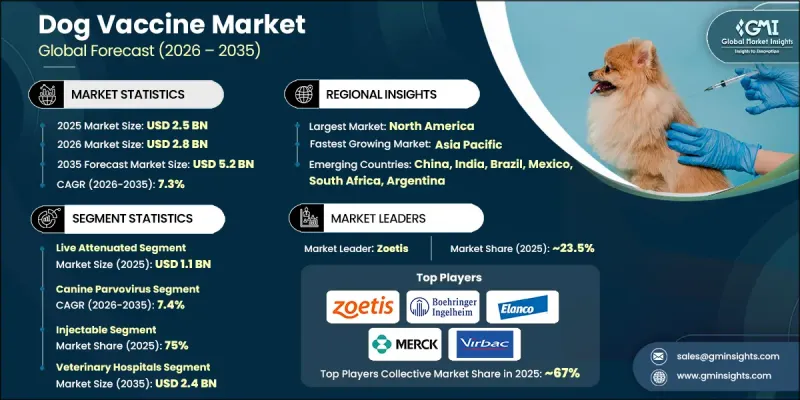
The Global Dog Vaccine Market was valued at USD 2.5 billion in 2025 and is estimated to grow at a CAGR of 7.3% to reach USD 5.2 billion by 2035.
The expansion is fueled by increasing awareness of pet health, rising incidences of canine diseases such as rabies, parvovirus, and distemper, and a growing emphasis on preventive healthcare. As dog ownership rises worldwide, pet owners are prioritizing vaccination programs to protect their animals from life-threatening illnesses. Dog vaccines are biological formulations that stimulate the immune system to recognize and defend against specific pathogens, using antigens that mimic disease agents without causing infection. Government initiatives, including subsidized vaccination campaigns and public health awareness programs, play a crucial role in increasing immunization coverage. These measures not only reduce disease prevalence but also promote healthier pet populations, encouraging regular vaccination schedules and reinforcing the overall importance of canine preventive care.
| Market Scope | |
|---|---|
| Start Year | 2025 |
| Forecast Year | 2026-2035 |
| Start Value | $2.5 Billion |
| Forecast Value | $5.2 Billion |
| CAGR | 7.3% |
The live attenuated segment generated USD 1.1 billion in 2025. Live attenuated vaccines contain weakened pathogens that trigger a strong and long-lasting immune response without causing illness. They are highly effective in inducing both cellular and humoral immunity, providing comprehensive protection against multiple canine diseases. Their requirement for fewer doses enhances convenience for veterinarians and pet owners, which contributes to their widespread adoption as the preferred vaccination option.
The injectable segment accounted for 75% share in 2025. Injectable vaccines are widely preferred due to their ability to deliver precise dosages and generate consistent immune responses. Administered under professional supervision, these vaccines provide reliable protection and have a well-established clinical record in routine veterinary practice. Continuous innovations in injectable vaccine formulations are further driving adoption, making them the cornerstone of canine immunization programs worldwide.
North America Dog Vaccine Market held a 45.7% share in 2025. High pet ownership, strong veterinary healthcare infrastructure, and widespread awareness of preventive care drive this growth. The region's large dog population and substantial spending on veterinary services support regular immunization practices. Moreover, strict vaccination regulations and comprehensive veterinary networks encourage dog owners to adhere to recommended schedules, ensuring protection against diseases like rabies, distemper, and parvovirus. Advanced healthcare services and growing consumer willingness to invest in pet wellbeing reinforce North America's leadership position in the dog vaccine market.
Key players operating in the Global Dog Vaccine Market include Bioveta, Boehringer Ingelheim International, Brilliant Bio Pharma, Biogenesis Bago, Ceva Sante Animale, Elanco Animal Health Incorporated, HIPRA, Indian Immunologicals Limited, Merck & Co., Inc., NEOTECH, Tecnovax, Virbac, Zendal Group, and Zoetis. Companies in the Dog Vaccine Market are implementing diverse strategies to strengthen their market presence and expand their foothold. They are investing heavily in research and development to enhance vaccine efficacy, create novel formulations, and extend protection against emerging canine diseases. Strategic collaborations with veterinary networks, animal healthcare providers, and government initiatives help increase product reach and vaccination coverage. Geographic expansion into high-demand regions ensures access to growing pet populations, while digital platforms and tele-veterinary services improve distribution and awareness. Firms also focus on sustainability by optimizing production processes and packaging solutions. Product diversification, including combination vaccines, booster programs, and temperature-stable formulations, enables companies to meet evolving customer needs, maintain competitive advantage, and reinforce brand loyalty across global markets.
Table of Contents
Chapter 1 Methodology and Scope
- 1.1 Market scope and definition
- 1.2 Research approach
- 1.3 Quality commitments
- 1.3.1 GMI AI policy and data integrity commitment
- 1.3.1.1 Source consistency protocol
- 1.3.1 GMI AI policy and data integrity commitment
- 1.4 Research trail and confidence scoring
- 1.4.1 Research trail components
- 1.4.2 Scoring components
- 1.5 Data collection
- 1.5.1 Partial list of primary sources
- 1.6 Data mining sources
- 1.6.1 Paid sources
- 1.6.1.1 Sources, by region
- 1.6.1 Paid sources
- 1.7 Base estimates and calculations
- 1.7.1 Revenue share analysis
- 1.7.2 Base year calculation
- 1.8 Forecast model
- 1.9 Research transparency addendum
- 1.9.1 Source attribution framework
- 1.9.2 Quality assurance metrics
- 1.9.3 Our commitment to trust
Chapter 2 Executive Summary
- 2.1 Industry 360° synopsis
- 2.2 Key market trends
- 2.2.1 Regional trends
- 2.2.2 Vaccine type trends
- 2.2.3 Disease type trends
- 2.2.4 Route of administration trends
- 2.2.5 End use trends
- 2.3 CXO perspectives: Strategic imperatives
Chapter 3 Industry Insights
- 3.1 Industry ecosystem analysis
- 3.2 Industry impact forces
- 3.2.1 Growth drivers
- 3.2.1.1 Rising dog population and pet ownership
- 3.2.1.2 Growing awareness of preventive veterinary care
- 3.2.1.3 Government regulations and vaccination mandates
- 3.2.1.4 Expansion of veterinary healthcare infrastructure
- 3.2.1.5 Increasing expenditure on pet healthcare
- 3.2.2 Industry pitfalls & challenges
- 3.2.2.1 High cost of veterinary care in some regions
- 3.2.2.2 Cold-chain storage and distribution challenges
- 3.2.3 Market opportunities
- 3.2.3.1 Development of multivalent and combination vaccines
- 3.2.3.2 Expansion of preventive pet healthcare programs
- 3.2.1 Growth drivers
- 3.3 Growth potential analysis
- 3.4 Regulatory landscape (Driven by Primary Research)
- 3.4.1 North America
- 3.4.1.1 U.S.
- 3.4.1.2 Canada
- 3.4.2 Europe
- 3.4.3 Asia Pacific
- 3.4.1 North America
- 3.5 Technology and innovation landscape
- 3.5.1 Current technologies
- 3.5.2 Emerging technologies (Driven by Primary Research)
- 3.6 Clinical trial/pipeline analysis (Driven by Primary Research)
- 3.7 Patent analysis (Driven by Primary Research)
- 3.8 Dog population stats, by country
- 3.9 Future market trends
- 3.10 Impact of AI and generative AI on the market
- 3.11 Porter's analysis
- 3.12 PESTEL analysis
Chapter 4 Competitive Landscape, 2025
- 4.1 Introduction
- 4.2 Company market share analysis
- 4.3 Company matrix analysis
- 4.4 Competitive analysis of major market players
- 4.5 Competitive positioning matrix
- 4.6 Key developments
- 4.6.1 Merger and acquisition
- 4.6.2 Partnership and collaboration
- 4.6.3 New product launches
- 4.6.4 Expansion plans
Chapter 5 Market Estimates and Forecast, By Vaccine Type, 2022 - 2035 ($ Mn)
- 5.1 Key trends
- 5.2 Live attenuated
- 5.3 Inactivated
- 5.4 Recombinant
- 5.5 Other vaccine types
Chapter 6 Market Estimates and Forecast, By Disease Type, 2022 - 2035 ($ Mn)
- 6.1 Key trends
- 6.2 Canine distemper
- 6.3 Canine infectious respiratory disease complex (CIRDC)
- 6.4 Canine parvovirus
- 6.5 Canine leptospirosis
- 6.6 Canine lyme disease
- 6.7 Infectious canine hepatitis
- 6.8 Canine rabies
- 6.9 Other disease types
Chapter 7 Market Estimates and Forecast, By Route of Administration, 2022 - 2035 ($ Mn)
- 7.1 Key trends
- 7.2 Intranasal
- 7.3 Injectable
- 7.4 Oral
Chapter 8 Market Estimates and Forecast, By End Use, 2022 - 2035 ($ Mn)
- 8.1 Key trends
- 8.2 Veterinary hospitals
- 8.3 Veterinary clinics
- 8.4 Research institutes
Chapter 9 Market Estimates and Forecast, By Region, 2022 - 2035 ($ Mn)
- 9.1 Key trends
- 9.2 North America
- 9.2.1 U.S.
- 9.2.2 Canada
- 9.3 Europe
- 9.3.1 Germany
- 9.3.2 UK
- 9.3.3 France
- 9.3.4 Spain
- 9.3.5 Italy
- 9.3.6 Netherlands
- 9.4 Asia Pacific
- 9.4.1 Japan
- 9.4.2 China
- 9.4.3 India
- 9.4.4 Australia
- 9.4.5 South Korea
- 9.5 Latin America
- 9.5.1 Brazil
- 9.5.2 Mexico
- 9.5.3 Argentina
- 9.6 Middle East and Africa
- 9.6.1 Saudi Arabia
- 9.6.2 South Africa
- 9.6.3 UAE
Chapter 10 Company Profiles
- 10.1 Bioveta
- 10.2 Boehringer Ingelheim International
- 10.3 Brilliant Bio Pharma
- 10.4 Biogenesis Bago
- 10.5 Ceva Sante Animale
- 10.6 Elanco Animal Health Incorporated
- 10.7 HIPRA
- 10.8 Indian Immunologicals Limited
- 10.9 Merck & Co., Inc.
- 10.10 NEOTECH
- 10.11 Tecnovax
- 10.12 Virbac
- 10.13 Zendal Group
- 10.14 Zoetis

