
PUBLISHER: Global Market Insights Inc. | PRODUCT CODE: 2019145

PUBLISHER: Global Market Insights Inc. | PRODUCT CODE: 2019145
Animal Vaccines Market Opportunity, Growth Drivers, Industry Trend Analysis, and Forecast 2026 - 2035
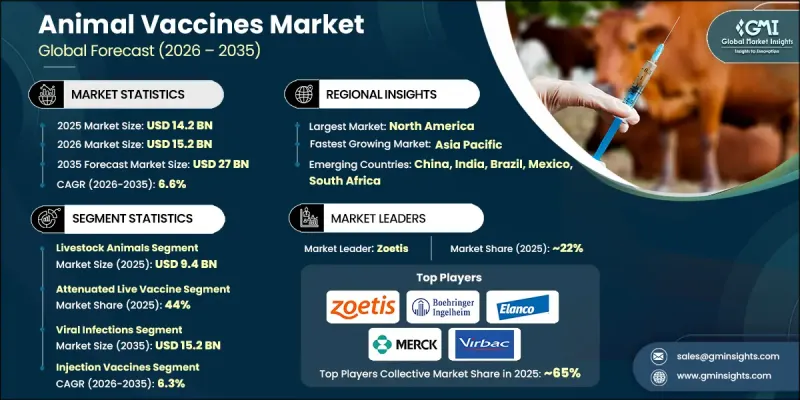
The Global Animal Vaccines Market was valued at USD 14.2 billion in 2025 and is estimated to grow at a CAGR of 6.6% to reach USD 27 billion by 2035.
The market is expanding due to rising global animal populations, growing demand for animal protein, increased adoption of pets, and higher veterinary care expenditure. The increasing prevalence of infectious diseases in livestock and companion animals, along with heightened concerns over zoonotic diseases and outbreak risks, has driven vaccine adoption. Governments and regulatory authorities worldwide are implementing stricter animal health policies and vaccination programs to safeguard public health and minimize economic losses in the livestock sector. Technological advancements in veterinary medicine, including improved vaccine formulations and delivery systems, further strengthen the market. Rising awareness of food security and disease prevention among farmers and pet owners has also created a sustained demand for effective animal immunization solutions, making vaccines a critical component of animal health management globally.
| Market Scope | |
|---|---|
| Start Year | 2025 |
| Forecast Year | 2026-2035 |
| Start Value | $14.2 Billion |
| Forecast Value | $27 Billion |
| CAGR | 6.6% |
The livestock animals segment generated USD 9.4 billion in 2025. The livestock segment, encompassing cattle, poultry, swine, aquaculture, and sheep and goats, is a key driver due to its economic significance in global food production. Vaccination in this sector prevents outbreaks of infectious diseases that could severely impact meat, dairy, and egg production. High private and government investments in livestock immunization programs fuel the demand for vaccines, ensuring both animal welfare and economic stability. Effective vaccination protocols help farmers manage disease outbreaks efficiently, reducing losses and supporting sustainable livestock farming practices.
The viral infections segment accounted for 55.3% share in 2025 and is expected to reach USD 15.2 billion by 2035. Viral infections remain a major concern for both livestock and companion animals, as diseases can cause significant economic and health burdens. The high prevalence of contagious viral conditions drives demand for targeted vaccines that prevent widespread outbreaks. Animal health professionals increasingly rely on viral vaccines as essential tools to protect animal populations, enhance productivity, and maintain food safety standards.
North America Animal Vaccines Market held a 41.7% share in 2025 and is anticipated to grow at a 6.3% CAGR during 2026-2035. The region's leadership is driven by advanced veterinary healthcare infrastructure, high animal healthcare spending, and extensive livestock production. Strong disease prevention programs, a large animal population, and government-backed monitoring initiatives further strengthen North America's position. The U.S. contributes significantly to regional growth due to robust vaccination adoption, veterinary expertise, and investments by major animal health companies in research, development, and distribution networks.
Key players in the Global Animal Vaccines Market include Boehringer Ingelheim International, Zoetis, Vetoquinol, Indian Immunologicals, Hipra Animal Health Limited, Dechra Pharmaceuticals, Merck Animal Health, Ceva Sante Animale, Elanco Animal Health, Neogen Corporation, Virbac, Brilliant Bio Pharma, Bioveta, and Henry Schein Animal Health (Covetrus, Inc.). Companies in the Global Animal Vaccines Market focus on expanding their presence by investing heavily in research and development to create innovative and highly effective vaccines. Strategic collaborations with veterinary clinics, distributors, and government programs help extend their market reach. Businesses leverage advanced manufacturing technologies to improve vaccine efficacy, reduce costs, and enhance delivery systems. Targeting emerging markets with rising livestock production and pet ownership ensures sustained growth. Marketing initiatives emphasize disease prevention, animal welfare, and economic benefits, building trust among farmers and pet owners. Participation in international trade shows, certification programs, and partnerships with animal health associations also strengthens brand recognition and competitive positioning globally.
Table of Contents
Chapter 1 Methodology and Scope
- 1.1 Market scope and definition
- 1.2 Research approach
- 1.3 Quality commitments
- 1.3.1 GMI AI policy and data integrity commitment
- 1.3.1.1 Source consistency protocol
- 1.3.1 GMI AI policy and data integrity commitment
- 1.4 Research trail and confidence scoring
- 1.4.1 Research trail components
- 1.4.2 Scoring components
- 1.5 Data collection
- 1.5.1 Partial list of primary sources
- 1.6 Data mining sources
- 1.6.1 Paid sources
- 1.6.1.1 Sources, by region
- 1.6.1 Paid sources
- 1.7 Base estimates and calculations
- 1.7.1 Revenue share analysis
- 1.7.2 Base year calculation
- 1.8 Forecast model
- 1.9 Research transparency addendum
- 1.9.1 Source attribution framework
- 1.9.2 Quality assurance metrics
- 1.9.3 Our commitment to trust
Chapter 2 Executive Summary
- 2.1 Industry 360° synopsis
- 2.2 Key market trends
- 2.2.1 Regional trends
- 2.2.2 Animal type trends
- 2.2.3 Vaccine type trends
- 2.2.4 Application trends
- 2.2.5 Route of administration trends
- 2.2.6 Distribution channel trends
- 2.3 CXO perspectives: Strategic imperatives
Chapter 3 Industry Insights
- 3.1 Industry ecosystem analysis
- 3.2 Industry impact forces
- 3.2.1 Growth drivers
- 3.2.1.1 Rising incidence of zoonotic diseases
- 3.2.1.2 Expanding livestock industry and food security concerns
- 3.2.1.3 Increasing pet adoption and expenditure on animal health
- 3.2.1.4 Advancements in vaccine technology
- 3.2.1.5 Increasing outbreaks of animal diseases
- 3.2.2 Industry pitfalls and challenges
- 3.2.2.1 High development costs
- 3.2.2.2 Stringent regulatory requirements
- 3.2.3 Market opportunities
- 3.2.3.1 Expansion of veterinary healthcare infrastructure in emerging markets
- 3.2.3.2 Increasing adoption of preventive veterinary care
- 3.2.1 Growth drivers
- 3.3 Growth potential analysis
- 3.4 Regulatory landscape (Driven by Primary Research)
- 3.4.1 North America
- 3.4.1.1 U.S.
- 3.4.1.2 Canada
- 3.4.2 Europe
- 3.4.3 Asia Pacific
- 3.4.1 North America
- 3.5 Technology and innovation landscape
- 3.5.1 Current technologies
- 3.5.2 Emerging technologies and their impact
- 3.6 Clinical trial/pipeline analysis (Driven by Primary Research)
- 3.7 Patent analysis (Driven by Primary Research)
- 3.8 Impact of AI on the market
- 3.9 Porter's analysis
- 3.10 PESTEL analysis
Chapter 4 Competitive Landscape, 2025
- 4.1 Introduction
- 4.2 Company market share analysis
- 4.2.1 North America
- 4.2.2 Europe
- 4.2.3 Asia Pacific
- 4.3 Company matrix analysis
- 4.4 Competitive analysis of major market players
- 4.5 Competitive positioning matrix
- 4.6 Key developments
- 4.6.1 Merger and acquisition
- 4.6.2 Partnership and collaboration
- 4.6.3 New product launches
- 4.6.4 Expansion plans
Chapter 5 Market Estimates and Forecast, By Animal Type, 2022 - 2035 ($ Mn)
- 5.1 Key trends
- 5.2 Livestock animals
- 5.2.1 Poultry
- 5.2.2 Cattle
- 5.2.3 Swine
- 5.2.4 Aquaculture
- 5.2.5 Sheep and goats
- 5.3 Companion animals
- 5.3.1 Canine
- 5.3.2 Feline
- 5.3.3 Equine
- 5.3.4 Avian
Chapter 6 Market Estimates and Forecast, By Vaccine Type, 2022 - 2035 ($ Mn)
- 6.1 Key trends
- 6.2 Attenuated live vaccine
- 6.3 Conjugate vaccine
- 6.4 Inactivated vaccine
- 6.5 DNA vaccine
- 6.6 Recombinant vaccine
- 6.7 Other vaccine types
Chapter 7 Market Estimates and Forecast, By Application, 2022 - 2035 ($ Mn)
- 7.1 Key trends
- 7.2 Bacterial infections
- 7.3 Viral infections
- 7.4 Parasitic infections
- 7.5 Fungal infections
- 7.6 Other applications
Chapter 8 Market Estimates and Forecast, By Route of Administration, 2022 - 2035 ($ Mn)
- 8.1 Key trends
- 8.2 Injection vaccines
- 8.3 Oral vaccines
- 8.4 Immersion/spray vaccines
Chapter 9 Market Estimates and Forecast, By Distribution Channel, 2022 - 2035 ($ Mn)
- 9.1 Key trends
- 9.2 Veterinary hospital pharmacies
- 9.3 Retail pharmacies
- 9.4 E-commerce
Chapter 10 Market Estimates and Forecast, By Region, 2022 - 2035 ($ Mn)
- 10.1 Key trends
- 10.2 North America
- 10.2.1 U.S.
- 10.2.2 Canada
- 10.3 Europe
- 10.3.1 Germany
- 10.3.2 UK
- 10.3.3 France
- 10.3.4 Spain
- 10.3.5 Italy
- 10.3.6 Netherlands
- 10.4 Asia Pacific
- 10.4.1 China
- 10.4.2 Japan
- 10.4.3 India
- 10.4.4 Australia
- 10.4.5 South Korea
- 10.5 Latin America
- 10.5.1 Brazil
- 10.5.2 Mexico
- 10.5.3 Argentina
- 10.6 Middle East and Africa
- 10.6.1 South Africa
- 10.6.2 Saudi Arabia
- 10.6.3 UAE
Chapter 11 Company Profiles
- 11.1 Boehringer Ingelheim International
- 11.2 Brilliant Bio Pharma
- 11.3 Bioveta
- 11.4 Ceva Sante Animale
- 11.5 Dechra Pharmaceuticals
- 11.6 Elanco Animal Health
- 11.7 Henry Schein Animal Health (Covetrus, Inc.)
- 11.8 Hipra Animal Health Limited
- 11.9 Indian Immunologicals
- 11.10 Merck Animal Health
- 11.11 Neogen Corporation
- 11.12 Vetoquinol
- 11.13 Virbac
- 11.14 Zoetis

