PUBLISHER: Global Market Insights Inc. | PRODUCT CODE: 2019103

PUBLISHER: Global Market Insights Inc. | PRODUCT CODE: 2019103
Salicylic Acid Market Opportunity, Growth Drivers, Industry Trend Analysis, and Forecast 2026 - 2035
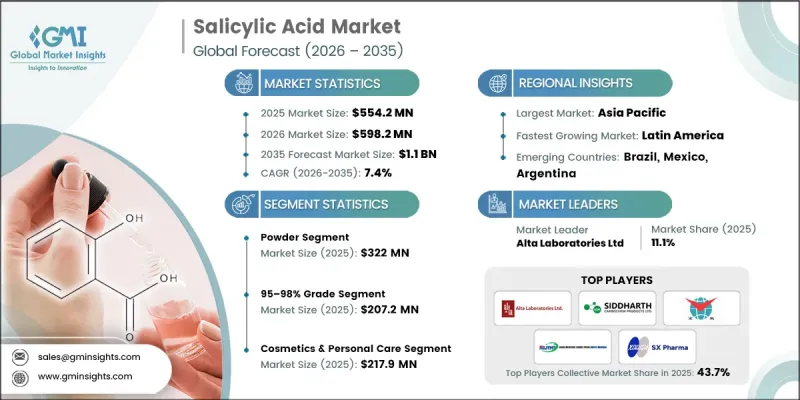
The Global Salicylic Acid Market was valued at USD 554.2 million in 2025 and is estimated to grow at a CAGR of 7.4% to reach USD 1.1 billion by 2035.
Salicylic acid is a versatile organic compound recognized for its keratolytic properties, anti-inflammatory effects, and antimicrobial activity. It is available naturally from plant sources or produced synthetically for industrial applications. The compound serves as a key chemical intermediate in the manufacture of pharmaceuticals, cosmetics, and specialty chemical products. Its chemical structure allows it to function in multiple processes, from exfoliation in personal care formulations to the creation of esters, preservatives, and fragrances. Manufacturers rely on salicylic acid to enhance product stability and performance while improving the overall effectiveness of formulations. Market growth is fueled by increasing consumer interest in skincare routines, pharmaceutical applications, and food and agricultural products. Rising awareness of ingredient composition, along with demand for high-quality, effective products, continues to drive adoption across various industries.
| Market Scope | |
|---|---|
| Start Year | 2025 |
| Forecast Year | 2026-2035 |
| Start Value | $554.2 Million |
| Forecast Value | $1.1 Billion |
| CAGR | 7.4% |
The powdered salicylic acid segment accounted for USD 322 million in 2025, holding the largest market share by form. Its solid state provides excellent stability, extended shelf life, and adaptability across multiple manufacturing methods, including tablets, topical powders, and high-purity cosmetic blends. The powder form supports accurate dosage and formulation consistency, making it critical for pharmaceutical-grade products and expanding its usage in new and traditional applications.
The cosmetics and personal care segment captured USD 217.9 million in 2025. The sector drives demand through daily and specialized skincare formulations designed for exfoliation, blemish control, and skin texture improvement. Pharmaceutical applications benefit from the keratolytic and functional properties of salicylic acid, supporting over-the-counter treatments and dermatological products. Agricultural uses are growing as well, where the compound helps improve plant health, resilience, and crop yield performance. The food and specialty chemical sectors also contribute to consistent demand growth.
North America Salicylic Acid Market reached USD 139.6 million in 2025. Demand is sustained across skincare products, over-the-counter dermatology solutions, and pharmaceutical intermediates. U.S. consumers drive demand for acne treatment cleansers, leave-on exfoliants, medicated patches, and dandruff control products. Companies focus on creating formulations suitable for all skin types, offering fragrance-free options and transparent ingredient labeling to meet consumer expectations for safety and effectiveness.
Key players operating in the Global Salicylic Acid Market include Dhairya International, Alta Laboratories, Spectrum Chemical, Shandong Longxin Chemical, Merck, Vizag Chemical, Siddharth Carbochem Products, Seqens, Hebei Jingye Medical, and Zhenjiang Gaopeng Pharmaceutical. Companies in the Global Salicylic Acid Market are employing multiple strategies to strengthen their foothold. They focus on expanding manufacturing capacity and enhancing production efficiency to meet growing global demand. Strategic collaborations with cosmetic, pharmaceutical, and agricultural manufacturers help secure long-term supply contracts. R&D investments enable the development of high-purity grades and innovative formulations tailored to specific applications. Firms prioritize regulatory compliance, quality assurance, and sustainability initiatives to enhance brand credibility. Expanding distribution networks, optimizing logistics, and offering technical support for product usage reinforce market presence. Additionally, targeted marketing and product differentiation strategies help companies capture emerging segments and maintain competitiveness in regional and global markets.
Table of Contents
Chapter 1 Methodology & Scope
- 1.1 Market scope and definition
- 1.2 Research design
- 1.2.1 Research approach
- 1.2.2 Data collection methods
- 1.3 Data mining sources
- 1.3.1 Global
- 1.3.2 Regional/Country
- 1.4 Base estimates and calculations
- 1.4.1 Base year calculation
- 1.4.2 Key trends for market estimation
- 1.5 Primary research and validation
- 1.5.1 Primary sources
- 1.6 Forecast model
- 1.7 Research assumptions and limitations
Chapter 2 Executive Summary
- 2.1 Industry 360° synopsis
- 2.2 Key market trends
- 2.2.1 Form
- 2.2.2 End Use Industry
- 2.2.3 Regional
- 2.3 TAM Analysis, 2026-2035
- 2.4 CXO perspectives: Strategic imperatives
- 2.5 Future outlook and strategic recommendations
Chapter 3 Industry Insights
- 3.1 Industry ecosystem analysis
- 3.1.1 Supplier landscape
- 3.1.2 Profit margin
- 3.1.3 Value addition at each stage
- 3.1.4 Factor affecting the value chain
- 3.1.5 Disruptions
- 3.2 Industry impact forces
- 3.2.1 Growth drivers
- 3.2.1.1 Rising skincare awareness supports consistent salicylic acid consumption.
- 3.2.1.2 Expanding pharmaceutical applications create broader industry product demand.
- 3.2.1.3 Preference for multifunctional ingredients boosts salicylic acid usage.
- 3.2.2 Industry pitfalls and challenges
- 3.2.2.1 Raw material fluctuations impact production stability and pricing.
- 3.2.2.2 Strict regulatory requirements increase compliance cost for manufacturers
- 3.2.3 Market opportunities
- 3.2.3.1 Growing natural skincare trends encourage innovative formulation development.
- 3.2.3.2 Advancements in green synthesis enhance sustainable production potential.
- 3.2.3.3 Emerging markets show increasing interest in affordable skincare solutions
- 3.2.1 Growth drivers
- 3.3 Growth potential analysis
- 3.4 Regulatory landscape
- 3.4.1 North America
- 3.4.2 Europe
- 3.4.3 Asia Pacific
- 3.4.4 Latin America
- 3.4.5 Middle East & Africa
- 3.5 Porter's analysis
- 3.6 PESTEL analysis
- 3.7 Technology and innovation landscape
- 3.7.1 Current technological trends
- 3.7.2 Emerging technologies
- 3.8 Price trends
- 3.8.1 By region
- 3.8.2 By form
- 3.9 Future market trends
- 3.10 Patent landscape
- 3.11 Trade statistics (HS code)
- 3.11.1 Major importing countries
- 3.11.2 Major exporting countries
- 3.12 Sustainability and environmental aspects
- 3.12.1 Sustainable practices
- 3.12.2 Waste reduction strategies
- 3.12.3 Energy efficiency in production
- 3.12.4 Eco-friendly initiatives
- 3.13 Carbon footprint consideration
Chapter 4 Competitive Landscape, 2025
- 4.1 Introduction
- 4.2 Company market share analysis
- 4.2.1 By region
- 4.2.1.1 North America
- 4.2.1.2 Europe
- 4.2.1.3 Asia Pacific
- 4.2.1.4 LATAM
- 4.2.1.5 MEA
- 4.2.1 By region
- 4.3 Company matrix analysis
- 4.4 Competitive analysis of major market players
- 4.5 Competitive positioning matrix
- 4.6 Key developments
- 4.6.1 Mergers & acquisitions
- 4.6.2 Partnerships & collaborations
- 4.6.3 New product launches
- 4.6.4 Expansion plans
Chapter 5 Market Estimates and Forecast, By Form, 2022-2035 (USD Million) (Kilo Tons)
- 5.1 Key trends
- 5.2 Liquid
- 5.3 Powder
Chapter 6 Market Estimates and Forecast, By Purity, 2022-2035 (USD Million) (Kilo Tons)
- 6.1 Key trends
- 6.2 99.5% Grade
- 6.3 99.0% Grade
- 6.4 98-99% Grade
- 6.5 95-98% Grade
Chapter 7 Market Estimates and Forecast, By End Use Industry, 2022-2035 (USD Million) (Kilo Tons)
- 7.1 Key trends
- 7.2 Cosmetics & personal care
- 7.3 Pharmaceuticals
- 7.4 Agriculture
- 7.5 Food & beverage
- 7.6 Others
Chapter 8 Market Estimates and Forecast, By Region, 2022-2035 (USD Million) (Kilo Tons)
- 8.1 Key trends
- 8.2 North America
- 8.2.1 U.S.
- 8.2.2 Canada
- 8.3 Europe
- 8.3.1 Germany
- 8.3.2 UK
- 8.3.3 France
- 8.3.4 Spain
- 8.3.5 Italy
- 8.3.6 Rest of Europe
- 8.4 Asia Pacific
- 8.4.1 China
- 8.4.2 India
- 8.4.3 Japan
- 8.4.4 Australia
- 8.4.5 South Korea
- 8.4.6 Rest of Asia Pacific
- 8.5 Latin America
- 8.5.1 Brazil
- 8.5.2 Mexico
- 8.5.3 Argentina
- 8.5.4 Rest of Latin America
- 8.6 Middle East and Africa
- 8.6.1 Saudi Arabia
- 8.6.2 South Africa
- 8.6.3 UAE
- 8.6.4 Rest of Middle East and Africa
Chapter 9 Company Profiles
- 9.1 Alta Laboratories
- 9.2 Dhairya International
- 9.3 Hebei Jingye Medical
- 9.4 Merck
- 9.5 Seqens
- 9.6 Shandong Longxin Chemical
- 9.7 Siddharth Carbochem Products
- 9.8 Spectrum Chemical
- 9.9 Vizag Chemical
- 9.10 Zhenjiang Gaopeng Pharmaceutical

