PUBLISHER: Global Market Insights Inc. | PRODUCT CODE: 2019104

PUBLISHER: Global Market Insights Inc. | PRODUCT CODE: 2019104
Massive MIMO Market Opportunity, Growth Drivers, Industry Trend Analysis, and Forecast 2026 - 2035
The Global Massive MIMO Market was valued at USD 6.3 billion in 2025 and is estimated to grow at a CAGR of 39.3% to reach USD 166.2 billion by 2035.
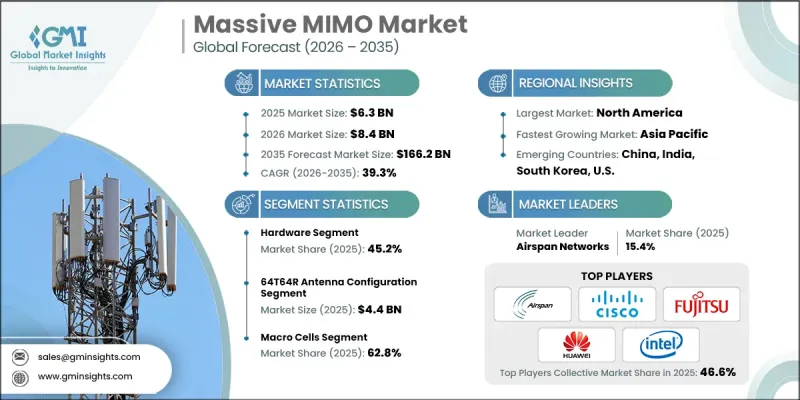
The massive MIMO market is experiencing accelerated growth due to the widespread rollout of next-generation wireless communication infrastructure and the increasing demand for high-capacity, low-latency connectivity. Rapid progress in standalone 5G architecture is significantly influencing adoption, as network operators require advanced radio technologies to meet evolving performance expectations. Rising network densification, particularly in high-traffic urban environments, is further driving the need for efficient spectrum utilization and enhanced signal performance. At the same time, expanding broadband connectivity initiatives in underserved regions are contributing to the broader deployment of massive MIMO systems. The growing use of frequency division duplex technologies in existing spectrum bands is supporting smoother integration with legacy networks. Additionally, increasing emphasis on reducing energy consumption and leveraging artificial intelligence for network optimization is encouraging innovation across the massive MIMO industry. Continuous advancements in antenna technologies and infrastructure capabilities are enabling service providers to deliver consistent and high-speed connectivity across diverse deployment scenarios.
| Market Scope | |
|---|---|
| Start Year | 2025 |
| Forecast Year | 2026-2035 |
| Start Value | $6.3 Billion |
| Forecast Value | $166.2 Billion |
| CAGR | 39.3% |
Growth across the massive MIMO market is strongly influenced by the rapid deployment of advanced wireless network infrastructure, which requires highly efficient and scalable radio access solutions. Increasing focus on enabling ultra-reliable communication and improved network management capabilities is encouraging the adoption of sophisticated antenna systems. Government-led initiatives aimed at expanding next-generation connectivity are also playing a crucial role in strengthening the market landscape. The rising allocation and utilization of mid-band spectrum frequencies are further supporting large-scale deployments, as these bands offer an effective balance between coverage range and network capacity. As a result, operators are increasingly investing in infrastructure that can efficiently handle rising data traffic while maintaining consistent performance levels.
The hardware segment held 45.2% share in 2025, reflecting its critical role in building and maintaining communication networks. Hardware components form the backbone of these systems, enabling wide-area coverage and supporting high data throughput. Advanced antenna arrays and radio frequency components are essential for delivering efficient beamforming and signal management capabilities. These systems are designed to operate effectively across diverse environments, ensuring reliable connectivity in both densely populated regions and remote locations. Ongoing improvements in hardware design are also contributing to better performance, scalability, and energy efficiency.
The 32T32R segment is expected to grow at a CAGR of 37.6% during 2026-2035, driven by its suitability for deployments that require balanced performance and cost efficiency. This configuration is gaining traction in environments where moderate capacity and coverage are sufficient to meet operational requirements. Its relatively lower power consumption and ease of integration make it an attractive option for a wide range of network applications. Additionally, its flexibility in deployment supports diverse use cases, enabling operators to optimize network performance while managing infrastructure costs effectively.
North America Massive MIMO Market accounted for 31.2% share in 2025, driven by strong regulatory support and continuous investments in advanced communication infrastructure. The region benefits from proactive spectrum management policies that facilitate the deployment of high-capacity wireless networks. Expanding availability of mid-band spectrum is enabling operators to enhance network performance and meet increasing data demands. Regulatory frameworks are also supporting efficient spectrum utilization, encouraging innovation and adoption of advanced technologies. As a result, the region continues to maintain a strong position in the global massive MIMO market, supported by ongoing advancements in network infrastructure and technology adoption.
Key companies operating in the Global Massive MIMO Market include Airspan Networks, Airtel, Altiostar Networks, Inc., Analog Devices, Inc., Cisco Systems, Inc., Comba Telecom, Ericsson, Fujitsu Limited, Huawei Technologies Co., Ltd., Intel Corporation, Keysight Technologies, Marvell Technology Group Ltd., Mavenir Systems, Inc., NEC Corporation, Nokia Corporation, Qualcomm Technologies, Inc., Rakuten Mobile, Inc., Samsung Electronics Co., Ltd., Spirent Communications, Texas Instruments Incorporated, T-Mobile, Verizon Communications Inc., VIAVI Solutions Inc., and ZTE Corporation. Companies in the Massive MIMO Market are strengthening their market position through continuous investment in research and development, focusing on improving antenna efficiency, signal processing, and energy optimization. Strategic partnerships with telecom operators and infrastructure providers are enabling faster deployment and broader market reach. Many players are prioritizing the integration of artificial intelligence and automation to enhance network performance and reduce operational costs. Expanding product portfolios with scalable and flexible solutions is also a key approach to address diverse deployment needs.
Table of Contents
Chapter 1 Methodology and Scope
- 1.1 Market scope and definition
- 1.2 Research design
- 1.2.1 Research approach
- 1.2.2 Data collection methods
- 1.3 Data mining sources
- 1.3.1 Global
- 1.3.2 Regional/Country
- 1.4 Base estimates and calculations
- 1.4.1 Base year calculation
- 1.4.2 Key trends for market estimation
- 1.5 Primary research and validation
- 1.5.1 Primary sources
- 1.6 Forecast model
- 1.7 Research assumptions and limitations
Chapter 2 Executive Summary
- 2.1 Industry 360° synopsis, 2022 - 2035
- 2.2 Key market trends
- 2.2.1 Component type trends
- 2.2.2 Antenna configuration trends
- 2.2.3 Cell type trends
- 2.2.4 Network architecture trends
- 2.2.5 Technology generation trends
- 2.2.6 End-user trends
- 2.2.7 Regional trends
- 2.3 TAM Analysis, 2026-2035
- 2.4 CXO perspectives: Strategic imperatives
Chapter 3 Industry Insights
- 3.1 Industry ecosystem analysis
- 3.1.1 Supplier Landscape
- 3.1.2 Profit Margin
- 3.1.3 Cost structure
- 3.1.4 Value addition at each stage
- 3.1.5 Factor affecting the value chain
- 3.1.6 Disruptions
- 3.2 Industry impact forces
- 3.2.1 Growth drivers
- 3.2.1.1 Accelerated global 5G standalone network deployments
- 3.2.1.2 Mid-band spectrum adoption (3.3-4.9 GHz) growth
- 3.2.1.3 Network densification in urban high-capacity zones
- 3.2.1.4 Mobile data traffic CAGR exceedingly globally
- 3.2.1.5 Increasing FDD Massive MIMO adoption in legacy bands
- 3.2.2 Industry pitfalls and challenges
- 3.2.2.1 High power consumption of active antenna units
- 3.2.2.2 Complex beamforming calibration in dense deployments
- 3.2.3 Market opportunities
- 3.2.3.1 Open RAN integration with Massive MIMO radios
- 3.2.3.2 AI-driven beam management and energy optimization
- 3.2.1 Growth drivers
- 3.3 Growth potential analysis
- 3.4 Regulatory landscape
- 3.4.1 North America
- 3.4.2 Europe
- 3.4.3 Asia Pacific
- 3.4.4 Latin America
- 3.4.5 Middle East & Africa
- 3.5 Porter's analysis
- 3.6 PESTEL analysis
- 3.7 Technology and Innovation landscape
- 3.7.1 Current technological trends
- 3.7.2 Emerging technologies
- 3.8 Price trends
- 3.8.1 By region
- 3.8.2 By product
- 3.9 Pricing Strategies
- 3.10 Emerging Business Models
- 3.11 Compliance Requirements
- 3.12 Patent and IP analysis
Chapter 4 Competitive Landscape, 2025
- 4.1 Introduction
- 4.2 Company market share analysis
- 4.2.1 By region
- 4.2.1.1 North America
- 4.2.1.2 Europe
- 4.2.1.3 Asia Pacific
- 4.2.1.4 Latin America
- 4.2.1.5 Middle East & Africa
- 4.2.2 Market concentration analysis
- 4.2.1 By region
- 4.3 Competitive benchmarking of key players
- 4.3.1 Financial performance comparison
- 4.3.1.1 Revenue
- 4.3.1.2 Profit margin
- 4.3.1.3 R&D
- 4.3.2 Product portfolio comparison
- 4.3.2.1 Product range breadth
- 4.3.2.2 Technology
- 4.3.2.3 Innovation
- 4.3.3 Geographic presence comparison
- 4.3.3.1 Global footprint analysis
- 4.3.3.2 Service network coverage
- 4.3.3.3 Market penetration by region
- 4.3.4 Competitive positioning matrix
- 4.3.4.1 Leaders
- 4.3.4.2 Challengers
- 4.3.4.3 Followers
- 4.3.4.4 Niche players
- 4.3.5 Strategic outlook matrix
- 4.3.1 Financial performance comparison
- 4.4 Key developments
- 4.4.1 Mergers and acquisitions
- 4.4.2 Partnerships and collaborations
- 4.4.3 Technological advancements
- 4.4.4 Expansion and investment strategies
- 4.4.5 Digital transformation initiatives
- 4.5 Emerging/ startup competitors landscape
Chapter 5 Market Estimates and Forecast, By Component Type, 2022 - 2035 (USD Million)
- 5.1 Key trends
- 5.2 Hardware
- 5.3 RAN software & intelligence
- 5.4 Deployment & managed services
Chapter 6 Market Estimates and Forecast, By Antenna Configuration, 2022 - 2035 (USD Million)
- 6.1 Key trends
- 6.2 32T32R
- 6.3 64T64R
Chapter 7 Market Estimates and Forecast, By Cell Type, 2022 - 2035 (USD Million)
- 7.1 Key trends
- 7.2 Macro cells
- 7.3 Small cells
Chapter 8 Market Estimates and Forecast, By Network Architecture, 2022 - 2035 (USD Million)
- 8.1 Key trends
- 8.2 Traditional RAN
- 8.3 Open RAN
Chapter 9 Market Estimates and Forecast, By Technology Generation, 2022 - 2035 (USD Million)
- 9.1 Key trends
- 9.2 5G NR
- 9.3 4G LTE
Chapter 10 Market Estimates and Forecast, By End-User, 2022 - 2035 (USD Million)
- 10.1 Key trends
- 10.2 Telecom operators
- 10.3 Private networks
- 10.4 Neutral hosts
Chapter 11 Market Estimates and Forecast, By Region, 2022 - 2035 (USD Million)
- 11.1 Key trends
- 11.2 North America
- 11.2.1 U.S.
- 11.2.2 Canada
- 11.3 Europe
- 11.3.1 Germany
- 11.3.2 UK
- 11.3.3 France
- 11.3.4 Spain
- 11.3.5 Italy
- 11.3.6 Netherlands
- 11.4 Asia Pacific
- 11.4.1 China
- 11.4.2 India
- 11.4.3 Japan
- 11.4.4 Australia
- 11.4.5 South Korea
- 11.5 Latin America
- 11.5.1 Brazil
- 11.5.2 Mexico
- 11.5.3 Argentina
- 11.6 Middle East and Africa
- 11.6.1 South Africa
- 11.6.2 Saudi Arabia
- 11.6.3 UAE
Chapter 12 Company Profiles
- 12.1 Global Key Players
- 12.1.1 Ericsson
- 12.1.2 Huawei Technologies Co., Ltd.
- 12.1.3 Nokia Corporation
- 12.1.4 Qualcomm Technologies, Inc.
- 12.1.5 Samsung Electronics Co., Ltd.
- 12.2 Regional key players
- 12.2.1 North America
- 12.2.1.1 Cisco Systems, Inc.
- 12.2.1.2 Intel Corporation
- 12.2.1.3 T-Mobile
- 12.2.1.4 Verizon Communications Inc.
- 12.2.1.5 Keysight Technologies
- 12.2.1.6 Texas Instruments Incorporated
- 12.2.2 Asia Pacific
- 12.2.2.1 Airspan Networks
- 12.2.2.2 Airtel
- 12.2.2.3 Altiostar Networks, Inc.
- 12.2.2.4 Comba Telecom
- 12.2.2.5 Rakuten Mobile, Inc.
- 12.2.3 Europe
- 12.2.3.1 Fujitsu Limited
- 12.2.3.2 NEC Corporation
- 12.2.3.3 Spirent Communications
- 12.2.3.4 Marvell Technology Group Ltd.
- 12.2.3.5 VIAVI Solutions Inc.
- 12.2.1 North America
- 12.3 Niche Players/Disruptors
- 12.3.1 Analog Devices, Inc.
- 12.3.2 Mavenir Systems, Inc.
- 12.3.3 ZTE Corporation

