PUBLISHER: Global Market Insights Inc. | PRODUCT CODE: 2019108

PUBLISHER: Global Market Insights Inc. | PRODUCT CODE: 2019108
Scrambled Egg Mix Market Opportunity, Growth Drivers, Industry Trend Analysis, and Forecast 2026 - 2035
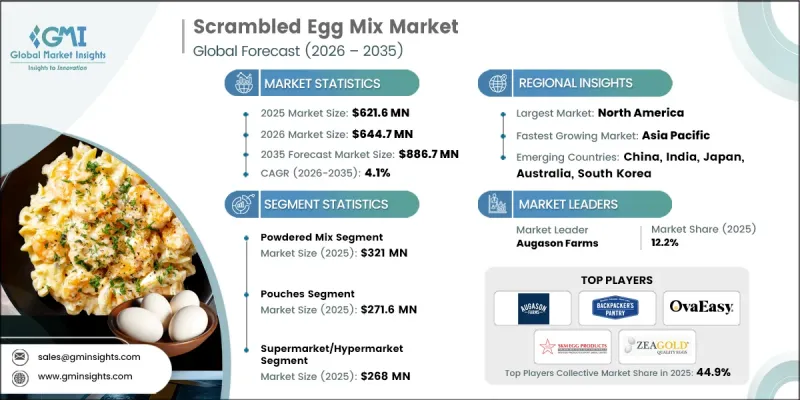
The Global Scrambled Egg Mix Market was valued at USD 621.6 million in 2025 and is estimated to grow at a CAGR of 4.1% to reach USD 886.7 million by 2035.
The industry continues to evolve as consumers increasingly prioritize convenience-oriented food solutions that reduce preparation time while maintaining consistent taste and quality. Scrambled egg mix products are formulated using whole eggs and egg derivatives blended with functional ingredients that help preserve flavor, texture, and shelf stability over extended periods. These products are available in liquid, frozen, and powdered formats, allowing flexibility across different storage and preparation conditions. Demand is being driven by shifting lifestyles, rising urban populations, and the growing preference for ready-to-cook meal options that align with time-constrained routines. In addition, advancements in food processing technologies have significantly enhanced product quality, enabling manufacturers to retain nutritional value while improving shelf life. Improved preservation techniques and efficient distribution systems are further strengthening supply chains, ensuring product availability across diverse end-use environments. The market is also benefiting from consistent demand across commercial and institutional food operations that require standardized meal preparation and portion control.
| Market Scope | |
|---|---|
| Start Year | 2025 |
| Forecast Year | 2026-2035 |
| Start Value | $621.6 Million |
| Forecast Value | $886.7 Million |
| CAGR | 4.1% |
The powdered segment accounted for USD 321 million in 2025 and continues to demonstrate steady demand due to its extended shelf life, ease of transportation, and compatibility with non-refrigerated storage systems. Its dry format supports efficient logistics and simplifies inventory management, making it highly suitable for large-scale food programs. The segment remains relevant for applications that require reliable performance under varying storage conditions while maintaining consistent product quality. Ongoing improvements in dehydration and processing techniques are enhancing the overall usability and functional properties of powdered mixes.
The pouches segment generated USD 271.6 million in 2025 owing to its lightweight structure, user-friendly design, and space-efficient storage capabilities. Packaging innovations are enabling improved convenience for both retail and foodservice operations, supporting easier handling and transportation. At the same time, alternative packaging formats continue to hold importance in applications that require structured storage and controlled dispensing systems. Manufacturers are focusing on packaging advancements that improve durability, extend shelf life, and enhance overall product accessibility across distribution channels.
North America Scrambled Egg Mix Market was valued at USD 210 million in 2025 and is projected to reach USD 303.7 million by 2035, reflecting steady growth over the forecast period. The region continues to generate consistent demand due to the widespread adoption of convenient meal solutions across foodservice providers, institutional kitchens, and household consumers. Strong consumption patterns are supported by well-established distribution networks and a high level of product awareness. The market benefits from continuous usage across commercial food operations, which rely on efficient preparation methods and consistent product quality to meet operational requirements.
Key players operating in the Global Scrambled Egg Mix Market include Augason Farms, Backpacker's Pantry, GCF Corporation, Lodewijckx NV/SA, National Food Group, Nutriom OvaEasy, Saratoga Farms, Sonstegard Foods Company, SKM Egg, and Zeagold Quality Eggs. Companies operating in the global scrambled egg mix market are strengthening their market position through a combination of product innovation, supply chain optimization, and packaging advancements. Manufacturers are investing in advanced processing technologies to improve product consistency, nutritional retention, and shelf stability. Strategic focus on developing versatile product formats allows companies to cater to diverse consumer and institutional requirements. Firms are also enhancing distribution capabilities to expand their reach across both developed and emerging markets. In addition, partnerships with foodservice operators and bulk buyers are helping secure long-term demand. Emphasis on sustainable packaging and efficient logistics is further supporting operational efficiency and brand differentiation in a competitive market landscape.
Table of Contents
Chapter 1 Methodology & Scope
- 1.1 Market scope and definition
- 1.2 Research design
- 1.2.1 Research approach
- 1.2.2 Data collection methods
- 1.3 Data mining sources
- 1.3.1 Global
- 1.3.2 Regional/Country
- 1.4 Base estimates and calculations
- 1.4.1 Base year calculation
- 1.4.2 Key trends for market estimation
- 1.5 Primary research and validation
- 1.5.1 Primary sources
- 1.6 Forecast model
- 1.7 Research assumptions and limitations
Chapter 2 Executive Summary
- 2.1 Industry 360° synopsis
- 2.2 Key market trends
- 2.2.1 Product Type
- 2.2.2 Packaging Type
- 2.2.3 Distribution Channel
- 2.2.4 Regional
- 2.3 TAM Analysis, 2026-2035
- 2.4 CXO perspectives: Strategic imperatives
- 2.5 Future outlook and strategic recommendations
Chapter 3 Industry Insights
- 3.1 Industry ecosystem analysis
- 3.1.1 Supplier landscape
- 3.1.2 Profit margin
- 3.1.3 Value addition at each stage
- 3.1.4 Factor affecting the value chain
- 3.1.5 Disruptions
- 3.2 Industry impact forces
- 3.2.1 Growth drivers
- 3.2.1.1 Increasing demand for affordable staple foods drives market expansion
- 3.2.1.2 Growth in food service and quick-service restaurants boosts bulk consumption
- 3.2.1.3 Rising urban populations support higher packaged food sales
- 3.2.2 Pitfalls/challenge
- 3.2.2.1 Volatile wheat prices pressure manufacturer margins
- 3.2.2.2 Supply chain disruptions affect raw material stability
- 3.2.3 Opportunities
- 3.2.3.1 Long shelf life supports large-scale distribution and exports
- 3.2.3.2 Regional flavor customization can expand consumer base
- 3.2.1 Growth drivers
- 3.3 Growth potential analysis
- 3.4 Regulatory landscape
- 3.4.1 North America
- 3.4.2 Europe
- 3.4.3 Asia Pacific
- 3.4.4 Latin America
- 3.4.5 Middle East & Africa
- 3.5 Porter's analysis
- 3.6 PESTEL analysis
- 3.7 Technology and innovation landscape
- 3.7.1 Current technological trends
- 3.7.2 Emerging technologies
- 3.8 Price trends
- 3.8.1 By region
- 3.8.2 By product type
- 3.9 Future market trends
- 3.10 Technology and innovation landscape
- 3.10.1 Current technological trends
- 3.10.2 Emerging technologies
- 3.11 Patent landscape
- 3.12 Trade statistics (HS code)
- 3.12.1 Major importing countries
- 3.12.2 Major exporting countries
- 3.13 Sustainability and environmental aspects
- 3.13.1 Sustainable practices
- 3.13.2 Waste reduction strategies
- 3.13.3 Energy efficiency in production
- 3.13.4 Eco-friendly initiatives
- 3.14 Carbon footprint consideration
Chapter 4 Competitive Landscape, 2025
- 4.1 Introduction
- 4.2 Company market share analysis
- 4.2.1 By region
- 4.2.1.1 North America
- 4.2.1.2 Europe
- 4.2.1.3 Asia Pacific
- 4.2.1.4 LATAM
- 4.2.1.5 MEA
- 4.2.1 By region
- 4.3 Company matrix analysis
- 4.4 Competitive analysis of major market players
- 4.5 Competitive positioning matrix
- 4.6 Key developments
- 4.6.1 Mergers & acquisitions
- 4.6.2 Partnerships & collaborations
- 4.6.3 New product launches
- 4.6.4 Expansion plans
Chapter 5 Market Estimates and Forecast, By Product Type, 2022-2035 (USD Million) (Kilo Tons)
- 5.1 Key trends
- 5.2 Powdered mix
- 5.3 Liquid mix
- 5.4 Frozen mix
Chapter 6 Market Estimates and Forecast, By Packaging Type, 2022-2035 (USD Million) (Kilo Tons)
- 6.1 Key trends
- 6.2 Pouches
- 6.3 Cartons
- 6.4 Cans
- 6.5 Other (Blister Packs, Tubs)
Chapter 7 Market Estimates and Forecast, By Distribution Channel, 2022-2035 (USD Million) (Kilo Tons)
- 7.1 Key trends
- 7.2 Online Retail
- 7.3 Supermarket/Hypermarket
- 7.4 Grocery Store
- 7.5 Other
Chapter 8 Market Estimates and Forecast, By Region, 2022-2035 (USD Million) (Kilo Tons)
- 8.1 Key trends
- 8.2 North America
- 8.2.1 U.S.
- 8.2.2 Canada
- 8.3 Europe
- 8.3.1 Germany
- 8.3.2 UK
- 8.3.3 France
- 8.3.4 Spain
- 8.3.5 Italy
- 8.3.6 Rest of Europe
- 8.4 Asia Pacific
- 8.4.1 China
- 8.4.2 India
- 8.4.3 Japan
- 8.4.4 Australia
- 8.4.5 South Korea
- 8.4.6 Rest of Asia Pacific
- 8.5 Latin America
- 8.5.1 Brazil
- 8.5.2 Mexico
- 8.5.3 Argentina
- 8.5.4 Rest of Latin America
- 8.6 Middle East and Africa
- 8.6.1 Saudi Arabia
- 8.6.2 South Africa
- 8.6.3 UAE
- 8.6.4 Rest of Middle East and Africa
Chapter 9 Company Profiles
- 9.1 Augason Farms
- 9.2 Backpacker's Pantry
- 9.3 GCF Corporation
- 9.4 Lodewijckx NV/SA
- 9.5 National Food Group
- 9.6 Nutriom OvaEasy
- 9.7 Saratoga Farms
- 9.8 Sonstegard Foods Company
- 9.9 SKM egg
- 9.10 Zeagold Quality Eggs

