PUBLISHER: Global Market Insights Inc. | PRODUCT CODE: 2019115

PUBLISHER: Global Market Insights Inc. | PRODUCT CODE: 2019115
e-Corner System Market Opportunity, Growth Drivers, Industry Trend Analysis, and Forecast 2026 - 2035
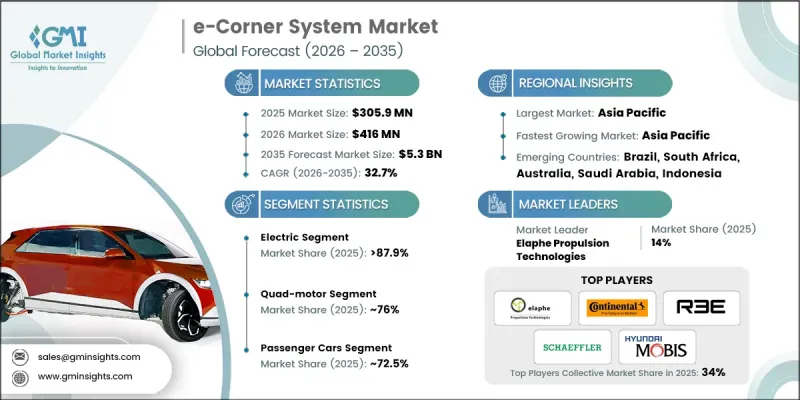
The Global e-Corner System Market was valued at USD 305.9 million in 2025 and is estimated to grow at a CAGR of 32.7% to reach USD 5.3 billion by 2035.
The e-Corner system industry is experiencing rapid growth, largely driven by the accelerating adoption of electric vehicles worldwide. These systems are particularly suited for modern EV architectures, as they integrate propulsion, braking, steering, and suspension into compact wheel modules. This integration enables automakers to improve vehicle efficiency, reduce mechanical complexity, and maximize interior and structural space. At the same time, increasing demand for enhanced vehicle maneuverability is supporting market expansion. Advanced e-Corner technologies enable precise control of vehicle movement, including multi-directional driving capabilities, which improve navigation in constrained environments. Rising urbanization and increasing traffic congestion are further strengthening the demand for highly agile vehicles that can operate efficiently in dense city conditions. As mobility trends evolve, the e-Corner system market is emerging as a key enabler of next-generation vehicle design, offering improvements in safety, operational flexibility, and overall driving performance.
| Market Scope | |
|---|---|
| Start Year | 2025 |
| Forecast Year | 2026-2035 |
| Start Value | $305.9 Million |
| Forecast Value | $5.3 Billion |
| CAGR | 32.7% |
The electric segment held an 87.9% share in 2025 and is projected to reach USD 4.8 billion by 2035. The transition toward electric mobility, supported by global emission reduction goals, is significantly contributing to segment growth. E-Corner systems play a crucial role in enhancing propulsion control, handling precision, and overall vehicle performance in electric vehicles. Increasing adoption of battery electric vehicles is further driving demand, as automakers seek advanced solutions to improve efficiency and meet regulatory standards.
The quad-motor segment held a 76% share in 2025. These configurations enable precise torque control at each wheel, resulting in improved handling, stability, and power distribution. Enhanced torque vectoring capabilities allow vehicles to adapt effectively to varying road conditions, improving traction and driving performance. This level of control is particularly valuable for applications requiring high stability and responsiveness, supporting broader adoption of e-Corner technologies.
Asia Pacific e-Corner System Market held a 38.2% share in 2025, with China maintaining a dominant position within the region. Rapid urban development and increasing demand for highly maneuverable vehicles are driving growth across key markets. Independent wheel control offered by e-Corner systems enables advanced movement capabilities, enhancing mobility in congested environments. Strong growth in electric vehicle production, supported by favorable policies and increasing technological adoption, is further accelerating the integration of e-Corner systems across passenger and emerging mobility platforms.
Key companies operating in the Global e-Corner System Market include Continental, Hyundai, ZF Friedrichshafen, Schaeffler, REE Automotive, Protean Electric, Elaphe Propulsion Technologies, BorgWarner Drive Systems, and Dana. Companies in the e-Corner System Market are strengthening their market presence through continuous innovation and strategic collaboration. They are investing heavily in research and development to enhance system integration, improve efficiency, and optimize vehicle performance. Strategic partnerships with automakers and technology providers are enabling faster deployment and commercialization of advanced solutions. Firms are also focusing on developing scalable and modular architectures to support a wide range of vehicle platforms. In addition, companies are expanding production capabilities and improving supply chain efficiency to meet rising demand. Emphasis on advanced software integration, precision control systems, and energy-efficient designs is helping companies maintain a competitive edge in the evolving mobility landscape.
Table of Contents
Chapter 1 Methodology & Scope
- 1.1 Research design
- 1.2 Research approach
- 1.2.1 Quality Commitments
- 1.3 GMI AI policy & data integrity commitment
- 1.3.1 Research Trail & Confidence Scoring
- 1.3.2 Research Trail Components
- 1.4 Scoring Components
- 1.4.1 Data Collection
- 1.5 Partial list of primary sources
- 1.5.1 Data mining sources
- 1.6 Paid sources
- 1.6.1 Base estimates and calculations
- 1.7 Base year calculation for any one approach
- 1.8 Forecast model
- 1.9 Research transparency addendum
Chapter 2 Executive Summary
- 2.1 Industry 360° synopsis, 2022 - 2035
- 2.2 Key market trends
- 2.2.1 Motor Configuration
- 2.2.2 Vehicle
- 2.2.3 Propulsion
- 2.2.4 Technology
- 2.2.5 Vehicle Configuration
- 2.3 TAM Analysis, 2026-2035
- 2.4 CXO perspectives: Strategic imperatives
Chapter 3 Industry Insights
- 3.1 Industry ecosystem analysis
- 3.1.1 Supplier landscape
- 3.1.2 Profit margin
- 3.1.3 Cost structure
- 3.1.4 Value addition at each stage
- 3.1.5 Factor affecting the value chain
- 3.1.6 Disruptions
- 3.2 Industry impact forces
- 3.2.1 Growth drivers
- 3.2.1.1 Growing demand for enhanced vehicle maneuverability and advanced parking solutions
- 3.2.1.2 Rising adoption of autonomous and electric vehicles integrating steer-by-wire and brake-by-wire technologies
- 3.2.1.3 Increasing focus on vehicle safety, stability, and dynamic control
- 3.2.1.4 Advancements in in-wheel motor technology and modular e-corner architectures
- 3.2.2 Industry pitfalls and challenges
- 3.2.2.1 High development and integration costs
- 3.2.2.2 Regulatory and standardization challenges
- 3.2.3 Market opportunities
- 3.2.3.1 Expansion of Electric Vehicle (EV) Adoption Worldwide
- 3.2.3.2 Growing Demand for Autonomous and Smart Mobility Solutions
- 3.2.3.3 Increasing Integration of In-Wheel Motor and Modular Chassis Technologies
- 3.2.3.4 Rising Investments in Advanced Urban Mobility and Commercial EV Platforms
- 3.2.1 Growth drivers
- 3.3 Regulatory landscape
- 3.3.1 North America
- 3.3.1.1 United States: Federal Motor Vehicle Safety Standards (FMVSS)
- 3.3.1.2 Canada: Canadian Motor Vehicle Safety Standards (CMVSS)
- 3.3.2 Europe
- 3.3.2.1 Germany: UNECE Vehicle Regulations / EU Whole Vehicle Type Approval (WVTA)
- 3.3.2.2 France: EU Whole Vehicle Type Approval (WVTA) / UNECE Vehicle Regulations
- 3.3.2.3 United Kingdom: UK Whole Vehicle Type Approval (UKWVTA)
- 3.3.3 Asia Pacific
- 3.3.3.1 China: GB Automotive Safety Standards (Guobiao Standards)
- 3.3.3.2 India: Central Motor Vehicle Rules (CMVR) / Automotive Industry Standards (AIS)
- 3.3.3.3 Japan: Road Vehicle Safety Standards (MLIT)
- 3.3.4 Latin America
- 3.3.4.1 Brazil: CONTRAN Vehicle Safety Regulations
- 3.3.5 MEA
- 3.3.5.1 South Africa: National Road Traffic Act / South African National Standards (SANS)
- 3.3.1 North America
- 3.4 Porter's analysis
- 3.5 PESTEL analysis
- 3.6 Technology and innovation landscape
- 3.6.1 Current technological trends
- 3.6.2 Emerging technologies
- 3.7 Pricing Analysis (Driven by Primary Research)
- 3.7.1 Historical Price Trend Analysis
- 3.7.2 Pricing Strategy by Player Type
- 3.8 Trade statistics (Driven by Paid Database)
- 3.8.1 Production hubs
- 3.8.2 Consumption hubs
- 3.8.3 Export and import
- 3.9 Cost breakdown analysis
- 3.10 Patent analysis (Driven by Primary Research)
- 3.11 Sustainability and environmental aspects
- 3.11.1 Sustainable practices
- 3.11.2 Waste reduction strategies
- 3.11.3 Energy efficiency in production
- 3.11.4 Eco-friendly initiatives
- 3.11.5 Carbon footprint considerations
- 3.12 Risk & Resilience Analysis
- 3.12.1 Technology Risk Assessment
- 3.12.2 Operational Risk Management
- 3.12.3 Security Risk Framework
- 3.13 Case Studies
- 3.14 Impact of AI & generative AI on the market
- 3.14.1 AI-driven disruption of existing business models
- 3.14.2 Automated System Design & Workflow Optimization
- 3.14.3 Automated System Design & Layout Optimization
- 3.14.3.1 GenAI Use Cases & Adoption Roadmap
- 3.14.3.2 Automated System Configuration & Optimization
- 3.14.3.3 Real-Time Monitoring & Virtual Assistance
- 3.14.3.4 Predictive Maintenance & Performance Reporting
- 3.14.4 Risks, limitations & regulatory considerations
- 3.15 Forecast assumptions & scenario analysis (Driven by Primary Research)
- 3.15.1 Base Case- Key Macro & Industry Variables Driving CAGR
- 3.15.2 Optimistic Scenarios- Favourable macro and industry tailwinds
- 3.15.3 Pessimistic Scenario - Macroeconomic slowdown or industry headwinds
Chapter 4 Competitive Landscape, 2025
- 4.1 Introduction
- 4.2 Company market share analysis
- 4.2.1 North America
- 4.2.2 Europe
- 4.2.3 Asia-Pacific
- 4.2.4 Latin America
- 4.2.5 Middle East & Africa
- 4.3 Competitive analysis of major market players
- 4.4 Competitive positioning matrix
- 4.5 Company Tier Benchmarking
- 4.5.1 Tier Classification Criteria & Qualifying Thresholds
- 4.5.2 Tier Positioning Matrix by Revenue, Geography & Innovation
- 4.6 Key developments
- 4.6.1 Mergers & acquisitions
- 4.6.2 Partnerships & collaborations
- 4.6.3 New product launches
- 4.6.4 Expansion plans and funding
Chapter 5 Market Estimates & Forecast, By Motor Configuration, 2022 - 2035 ($Bn, Units)
- 5.1 Key trends
- 5.2 Tri-motor configuration
- 5.3 Quad-motor configuration
Chapter 6 Market Estimates & Forecast, By Vehicle, 2022 - 2035 ($Bn, Units)
- 6.1 Key trends
- 6.2 Passenger cars
- 6.2.1 Sedans
- 6.2.2 Hatchbacks
- 6.2.3 SUVs
- 6.3 Commercial vehicles
- 6.3.1 Light Commercial Vehicles (LCVs)
- 6.3.2 Medium Commercial Vehicles (MCVs)
- 6.3.3 Heavy Commercial Vehicles (HCVs)
Chapter 7 Market Estimates & Forecast, By Propulsion, 2022 - 2035 ($Bn, Units)
- 7.1 Key trends
- 7.2 ICE
- 7.3 Electric
- 7.3.1 BEV
- 7.3.2 HEV
- 7.3.3 PHEV
- 7.3.4 FCEV
Chapter 8 Market Estimates & Forecast, By Vehicle Configuration, 2022 - 2035 ($Bn, Units)
- 8.1 Key trends
- 8.2 2-Wheel Drive (2WD)
- 8.3 All-Wheel Drive (AWD)
- 8.4 4-Wheel Drive (4WD)
Chapter 9 Market Estimates & Forecast, By Technology, 2022 - 2035 ($Bn, Units)
- 9.1 Key trends
- 9.2 Hydraulic
- 9.3 Electric
- 9.4 Others
Chapter 10 Market Estimates & Forecast, By Region, 2022 - 2035 ($Bn, Units)
- 10.1 Key trends
- 10.2 North America
- 10.2.1 U.S.
- 10.2.2 Canada
- 10.3 Europe
- 10.3.1 UK
- 10.3.2 Germany
- 10.3.3 France
- 10.3.4 Italy
- 10.3.5 Spain
- 10.3.6 Russia
- 10.3.7 Nordics
- 10.4 Asia Pacific
- 10.4.1 China
- 10.4.2 India
- 10.4.3 Japan
- 10.4.4 Australia
- 10.4.5 South Korea
- 10.4.6 Southeast Asia
- 10.5 Latin America
- 10.5.1 Brazil
- 10.5.2 Mexico
- 10.5.3 Argentina
- 10.6 MEA
- 10.6.1 UAE
- 10.6.2 South Africa
- 10.6.3 Saudi Arabia
Chapter 11 Company Profiles
- 11.1 Global leaders
- 11.1.1 Aptiv
- 11.1.2 Continental
- 11.1.3 Denso
- 11.1.4 Faurecia
- 11.1.5 GKN Automotive
- 11.1.6 Hitachi
- 11.1.7 Schaeffler
- 11.1.8 Siemens
- 11.1.9 Valeo
- 11.1.10 ZF Friedrichshafen
- 11.2 Regional players
- 11.2.1 Allison Transmission
- 11.2.2 Benteler
- 11.2.3 BorgWarner Drive Systems
- 11.2.4 Dana
- 11.2.5 Elaphe Propulsion Technologies
- 11.2.6 Indigo Technologies
- 11.2.7 Meritor
- 11.2.8 NSK
- 11.2.9 Parker Hannifin
- 11.2.10 Protean Electric
- 11.3 Emerging players
- 11.3.1 Canoo
- 11.3.2 Lucid Motors
- 11.3.3 NIO
- 11.3.4 Rivian
- 11.3.5 Zeekr

