PUBLISHER: Global Market Insights Inc. | PRODUCT CODE: 2019130

PUBLISHER: Global Market Insights Inc. | PRODUCT CODE: 2019130
Armored Cable Market Opportunity, Growth Drivers, Industry Trend Analysis, and Forecast 2026 - 2035
The Global Armored Cable Market was valued at USD 52.5 billion in 2025 and is estimated to grow at a CAGR of 6.6% to reach USD 102.8 billion by 2035.
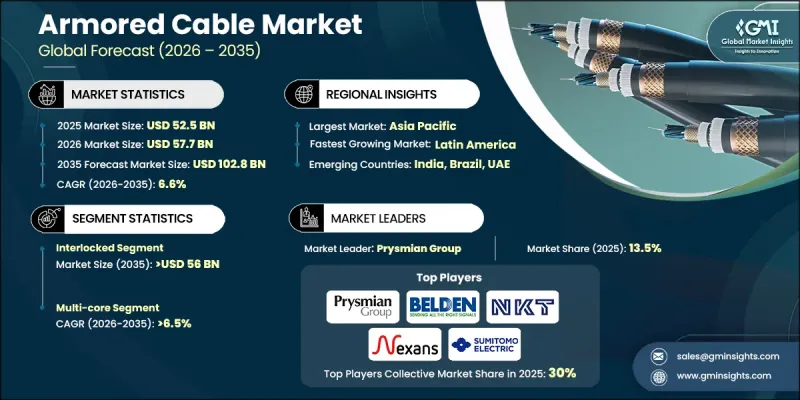
The armored cable market is experiencing strong expansion due to rising demand across construction, industrial, and energy sectors. These cables are widely preferred for their ability to withstand harsh environmental conditions, mechanical stress, and moisture, making them essential for modern infrastructure development. Rapid urbanization in emerging economies is driving the need for reliable electrical systems, further accelerating adoption. In addition, growing investments in power transmission, grid modernization, and renewable energy integration are significantly contributing to market growth. Armored cables play a crucial role in ensuring safe and efficient electricity distribution, especially in large-scale infrastructure projects. Increasing focus on grid reliability, replacement of aging electrical networks, and expansion of power capacity are further strengthening demand. Continuous advancements in cable materials and design are enhancing performance, safety, and durability, supporting their widespread use across diverse applications.
| Market Scope | |
|---|---|
| Start Year | 2025 |
| Forecast Year | 2026-2035 |
| Start Value | $52.5 Billion |
| Forecast Value | $102.8 Billion |
| CAGR | 6.6% |
The interlocked segment is expected to reach USD 56 billion by 2035, driven by its strong mechanical protection, flexibility, and cost efficiency. These cables feature a metallic layer formed by wrapping a metal strip around the core, providing enhanced resistance against physical damage and external impacts. Their robust construction makes them highly suitable for environments requiring high durability and protection, particularly in industrial and infrastructure applications.
The multi-core armored cable segment is projected to grow at a CAGR of 6.5% through 2035, supported by increasing demand for efficient and compact power distribution solutions. These cables allow multiple electrical circuits to be housed within a single structure, reducing installation complexity and overall costs. Their ability to support multiple connections in limited spaces makes them highly effective for complex electrical systems, driving their adoption across various industries.
U.S. Armored Cable Market is anticipated to reach USD 15 billion by 2035, fueled by rising investments in construction, energy, and telecommunications infrastructure. Growing urban development and the expansion of smart city initiatives are increasing the need for durable and reliable wiring systems capable of withstanding environmental and physical stress. Additionally, the rapid growth of renewable energy projects is further supporting market expansion, as armored cables are essential for power transmission in exposed and demanding conditions.
Key players operating in the Global Armored Cable Market include Prysmian Group, Nexans, Southwire Company, Belden, CommScope, LS Cable & Systems, Sumitomo Electric, Furukawa Electric, Fujikura, Elsewedy Electric, Leoni, Lapp Group, Helukabel, NKT A/S, Kabelwerk Eupen, Hellenic Group, Polycab, Shawcor, Tecnikabel, TFKable, and TE Connectivity. Companies in the Global Armored Cable Market are focusing on strategic initiatives to strengthen their competitive position and expand market share. They are investing in advanced manufacturing technologies and high-performance materials to enhance cable durability, safety, and efficiency. Expanding production capacities and establishing regional facilities help meet growing infrastructure and energy demands. Strategic partnerships with construction firms, utilities, and renewable energy developers enable broader market penetration. Firms are also prioritizing product innovation, including fire-resistant and eco-friendly cable solutions, to comply with evolving regulations.
Table of Contents
Chapter 1 Methodology & Scope
- 1.1 Research design
- 1.2 Market estimates & forecast parameters
- 1.3 Forecast calculation
- 1.4 Data sources
- 1.4.1 Primary
- 1.4.2 Secondary
- 1.4.2.1 Paid
- 1.4.2.2 Public
Chapter 2 Executive Summary
- 2.1 Industry synopsis, 2022 - 2035
Chapter 3 Industry Insights
- 3.1 Industry ecosystem analysis
- 3.2 Industry impact forces
- 3.2.1 Growth drivers
- 3.2.2 Industry pitfalls & challenges
- 3.3 Growth potential analysis
- 3.4 Regulatory landscape
- 3.5 Porter's analysis
- 3.5.1 Bargaining power of suppliers
- 3.5.2 Bargaining power of buyers
- 3.5.3 Threat of new entrants
- 3.5.4 Threat of substitutes
- 3.6 PESTEL analysis
- 3.6.1 Political factors
- 3.6.2 Economic factors
- 3.6.3 Social factors
- 3.6.4 Technological factors
- 3.6.5 Legal factors
- 3.6.6 Environmental factors
- 3.7 Price trend analysis
- 3.8 Emerging opportunities & trends
- 3.8.1 Digitalization & IoT integration
- 3.8.2 Emerging market penetration
- 3.9 Investment analysis & future outlook
Chapter 4 Competitive Landscape, 2026
- 4.1 Introduction
- 4.2 Company market share analysis, by region, 2025
- 4.2.1 North America
- 4.2.2 Europe
- 4.2.3 Asia Pacific
- 4.2.4 Middle East & Africa
- 4.2.5 Latin America
- 4.3 Key developments
- 4.3.1 Mergers & acquisitions
- 4.3.2 Partnerships & collaborations
- 4.3.3 New product launches
- 4.3.4 Expansion plans and funding
Chapter 5 Armored Cable Market Size and Forecast, By Armor Type, 2022 - 2035 (USD Million & '000 Tonnes)
- 5.1 Key trends
- 5.2 Interlocked
- 5.3 Continuously Corrugated Welded
Chapter 6 Armored Cable Market Size and Forecast, By Core Type, 2022 - 2035 (USD Million & '000 Tonnes)
- 6.1 Key trends
- 6.2 Single Core
- 6.3 Multi-Core
Chapter 7 Armored Cable Market Size and Forecast, By End User, 2022 - 2035 (USD Million & '000 Tonnes)
- 7.1 Key trends
- 7.2 Oil & Gas
- 7.3 Manufacturing
- 7.4 Mining
- 7.5 Construction
- 7.6 Others
Chapter 8 Armored Cable Market Size and Forecast, By Region, 2022 - 2035 (USD Million & '000 Tonnes)
- 8.1 Key trends
- 8.2 North America
- 8.2.1 U.S.
- 8.2.2 Canada
- 8.2.3 Mexico
- 8.3 Europe
- 8.3.1 UK
- 8.3.2 France
- 8.3.3 Germany
- 8.3.4 Italy
- 8.3.5 Russia
- 8.3.6 Spain
- 8.4 Asia Pacific
- 8.4.1 China
- 8.4.2 Australia
- 8.4.3 India
- 8.4.4 Japan
- 8.4.5 South Korea
- 8.5 Middle East & Africa
- 8.5.1 Saudi Arabia
- 8.5.2 UAE
- 8.5.3 Turkey
- 8.5.4 South Africa
- 8.5.5 Egypt
- 8.6 Latin America
- 8.6.1 Brazil
- 8.6.2 Argentina
Chapter 9 Company Profiles
- 9.1 Belden
- 9.2 CommScope
- 9.3 Elsewedy Electric
- 9.4 Fujikura
- 9.5 Furukawa Electric
- 9.6 Helukabel
- 9.7 Hellenic Group
- 9.8 Kabelwerk Eupen
- 9.9 Lapp Group
- 9.10 Leoni
- 9.11 LS Cable & Systems
- 9.12 Nexans
- 9.13 NKT A/S
- 9.14 Polycab
- 9.15 Prysmian Group
- 9.16 Shawcor
- 9.17 Southwire Company
- 9.18 Sumitomo Electric
- 9.19 Tecnikabel
- 9.20 TFKable
- 9.21 TE Connectivity

