PUBLISHER: Global Market Insights Inc. | PRODUCT CODE: 2019164

PUBLISHER: Global Market Insights Inc. | PRODUCT CODE: 2019164
Interlocked Armored Cable Market Opportunity, Growth Drivers, Industry Trend Analysis, and Forecast 2026 - 2035
The Global Interlocked Armored Cable Market was valued at USD 28.5 billion in 2025 and is estimated to grow at a CAGR of 6.8% to reach USD 56.8 billion by 2035.
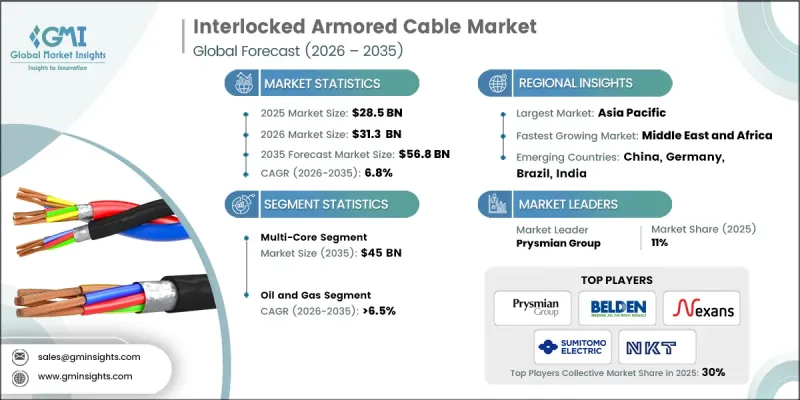
Growth is driven by the increasing need for cables that can tolerate mechanical stress, harsh environments, and long operational lifecycles. These cables are widely utilized in critical applications due to their ability to provide enhanced protection, reliability, and safety in complex installations. Rapid urban development and ongoing industrialization across emerging economies are creating sustained demand for advanced electrical distribution systems. Additionally, the rising need for efficient power transmission and secure connectivity solutions is further strengthening market expansion. Industries are increasingly focusing on robust cable solutions that ensure uninterrupted performance under demanding conditions. Continuous investments in infrastructure modernization, along with the integration of automation and digital systems, are accelerating the adoption of interlocked armored cables across multiple sectors, reinforcing their importance in modern electrical networks.
| Market Scope | |
|---|---|
| Start Year | 2025 |
| Forecast Year | 2026-2035 |
| Start Value | $28.5 Billion |
| Forecast Value | $56.8 Billion |
| CAGR | 6.8% |
Demand for interlocked armored cables continues to rise as energy-intensive industries expand and require resilient electrical systems. Growing investments in power infrastructure and grid modernization are creating long-term opportunities for market growth. The increasing deployment of renewable energy systems and large-scale energy networks is contributing to higher adoption, as these cables offer strong resistance to external stress and environmental exposure. Their capability to maintain performance stability in challenging conditions makes them highly suitable for large-scale installations. Furthermore, stringent safety standards and regulatory requirements in industrial and commercial environments are encouraging the use of protected cable systems, supporting widespread adoption across various high-demand sectors.
The multi-core segment is expected to reach USD 45 billion by 2035, supported by rising industrial activities and continuous advancements in cable design and manufacturing processes. These cables are gaining traction due to their ability to carry multiple circuits within a single structure, improving efficiency and reducing installation complexity. Their compact configuration helps optimize space utilization while lowering overall system costs. Increasing demand for organized and high-capacity wiring solutions in complex infrastructure environments is further strengthening segment growth. Additionally, improvements in durability and performance characteristics make these cables suitable for challenging operating environments, supporting their expanding use across a wide range of industrial applications.
The oil and gas segment is projected to grow at a CAGR of 6.5% through 2035, driven by the need for highly reliable and long-lasting electrical solutions in demanding operational settings. Interlocked armored cables are widely adopted due to their ability to withstand mechanical stress, corrosion, and environmental exposure, ensuring consistent performance in critical operations. Ongoing expansion in energy production activities and increased focus on operational efficiency are contributing to higher demand. The need for dependable infrastructure that minimizes downtime and supports continuous operations further strengthens the role of these cables in energy-related applications.
U.S. Interlocked Armored Cable Market is anticipated to reach USD 8 billion by 2035, supported by rising demand for advanced and resilient electrical systems across key industries. Infrastructure development, modernization of electrical networks, and increasing integration of advanced technologies are key factors driving regional growth. The demand for high-performance cabling solutions is increasing as industries prioritize safety, efficiency, and long-term reliability. These cables are widely utilized due to their strength, resistance to temperature variations, and ability to perform effectively in challenging conditions, making them essential for large-scale industrial and commercial applications.
Key companies operating in the Global Interlocked Armored Cable Market include Prysmian, Nexans, Belden, Polycab, KEI Industries, RR Kabel, Southwire, Sumitomo Electric, Furukawa Electric, LS Cable & System, NKT, Leoni Cables, Helukabel, Havells, Finolex, Riyadh Cables, Okonite, Omni Cables, Atkore, Anixter, and AT&T. Companies in the Interlocked Armored Cable Market are focusing on strengthening their competitive position through product innovation, capacity expansion, and strategic collaborations. Manufacturers are investing in advanced materials and improved insulation technologies to enhance cable durability and performance. Expanding production capabilities and optimizing supply chains help meet growing global demand while maintaining cost efficiency. Strategic partnerships with infrastructure developers and energy companies enable wider market reach and project integration. Firms are also prioritizing compliance with international safety and quality standards to build trust and credibility.
Table of Contents
Chapter 1 Methodology & Scope
- 1.1 Research design
- 1.2 Market estimates & forecast parameters
- 1.3 Forecast calculation
- 1.4 Data sources
- 1.4.1 Primary
- 1.4.2 Secondary
- 1.4.2.1 Paid
- 1.4.2.2 Public
Chapter 2 Executive Summary
- 2.1 Industry synopsis, 2022 - 2035
Chapter 3 Industry Insights
- 3.1 Industry ecosystem analysis
- 3.2 Industry impact forces
- 3.2.1 Growth drivers
- 3.2.2 Industry pitfalls & challenges
- 3.3 Growth potential analysis
- 3.4 Regulatory landscape
- 3.5 Porter's analysis
- 3.5.1 Bargaining power of suppliers
- 3.5.2 Bargaining power of buyers
- 3.5.3 Threat of new entrants
- 3.5.4 Threat of substitutes
- 3.6 PESTEL analysis
- 3.6.1 Political factors
- 3.6.2 Economic factors
- 3.6.3 Social factors
- 3.6.4 Technological factors
- 3.6.5 Legal factors
- 3.6.6 Environmental factors
- 3.7 Price trend analysis, by region (USD/Unit)
- 3.8 Emerging opportunities & trends
- 3.8.1 Digitalization & IoT integration
- 3.8.2 Emerging market penetration
- 3.9 Investment analysis & future outlook
Chapter 4 Competitive Landscape, 2026
- 4.1 Introduction
- 4.2 Company market share analysis, by region, 2025
- 4.2.1 North America
- 4.2.2 Europe
- 4.2.3 Asia Pacific
- 4.2.4 Middle East & Africa
- 4.2.5 Latin America
- 4.3 Key developments
- 4.3.1 Mergers & acquisitions
- 4.3.2 Partnerships & collaborations
- 4.3.3 New product launches
- 4.3.4 Expansion plans and funding
Chapter 5 Interlocked Armored Cable Market Size and Forecast, By Core Type, 2022 - 2035 (USD Million & '000 Tonnes)
- 5.1 Key trends
- 5.2 Single Core
- 5.3 Multi-Core
Chapter 6 Interlocked Armored Cable Market Size and Forecast, By End User, 2022 - 2035 (USD Million & '000 Tonnes)
- 6.1 Key trends
- 6.2 Oil & Gas
- 6.3 Manufacturing
- 6.4 Mining
- 6.5 Construction
- 6.6 Others
Chapter 7 Interlocked Armored Cable Market Size and Forecast, By Region, 2022 - 2035 (USD Million & '000 Tonnes)
- 7.1 Key trends
- 7.2 North America
- 7.2.1 U.S.
- 7.2.2 Canada
- 7.2.3 Mexico
- 7.3 Europe
- 7.3.1 UK
- 7.3.2 France
- 7.3.3 Germany
- 7.3.4 Italy
- 7.3.5 Russia
- 7.3.6 Spain
- 7.4 Asia Pacific
- 7.4.1 China
- 7.4.2 Australia
- 7.4.3 India
- 7.4.4 Japan
- 7.4.5 South Korea
- 7.5 Middle East & Africa
- 7.5.1 Saudi Arabia
- 7.5.2 UAE
- 7.5.3 Turkey
- 7.5.4 South Africa
- 7.5.5 Egypt
- 7.6 Latin America
- 7.6.1 Brazil
- 7.6.2 Argentina
Chapter 8 Company Profiles
- 8.1 Anixter
- 8.2 AT&T
- 8.3 Atkore
- 8.4 Belden
- 8.5 Finolex
- 8.6 Furukawa Electric
- 8.7 Havells
- 8.8 Helukabel
- 8.9 KEI Industries
- 8.10 Leoni Cables
- 8.11 LS Cable & System
- 8.12 Nexans
- 8.13 NKT
- 8.14 Okonite
- 8.15 Omni Cables
- 8.16 Polycab
- 8.17 Prysmian
- 8.18 Riyadh Cables
- 8.19 RR Kabel
- 8.20 Southwire
- 8.21 Sumitomo Electric

