
PUBLISHER: Global Market Insights Inc. | PRODUCT CODE: 2019133

PUBLISHER: Global Market Insights Inc. | PRODUCT CODE: 2019133
Asia Pacific Gas Turbine Market Opportunity, Growth Drivers, Industry Trend Analysis, and Forecast 2026 - 2035
Asia Pacific Gas Turbine Market was valued at USD 9.1 billion in 2025 and is estimated to grow at a CAGR of 11.4% to reach USD 27.1 billion by 2035.
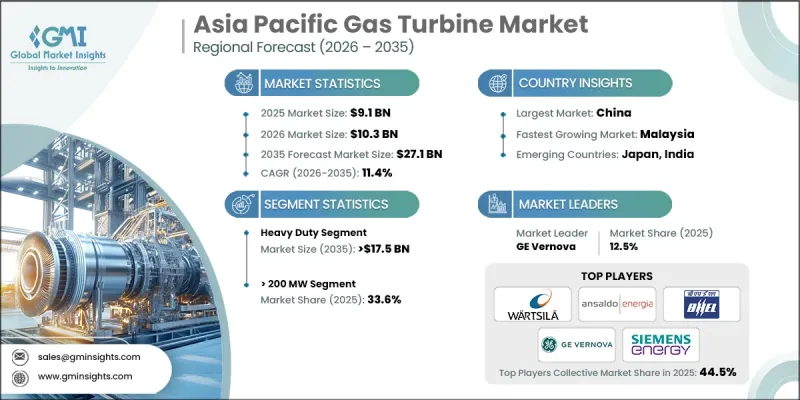
Market growth is driven by rising environmental awareness and stricter government regulations on greenhouse gas emissions, prompting industries and power producers to adopt cleaner, more efficient energy solutions. Policies promoting reduced carbon intensity are accelerating the deployment of advanced turbine technologies and combined cycle systems that maximize fuel utilization. Rising electricity demand, rapid urbanization, and industrial expansion further strengthen the need for scalable, reliable power generation. Gas turbines are critical as internal combustion engines that convert fuel into mechanical energy through stages of compression, combustion, and expansion. Their importance is amplified by the focus on grid resilience and energy security, providing stable power alongside variable sources like wind and solar. Upgrades of aging plants and infrastructure modernization are also supporting turbine adoption across the region.
| Market Scope | |
|---|---|
| Start Year | 2025 |
| Forecast Year | 2026-2035 |
| Start Value | $9.1 Billion |
| Forecast Value | $27.1 Billion |
| CAGR | 11.4% |
The heavy-duty gas turbine segment is projected to reach USD 17.5 billion by 2035 due to its ability to generate large-scale power efficiently. These turbines offer continuous operation, high reliability, and cost-effectiveness when integrated into combined cycle plants, making them a preferred choice for utilities seeking low-emission, high-efficiency energy solutions.
The >200 MW gas turbine segment accounted for 33.6% share in 2025, supported by innovations in combustion systems, turbine blade materials, and cooling technology. Improvements in firing temperatures and fuel flexibility, including hydrogen blends and low-carbon fuels, enhance operational efficiency and long-term applicability, driving future growth.
China Gas Turbine Market was valued at USD 3.6 billion in 2025, sustained by expanding manufacturing and processing industries that require captive and self-regulated power generation facilities. Government policies supporting a balanced and sustainable energy mix, along with strict emission regulations, reinforce market growth. Similarly, Japan's market is witnessing growth due to an emphasis on reducing greenhouse gas emissions and transitioning to cleaner energy sources.
Key players operating in the Asia Pacific Gas Turbine Market include Baker Hughes, GE Vernova, Mitsubishi Heavy Industries, Rolls-Royce, Siemens Energy, Wartsila, Ansaldo Energia, Bharat Forge, Bharat Heavy Electricals Limited, Capstone Green Energy Corporation, Destinus Energy, Doosan Enerbility, Everllence, FlexEnergy Solutions, IHI Corporation, Kawasaki Heavy Industries, N. S. Energy Group, Nanjing Steam Turbine Motor, Solar Turbines, and Vericor. Companies in the Asia Pacific Gas Turbine Market are adopting strategies to strengthen their presence by investing in advanced R&D for high-efficiency and low-emission turbines. They are focusing on modular and scalable solutions to cater to utilities and industrial clients seeking flexibility and reliability. Strategic partnerships with governments and industrial players help expand project pipelines and infrastructure upgrades. Firms emphasize digitalization, predictive maintenance, and fuel-flexible technologies to improve performance and long-term operational efficiency. Expanding regional manufacturing capabilities, establishing service networks, and targeting emerging markets allow companies to enhance market share, optimize supply chains, and meet growing electricity demand while complying with evolving environmental regulations.
Table of Contents
Chapter 1 Methodology & Scope
- 1.1 Research design
- 1.2 Quality commitments
- 1.2.1 GMI AI policy & data integrity commitment
- 1.2.1.1 Source consistency protocol
- 1.2.1 GMI AI policy & data integrity commitment
- 1.3 Research trail & confidence scoring
- 1.3.1 Research trail components
- 1.3.2 Scoring components
- 1.4 Data collection
- 1.4.1 Partial list of primary sources
- 1.5 Data mining sources
- 1.5.1 Paid sources
- 1.5.1.1 Sources, by region
- 1.5.1 Paid sources
- 1.6 Base estimates and calculations
- 1.6.1 Base year calculation for any one approach
- 1.7 Market estimates and forecasts parameters
- 1.8 Forecast model
- 1.8.1 Quantified market impact analysis
- 1.8.1.1 Mathematical impact of growth parameters on forecast
- 1.8.1 Quantified market impact analysis
- 1.9 Research transparency addendum
- 1.9.1 Source attribution framework
- 1.9.2 Quality assurance metrics
- 1.9.3 Our commitment to trust
- 1.10 Market definitions
Chapter 2 Executive Summary
- 2.1 Industry synopsis, 2022 - 2035
- 2.1.1 Business trends
- 2.1.2 Capacity trends
- 2.1.3 Product trends
- 2.1.4 Technology trends
- 2.1.5 Application trends
- 2.1.6 Country trends
Chapter 3 Industry Insights
- 3.1 Industry ecosystem analysis
- 3.1.1 Raw material availability & sourcing analysis
- 3.1.2 Manufacturing capacity assessment
- 3.1.3 Supply chain resilience & risk factors
- 3.1.4 Distribution network analysis
- 3.2 Industry impact forces
- 3.2.1 Growth drivers
- 3.2.2 Industry pitfalls & challenges
- 3.3 Regulatory landscape
- 3.4 Growth potential analysis
- 3.5 Price trend analysis (USD/MW)
- 3.5.1 By capacity
- 3.5.2 By product
- 3.6 Porter's analysis
- 3.6.1 Bargaining power of suppliers
- 3.6.2 Bargaining power of buyers
- 3.6.3 Threat of new entrants
- 3.6.4 Threat of substitutes
- 3.7 PESTEL analysis
- 3.7.1 Political factors
- 3.7.2 Economic factors
- 3.7.3 Social factors
- 3.7.4 Technological factors
- 3.7.5 Legal factors
- 3.7.6 Environmental factors
- 3.8 Cost structure analysis of gas turbine
- 3.9 Emerging opportunities & trends
- 3.9.1 Digitalization & IoT integration
- 3.9.2 Growth in untapped markets & applications
- 3.10 Investment analysis & future prospects
Chapter 4 Competitive Landscape, 2026
- 4.1 Introduction
- 4.2 Company market share analysis, by country, 2025
- 4.2.1 China
- 4.2.2 Australia
- 4.2.3 Japan
- 4.2.4 India
- 4.2.5 South Korea
- 4.2.6 Indonesia
- 4.2.7 Thailand
- 4.2.8 Malaysia
- 4.2.9 Bangladesh
- 4.3 Competitive positioning matrix
- 4.4 Key developments
- 4.4.1 Mergers & acquisitions
- 4.4.2 Partnerships & collaborations
- 4.4.3 New product launches
- 4.4.4 Expansion plans & funding
Chapter 5 Market Size and Forecast, By Capacity, 2022 - 2035 (USD Million & MW)
- 5.1 Key trends
- 5.2 ≤ 50 kW
- 5.3 > 50 kW to 500 kW
- 5.4 > 500 kW to 1 MW
- 5.5 > 1 MW to 30 MW
- 5.6 > 30 MW to 70 MW
- 5.7 > 70 MW to 200 MW
- 5.8 > 200 MW
Chapter 6 Market Size and Forecast, By Product, 2022 - 2035 (USD Million & MW)
- 6.1 Key trends
- 6.2 Aero-derivative
- 6.3 Heavy duty
Chapter 7 Market Size and Forecast, By Technology, 2022 - 2035 (USD Million & MW)
- 7.1 Key trends
- 7.2 Open cycle
- 7.3 Combined cycle
Chapter 8 Market Size and Forecast, By Application, 2022 - 2035 (USD Million & MW)
- 8.1 Key trends
- 8.2 Power plants
- 8.3 Oil & gas
- 8.4 Process plants
- 8.5 Aviation
- 8.6 Marine
- 8.7 Others
Chapter 9 Market Size and Forecast, By Country, 2022 - 2035 (USD Million & MW)
- 9.1 Key trends
- 9.2 China
- 9.3 Australia
- 9.4 Japan
- 9.5 India
- 9.6 South Korea
- 9.7 Indonesia
- 9.8 Thailand
- 9.9 Malaysia
- 9.10 Bangladesh
Chapter 10 Company Profiles
- 10.1 Ansaldo Energia
- 10.2 Baker Hughes
- 10.3 Bharat Forge
- 10.4 Bharat Heavy Electricals Limited
- 10.5 Capstone Green Energy Corporation
- 10.6 Destinus Energy
- 10.7 Doosan Enerbility
- 10.8 Everllence
- 10.9 FlexEnergy Solutions
- 10.10 GE Vernova
- 10.11 IHI Corporation
- 10.12 Kawasaki Heavy Industries
- 10.13 Mitsubishi Heavy Industries
- 10.14 N. S. Energy Group
- 10.15 Nanjing Steam Turbine Motor
- 10.16 Rolls-Royce
- 10.17 Siemens Energy
- 10.18 Solar Turbines
- 10.19 Vericor
- 10.20 Wartsila

