PUBLISHER: Global Market Insights Inc. | PRODUCT CODE: 2019144

PUBLISHER: Global Market Insights Inc. | PRODUCT CODE: 2019144
Single-Function Printers Market Opportunity, Growth Drivers, Industry Trend Analysis, and Forecast 2026 - 2035
The Global Single-Function Printers Market was valued at USD 8.1 billion in 2025 and is estimated to grow at a CAGR of 4.6% to reach USD 12.5 billion by 2035.
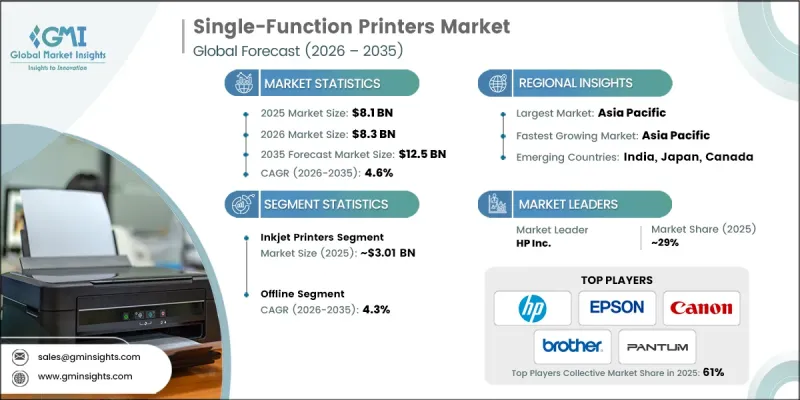
The market growth is fueled by rising demand for cost-effective printing solutions among households, small offices, and educational institutions. Single-function printers provide a streamlined, reliable printing experience without the complexity of multifunction devices, making them ideal for users who primarily need printing capabilities. Students, contractors, and office teams rely on these printers for producing assignments, reports, invoices, and other essential documents. Their compact design, low operating costs, and minimal maintenance requirements make them particularly attractive for homes, small offices, and classrooms. The increasing number of educational institutions, growing student populations, and expanding administrative needs in businesses are driving consistent adoption. Users prioritize dependable, high-quality output and efficient operations, making single-function printers a preferred solution for everyday printing demands.
| Market Scope | |
|---|---|
| Start Year | 2025 |
| Forecast Year | 2026-2035 |
| Start Value | $8.1 Billion |
| Forecast Value | $12.5 Billion |
| CAGR | 4.6% |
The inkjet printer segment generated USD 3.01 billion in 2025 and is expected to grow at a CAGR of 5.1% from 2026 to 2035. Inkjet technology leads the single-function printers market due to its precision, versatility, and affordability. Inkjet printers spray liquid ink directly onto paper, producing high-resolution text, graphics, and images, which is highly valued in homes, small offices, and businesses requiring quality output in a compact format. Advancements in printhead design, ink formulations, and cost-efficient maintenance further strengthen adoption across key markets.
The wired printers segment is projected to maintain strong growth through 2035. Their market leadership is supported by stable data transfer, reliable performance, and simple setup. Wired connectivity, often via USB or Ethernet, ensures uninterrupted printing, making these printers suitable for home offices, small businesses, and professional environments where security, consistency, and high-quality output are critical. Users appreciate wired models for their dependable connections and minimal susceptibility to network interruptions.
China Single-Function Printers Market reached USD 837.6 million in 2025 and is expected to grow at a CAGR of 5.9% from 2026 to 2035. Growth is driven by demand from SMEs, educational institutions, and home offices seeking cost-efficient, high-quality printing solutions. Single-function printers are preferred for their reliability, compact footprint, and low operational costs. Technological improvements such as energy-efficient operations, fast printing, and wireless connectivity further enhance user experience and drive adoption across business and educational sectors.
Key players operating in the Global Single-Function Printers Market include Canon Inc., Ricoh, Brother, HP Inc., Fujifilm, Epson, Zebra Technologies, Sharp, Kyocera, Toshiba TEC, TSC Auto ID, Pantum, Konica Minolta, and Sindoh. Companies in the Single-Function Printers Market are strengthening their position by investing in R&D to enhance print quality, speed, and energy efficiency while keeping costs low for end users. They focus on expanding distribution networks and building partnerships with retailers, educational institutions, and SMEs to improve accessibility. Product differentiation through compact design, low maintenance, and reliable wired or wireless connectivity is a key strategy to capture diverse customer segments. Marketing initiatives highlight affordability and convenience, while after-sales support, service networks, and availability of consumables strengthen customer loyalty. Companies are also targeting emerging regions by introducing locally optimized models, enabling market penetration and long-term growth.
Table of Contents
Chapter 1 Methodology & Scope
- 1.1 Market scope and definition
- 1.2 Research design
- 1.2.1 Research approach
- 1.2.2 Data collection methods
- 1.3 Data mining sources
- 1.3.1 Global
- 1.3.2 Regional/Country
- 1.4 Base estimates and calculations
- 1.4.1 Base year calculation
- 1.4.2 Key trends for market estimation
- 1.5 Primary research and validation
- 1.5.1 Primary sources
- 1.6 Forecast model
- 1.7 Research assumptions and limitations
Chapter 2 Executive Summary
- 2.1 Industry 360° synopsis
- 2.2 Key market trends
- 2.2.1 Regional
- 2.2.2 Technology
- 2.2.3 Connectivity
- 2.2.4 Print Speed
- 2.2.5 Price Range
- 2.2.6 End Use
- 2.2.7 Distribution channel
Chapter 3 Industry Insights
- 3.1 Industry ecosystem analysis
- 3.1.1 Supplier landscape
- 3.1.2 Profit margin
- 3.1.3 Value addition at each stage
- 3.1.4 Factor affecting the value chain
- 3.2 Industry impact forces
- 3.2.1 Growth drivers
- 3.2.1.1 Demand for cost-effective printing solutions in homes and small offices
- 3.2.1.2 Expansion of educational institutions and student printing needs
- 3.2.1.3 Growing e-commerce documentation and labeling requirements
- 3.2.2 Pitfalls & Challenges
- 3.2.2.1 Rising adoption of multifunction printers with integrated features
- 3.2.2.2 Increasing shift toward digital documentation and cloud workflows
- 3.2.3 Opportunities
- 3.2.3.1 Growing demand for specialized printers such as label and receipt printers
- 3.2.3.2 Expansion of wireless and mobile printing capabilities
- 3.2.1 Growth drivers
- 3.3 Growth potential analysis
- 3.4 Future market trends
- 3.5 Technology and innovation landscape
- 3.5.1 Current technological trends
- 3.5.2 Emerging technologies
- 3.6 Regulatory landscape
- 3.6.1 Standards and compliance requirements
- 3.6.2 Regional regulatory frameworks
- 3.6.3 Certification standards
- 3.7 Porter's analysis
- 3.8 PESTEL analysis
- 3.9 Pricing analysis (driven by primary research)
- 3.9.1 Historical price trend analysis (driven by primary research) (2019-2024)
- 3.9.2 Pricing strategy by player type (premium / value / cost-plus) (driven by primary research)
- 3.10 Trade data analysis (driven by paid data base)
- 3.10.1 Import/export volume & value trends by HS code (driven by paid data base)
- 3.10.2 Key trade corridors & tariff impact analysis (driven by paid data base)
- 3.11 Impact of AI & generative AI on the market
- 3.11.1 AI-driven disruption of existing business models
- 3.11.2 GenAI use cases & adoption roadmap by segment
- 3.11.3 Risks, limitations & regulatory considerations
- 3.12 Capacity & production landscape (driven by primary research)
- 3.12.1 Installed capacity by region & key producer (driven by primary research)
- 3.12.2 Capacity utilization rates & expansion pipelines (driven by primary research)
Chapter 4 Competitive Landscape, 2025
- 4.1 Introduction
- 4.2 Company market share analysis
- 4.2.1 By Region
- 4.2.1.1 North America
- 4.2.1.2 Europe
- 4.2.1.3 Asia Pacific
- 4.2.1.4 Latin America
- 4.2.1.5 Middle East & Africa
- 4.2.1 By Region
- 4.3 Company matrix analysis
- 4.4 Competitive analysis of major market players
- 4.5 Competitive positioning matrix
- 4.6 Key developments
- 4.6.1 Mergers & acquisitions
- 4.6.2 Partnerships & collaborations
- 4.6.3 New product launches
- 4.6.4 Expansion plans
Chapter 5 Market Estimates & Forecast, By Technology, 2022 - 2035, (USD Billion) (Thousand Units)
- 5.1 Key trends
- 5.2 Wired printers
- 5.3 Wireless printers
Chapter 6 Market Estimates & Forecast, By Connectivity, 2022 - 2035, (USD Billion) (Thousand Units)
- 6.1 Key trends
- 6.2 Wired printers
- 6.3 Wireless printers
Chapter 7 Market Estimates & Forecast, By Print Speed, 2022 - 2035, (USD Billion) (Thousand Units)
- 7.1 Key trends
- 7.2 High-speed printers
- 7.3 Low-speed printers
Chapter 8 Market Estimates & Forecast, By Price Range, 2022 - 2035, (USD Billion) (Thousand Units)
- 8.1 Key trends
- 8.2 Budget printers
- 8.3 Mid-range printers
- 8.4 Premium printers
Chapter 9 Market Estimates & Forecast, By End Use, 2022 - 2035, (USD Billion) (Thousand Units)
- 9.1 Key trends
- 9.2 Household
- 9.3 Commercial
- 9.4 Industrial
- 9.5 Others
Chapter 10 Market Estimates & Forecast, By Distribution Channel, 2022 - 2035, (USD Billion) (Thousand Units)
- 10.1 Key trends
- 10.2 Online
- 10.2.1 E-commerce
- 10.2.2 Company website
- 10.3 Offline
- 10.3.1 Electronics and appliance stores
- 10.3.2 Supermarkets and department stores
- 10.3.3 Specialized printer retailers
Chapter 11 Market Estimates & Forecast, By Region, 2022 - 2035, (USD Billion) (Thousand Units)
- 11.1 Key trends
- 11.2 North America
- 11.2.1 U.S.
- 11.2.2 Canada
- 11.3 Europe
- 11.3.1 Germany
- 11.3.2 UK
- 11.3.3 France
- 11.3.4 Italy
- 11.3.5 Spain
- 11.4 Asia Pacific
- 11.4.1 China
- 11.4.2 India
- 11.4.3 Japan
- 11.4.4 South Korea
- 11.4.5 Australia
- 11.5 Latin America
- 11.5.1 Brazil
- 11.5.2 Mexico
- 11.5.3 Argentina
- 11.6 MEA
- 11.6.1 Saudi Arabia
- 11.6.2 UAE
- 11.6.3 South Africa
Chapter 12 Company Profiles
- 12.1 Brother
- 12.2 Canon Inc.
- 12.3 Epson
- 12.4 FUJIFILM
- 12.5 HP Inc.
- 12.6 Konica Minolta
- 12.7 Kyocera
- 12.8 Pantum
- 12.9 Ricoh
- 12.10 Sharp
- 12.11 Sindoh
- 12.12 Toshiba TEC
- 12.13 TSC Auto ID
- 12.14 Xerox
- 12.15 Zebra Technologies

