PUBLISHER: Global Market Insights Inc. | PRODUCT CODE: 2019203

PUBLISHER: Global Market Insights Inc. | PRODUCT CODE: 2019203
Printer Market Opportunity, Growth Drivers, Industry Trend Analysis, and Forecast 2026 - 2035
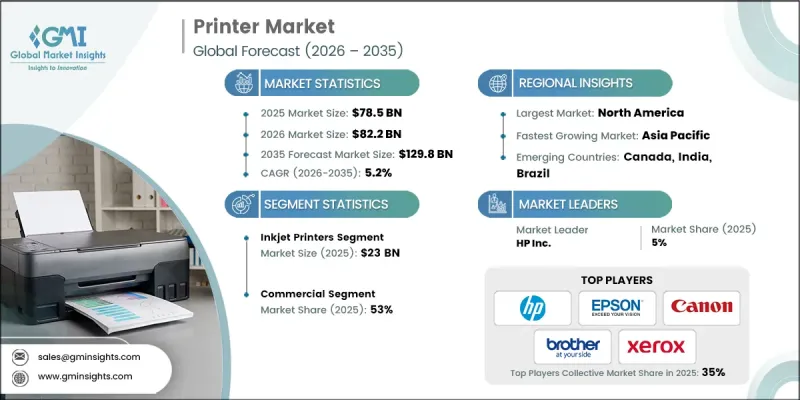
The Global Printer Market was valued at USD 78.5 billion in 2025 and is estimated to grow at a CAGR of 5.2% to reach USD 129.8 billion by 2035.
Printers are no longer seen merely as devices for producing documents but as intelligent tools integrated with IoT connectivity, cloud services, and smart device compatibility. Businesses benefit from optimized printing operations, reduced costs, and enhanced security, while consumers enjoy convenience, real-time ink monitoring, and automated workflow solutions. Cloud-based printing and data transmission features safeguard sensitive information, ensuring only authorized personnel can access documents. These smart functionalities improve overall efficiency, positioning printers as essential partners in both professional and residential environments while supporting digital adoption and process optimization.
| Market Scope | |
|---|---|
| Start Year | 2025 |
| Forecast Year | 2026-2035 |
| Start Value | $78.5 Billion |
| Forecast Value | $129.8 Billion |
| CAGR | 5.2% |
The inkjet printers segment held a 29.4% share, generating USD 23 billion in 2025. Their versatility caters to multiple applications, from residential document and photo printing to commercial needs, making them a popular choice across diverse user segments. Inkjet printers provide high-quality color output, cost-efficient operation, and flexible designs, including individual ink cartridges and compact form factors, appealing to both households and businesses.
The commercial segment generated USD 41.6 billion in 2025, representing 53% share. Commercial printers dominate due to high-volume demands from offices, educational institutions, and retail operations. Reliability, multifunction capabilities, high-speed output, and robust security features drive preference among organizations.
U.S. Printer Market accounted for 72% share, generating USD 16.9 billion in 2025. Strong technology infrastructure, digital printing adoption, and a premium product focus on security and managed print services reinforce North America's leadership. Regulatory requirements for data protection further accelerate the adoption of secure, cloud-connected printing systems.
Key players in the Global Printer Market include HP Inc., Epson, Canon Inc., Brother Industries, Xerox Holdings, Ricoh Company, Konica Minolta, Kyocera Corporation, Lexmark International, Stratasys Ltd., 3D Systems, Sharp Corporation, Fujifilm Holdings, Roland DG, and Toshiba. Companies strengthen their market presence by introducing smart, IoT-enabled printers with cloud integration and advanced security. They expand product portfolios to cater to commercial and residential users, emphasizing multifunctionality, high-speed performance, and energy efficiency. Strategic partnerships with IT service providers and retail networks enhance visibility and distribution. Investment in R&D drives innovation in ink technologies, automated workflows, and cost-effective solutions. Aggressive marketing campaigns, competitive pricing strategies, and after-sales support help retain customer loyalty while enabling entry into emerging markets. This multifaceted approach reinforces brand credibility and fortifies market foothold.
Table of Contents
Chapter 1 Methodology and Scope
- 1.1 Market scope and definition
- 1.2 Research design
- 1.2.1 Research approach
- 1.2.2 Data collection methods
- 1.3 Data mining sources
- 1.3.1 Global
- 1.3.2 Regional/Country
- 1.4 Base estimates and calculations
- 1.4.1 Base year calculation
- 1.4.2 Key trends for market estimation
- 1.5 Primary research and validation
- 1.5.1 Primary sources
- 1.6 Forecast model
- 1.7 Research assumptions and limitations
Chapter 2 Executive Summary
- 2.1 Industry 360° synopsis
- 2.2 Key market trends
- 2.2.1 Regional
- 2.2.2 Type
- 2.2.3 Functionality
- 2.2.4 Connectivity
- 2.2.5 Price
- 2.2.6 End User
- 2.2.7 Distribution Channel
- 2.3 CXO perspectives: Strategic imperatives
- 2.3.1 Key decision points for industry executives
- 2.3.2 Critical success factors for market players
- 2.4 Future outlook and strategic recommendations
Chapter 3 Industry Insights
- 3.1 Industry ecosystem analysis
- 3.1.1 Supplier landscape
- 3.1.2 Profit margin
- 3.1.3 Value addition at each stage
- 3.1.4 Factor affecting the value chain
- 3.2 Industry impact forces
- 3.2.1 Growth drivers
- 3.2.1.1 Rising demand for eco-friendly & sustainable printing solutions
- 3.2.1.2 Technological advancements in "Smart" printing
- 3.2.1.3 Growing digitalization & focus on managed print services
- 3.2.2 Industry pitfalls & challenges
- 3.2.2.1 High initial cost of premium commercial models
- 3.2.2.2 Rapid shift toward paperless operations
- 3.2.3 Opportunities
- 3.2.3.1 Expansion of 3D printing applications
- 3.2.3.2 Integration of smart features (IoT, cloud connectivity)
- 3.2.1 Growth drivers
- 3.3 Growth potential analysis
- 3.4 Future market trends
- 3.5 Technology and innovation landscape
- 3.5.1 Current technological trends
- 3.5.2 Emerging technologies
- 3.6 Pricing Analysis (Driven by Primary Research)
- 3.6.1 Historical Price Trend Analysis (Driven by Primary Research)
- 3.6.2 Pricing Strategy by Player Type (Premium / Value / Cost-Plus) (Driven by Primary Research)
- 3.7 Regulatory landscape
- 3.7.1 Standards and compliance requirements
- 3.7.2 Regional regulatory frameworks
- 3.7.3 Certification standards
- 3.8 Porter's analysis
- 3.9 PESTEL analysis
- 3.10 Trade Data Analysis (Driven by Primary Research)
- 3.10.1 Import/Export Volume & Value Trends (Driven by Primary Research)
- 3.10.2 Key Trade Corridors & Tariff Impact (Driven by Primary Research)
- 3.11 Impact of AI & Generative AI on the Market
- 3.11.1 AI-Driven Print Management & Predictive Maintenance
- 3.11.2 GenAI Use Cases & Adoption Roadmap by Segment
- 3.11.3 Risks, Limitations & Regulatory Considerations
- 3.12 Infrastructure & Deployment Landscape (Driven by Primary Research)
- 3.12.1 Deployment Penetration by Region & Buyer Segment (Driven by Primary Research)
- 3.12.2 Scalability Constraints & Infrastructure Investment Trends (Driven by Primary Research)
Chapter 4 Competitive Landscape, 2025
- 4.1 Introduction
- 4.2 Company market share analysis
- 4.2.1 By region
- 4.2.1.1 North America
- 4.2.1.2 Europe
- 4.2.1.3 Asia Pacific
- 4.2.1.4 Latin America
- 4.2.1.5 Middle East and Africa
- 4.2.1 By region
- 4.3 Company matrix analysis
- 4.4 Competitive analysis of major market players
- 4.5 Competitive positioning matrix
- 4.6 Key developments
- 4.6.1 Mergers & acquisitions
- 4.6.2 Partnerships & collaborations
- 4.6.3 New product launches
- 4.6.4 Expansion plans
Chapter 5 Market Estimates and Forecast, By Type, 2022 - 2035 (USD Billion) (Thousand units)
- 5.1 Key trends
- 5.2 Inkjet printers
- 5.3 Laser printers
- 5.4 Dot matrix printers
- 5.5 3D printers
- 5.6 Offset printers
- 5.7 Flexographic
- 5.8 Others
Chapter 6 Market Estimates and Forecast, By Functionality, 2022 - 2035 (USD Billion) (Thousand units)
- 6.1 Key trends
- 6.2 Single function printers
- 6.3 Multifunction printers
Chapter 7 Market Estimates and Forecast, By Connectivity, 2022 - 2035 (USD Billion) (Thousand units)
- 7.1 Key trends
- 7.2 Corded
- 7.3 Cordless
Chapter 8 Market Estimates and Forecast, By Price, 2022 - 2035 (USD Billion) (Thousand units)
- 8.1 Key trends
- 8.2 Low
- 8.3 Medium
- 8.4 High
Chapter 9 Market Estimates and Forecast, By End User, 2022 - 2035 (USD Billion) (Thousand units)
- 9.1 Key trends
- 9.2 Industrial
- 9.3 Residential
- 9.4 Commercial
- 9.4.1 Corporate offices
- 9.4.2 Healthcare
- 9.4.3 Educational
- 9.4.4 Hospitality
- 9.4.5 others (events planners etc.)
Chapter 10 Market Estimates & Forecast, By Distribution Channel, 2022 - 2035, (USD Billion) (Thousand units)
- 10.1 Key trends
- 10.2 Online
- 10.2.1 E-commerce
- 10.2.2 Company website
- 10.3 Offline
- 10.3.1 Electronics Stores
- 10.3.2 Brand Stores
- 10.3.3 Others
Chapter 11 Market Estimates and Forecast, By Region, 2022 - 2035 (USD Billion) (Thousand Units)
- 11.1 Key trends
- 11.2 North America
- 11.2.1 U.S.
- 11.2.2 Canada
- 11.3 Europe
- 11.3.1 Germany
- 11.3.2 UK
- 11.3.3 France
- 11.3.4 Italy
- 11.3.5 Spain
- 11.4 Asia Pacific
- 11.4.1 China
- 11.4.2 Japan
- 11.4.3 India
- 11.4.4 Australia
- 11.4.5 South Korea
- 11.5 Latin America
- 11.5.1 Brazil
- 11.5.2 Mexico
- 11.5.3 Argentina
- 11.6 Middle East and Africa
- 11.6.1 South Africa
- 11.6.2 Saudi Arabia
- 11.6.3 UAE
Chapter 12 Company Profiles
- 12.1 HP Inc.
- 12.2 Epson
- 12.3 Canon Inc.
- 12.4 Brother Industries
- 12.5 Xerox Holdings
- 12.6 Ricoh Company
- 12.7 Konica Minolta
- 12.8 Kyocera Corporation
- 12.9 Lexmark International
- 12.10 Stratasys Ltd.
- 12.11 3D Systems
- 12.12 Sharp Corporation
- 12.13 Fujifilm Holdings
- 12.14 Roland DG
- 12.15 Toshiba

