PUBLISHER: Global Market Insights Inc. | PRODUCT CODE: 2019152

PUBLISHER: Global Market Insights Inc. | PRODUCT CODE: 2019152
Healthy Snacks Market Opportunity, Growth Drivers, Industry Trend Analysis, and Forecast 2026 - 2035
The Global Healthy Snacks Market was valued at USD 107.3 billion in 2025 and is estimated to grow at a CAGR of 6.5% to reach USD 200.5 billion by 2035.
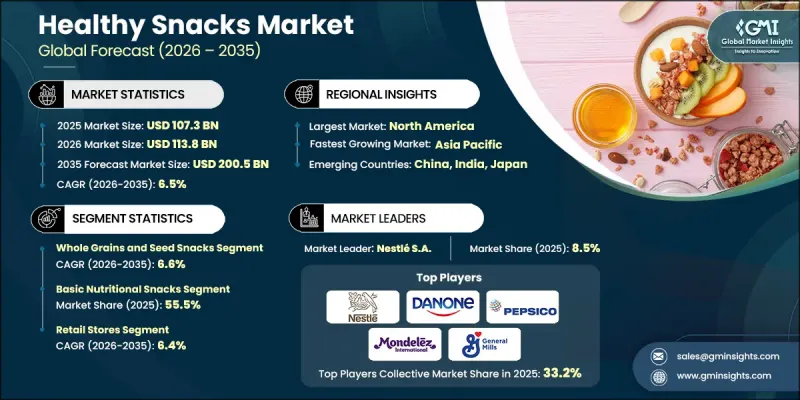
The expansion of this market is driven by consumers' increasing awareness of health and wellness and their preference for convenient, nutrient-rich foods. Health-conscious buyers are seeking snacks that provide essential nutrients, support weight management, and reduce the intake of processed and high-sugar foods. Healthy snacks deliver energy, essential vitamins, and minerals while promoting overall well-being. These products cater to specific dietary requirements, including vegan, gluten-free, and keto-friendly options, while avoiding artificial preservatives. The market serves multiple channels, with retailers offering products through supermarkets, health food stores, and e-commerce platforms, while the foodservice sector provides healthy options in cafes, vending machines, and convenience outlets. Innovations in portable snacks, including nuts, dried fruits, protein bars, and vegetable chips, are meeting the needs of consumers leading active lifestyles and seeking quick, nutritious options.
| Market Scope | |
|---|---|
| Start Year | 2025 |
| Forecast Year | 2026-2035 |
| Start Value | $107.3 Billion |
| Forecast Value | $200.5 Billion |
| CAGR | 6.5% |
The whole grain and seed snacks segment held a 20% share in 2025 and is expected to grow at a CAGR of 6.6% by 2035. The demand for natural, nutrient-dense snacks is driving this segment, as these products are rich in fiber and offer multiple health benefits. Fruit-based snacks are growing in popularity because consumers want sweet, vitamin-packed alternatives without excessive sugar. Nut and seed-based products remain strong performers due to their protein content, healthy fats, and ability to provide sustained energy for health-focused individuals.
The basic nutritional snacks segment accounted for 55.5% share in 2025 and is expected to grow at a CAGR of 6.2% from 2026 to 2035. Consumers continue to prefer simple, wholesome options that deliver essential nutrition. Snacks fortified with vitamins, minerals, and superfoods are increasingly popular as they address specific health concerns such as immunity, energy, and cognitive function. Functional health snacks that support digestive health, heart health, and weight management are gaining traction as consumers prioritize preventive care and wellness.
North America Healthy Snacks Market held a 36.2% share in 2025 and is growing rapidly. The region's healthy snacks market benefits from increasing consumer focus on clean-label and organic products, along with a rising prevalence of lifestyle-related health issues. Millennials and Gen Z are driving demand for functional snacks that provide protein enrichment, gut health benefits, and immune support. Convenience, portability, and easy-to-consume formats offered through supermarkets, convenience stores, and online channels are further fueling market growth.
Key players in the Global Healthy Snacks Market include PepsiCo, Inc., Nestle S.A., Danone S.A., Glanbia PLC, Hain Celestial Group, Inc., Mondelez
International, Inc., Hippeas, Simply Good Foods Company, Hormel Foods Corporation, and Kellanova Company. Companies in the Global Healthy Snacks Market are adopting multiple strategies to strengthen their market position and expand their footprint. They are investing in research and development to create innovative, functional products that meet evolving consumer demands for wellness and nutrition. Strategic partnerships with retailers and e-commerce platforms enhance distribution and accessibility, while targeted marketing campaigns highlight health benefits, sustainability, and clean-label credentials. Firms are also exploring acquisitions and collaborations to expand product portfolios and enter new geographic markets. Emphasis on packaging innovation, including eco-friendly and convenient designs, reinforces brand value. Companies are leveraging consumer insights and data analytics to anticipate trends, refine product offerings, and build long-term loyalty in competitive markets.
Table of Contents
Chapter 1 Methodology & Scope
- 1.1 Market scope and definition
- 1.2 Research design
- 1.2.1 Research approach
- 1.2.2 Data collection methods
- 1.3 Data mining sources
- 1.3.1 Global
- 1.3.2 Regional/Country
- 1.4 Base estimates and calculations
- 1.4.1 Base year calculation
- 1.4.2 Key trends for market estimation
- 1.5 Primary research and validation
- 1.5.1 Primary sources
- 1.6 Forecast model
- 1.7 Research assumptions and limitations
Chapter 2 Executive Summary
- 2.1 Industry 360° synopsis
- 2.2 Key market trends
- 2.2.1 Regional
- 2.2.2 Product
- 2.2.3 Function
- 2.2.4 Distribution channel
- 2.3 TAM Analysis, 2026-2035
- 2.4 CXO perspectives: Strategic imperatives
- 2.4.1 Executive decision points
Chapter 3 Industry Insights
- 3.1 Industry ecosystem analysis
- 3.1.1 Supplier landscape
- 3.1.2 Profit margin
- 3.1.3 Value addition at each stage
- 3.1.4 Factor affecting the value chain
- 3.1.5 Disruptions
- 3.2 Industry impact forces
- 3.2.1 Growth drivers
- 3.2.2 Industry pitfalls and challenges
- 3.2.3 Market opportunities
- 3.3 Growth potential analysis
- 3.4 Regulatory landscape
- 3.4.1 North America
- 3.4.2 Europe
- 3.4.3 Asia Pacific
- 3.4.4 Latin America
- 3.4.5 Middle East & Africa
- 3.5 Porter's analysis
- 3.6 PESTEL analysis
- 3.7 Price trends
- 3.7.1 By region
- 3.7.2 By type
- 3.8 Future market trends
- 3.9 Technology and Innovation landscape
- 3.9.1 Current technological trends
- 3.9.2 Emerging technologies
- 3.10 Patent Landscape
- 3.11 Trade statistics (HS code)
- 3.11.1 Major importing countries
- 3.11.2 Major exporting countries
- 3.12 Sustainability and environmental aspects
- 3.12.1 Sustainable practices
- 3.12.2 Waste reduction strategies
- 3.12.3 Energy efficiency in production
- 3.12.4 Eco-friendly initiatives
- 3.13 Carbon footprint consideration
Chapter 4 Competitive Landscape, 2025
- 4.1 Introduction
- 4.2 Company market share analysis
- 4.2.1 By region
- 4.2.1.1 North America
- 4.2.1.2 Europe
- 4.2.1.3 Asia Pacific
- 4.2.1.4 LATAM
- 4.2.1.5 MEA
- 4.2.1 By region
- 4.3 Company matrix analysis
- 4.4 Competitive analysis of major market players
- 4.5 Competitive positioning matrix
- 4.6 Key developments
- 4.6.1 Mergers & acquisitions
- 4.6.2 Partnerships & collaborations
- 4.6.3 New Product Launches
- 4.6.4 Expansion Plans
Chapter 5 Market Estimates and Forecast, By Product, 2022-2035 (USD Billion) (Kilo Tons)
- 5.1 Key trends
- 5.2 Whole grains and seeds snacks
- 5.3 Fruit-based snacks
- 5.4 Nut and seed-based snacks
- 5.5 Yogurt and dairy snacks
- 5.6 Vegetable snacks
- 5.7 Protein bars and snacks
- 5.8 Gluten-free and vegan snacks
- 5.9 Others
Chapter 6 Market Estimates and Forecast, By Function, 2022-2035 (USD Billion) (Kilo Tons)
- 6.1 Key trends
- 6.2 Basic nutritional snacks
- 6.3 Fortified/enhanced snacks
- 6.4 Functional health snacks
- 6.5 Sports & performance
Chapter 7 Market Estimates and Forecast, By Distribution Channel, 2022-2035 (USD Billion) (Kilo Tons)
- 7.1 Key trends
- 7.2 Retail stores
- 7.3 Online retail
- 7.4 Vending machines
- 7.5 Direct-to-consumer
Chapter 8 Market Estimates and Forecast, By Region, 2022-2035 (USD Billion) (Kilo Tons)
- 8.1 Key trends
- 8.2 North America
- 8.2.1 U.S.
- 8.2.2 Canada
- 8.3 Europe
- 8.3.1 Germany
- 8.3.2 UK
- 8.3.3 France
- 8.3.4 Spain
- 8.3.5 Italy
- 8.3.6 Rest of Europe
- 8.4 Asia Pacific
- 8.4.1 China
- 8.4.2 India
- 8.4.3 Japan
- 8.4.4 Australia
- 8.4.5 South Korea
- 8.4.6 Rest of Asia Pacific
- 8.5 Latin America
- 8.5.1 Brazil
- 8.5.2 Mexico
- 8.5.3 Argentina
- 8.5.4 Rest of Latin America
- 8.6 Middle East and Africa
- 8.6.1 Saudi Arabia
- 8.6.2 South Africa
- 8.6.3 UAE
- 8.6.4 Rest of Middle East and Africa
Chapter 9 Company Profiles
- 9.1 Danone S.A.
- 9.2 General Mills, Inc.
- 9.3 Glanbia PLC
- 9.4 Hain Celestial Group, Inc.
- 9.5 Hippeas
- 9.6 Hormel Foods Corporation
- 9.7 Kellanova Company
- 9.8 Mondelez International, Inc.
- 9.9 Nestle S.A.
- 9.10 PepsiCo, Inc.
- 9.11 Simply Good Foods Company

