
PUBLISHER: Global Market Insights Inc. | PRODUCT CODE: 2019153

PUBLISHER: Global Market Insights Inc. | PRODUCT CODE: 2019153
Hybrid Generator Sets Market Opportunity, Growth Drivers, Industry Trend Analysis, and Forecast 2026 - 2035
The Global Hybrid Generator Sets Market was valued at USD 4.8 billion in 2025 and is estimated to grow at a CAGR of 8.7% to reach USD 11.1 billion by 2035.
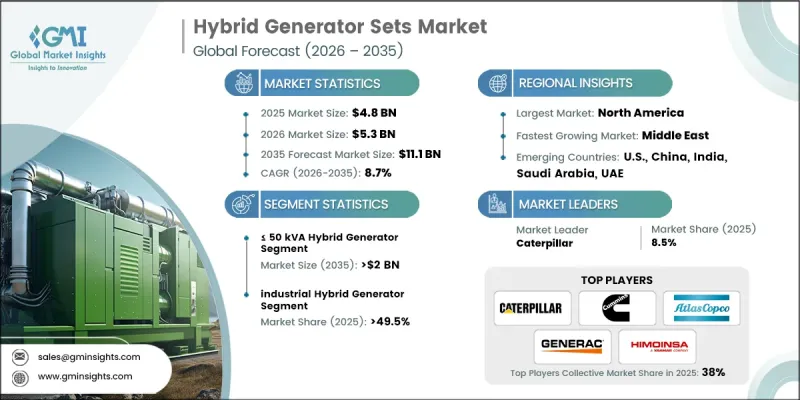
Growth in the hybrid generator sets market is being driven by rising concerns over emissions and the increasing instability of power grid infrastructure. Businesses and consumers are actively seeking reliable and efficient backup power solutions that can ensure uninterrupted operations. Hybrid generator sets offer enhanced fuel efficiency, consistent performance, and the ability to deliver continuous electricity during outages, making them highly attractive across multiple sectors. The integration of cleaner energy technologies is further strengthening their market appeal, as organizations focus on reducing environmental impact while maintaining operational reliability. In addition, increasing demand for energy security and the need for cost-effective power alternatives are supporting wider adoption. Advancements in energy management technologies and the shift toward sustainable energy systems are expected to accelerate the growth trajectory of the hybrid generator sets market over the forecast period.
| Market Scope | |
|---|---|
| Start Year | 2025 |
| Forecast Year | 2026-2035 |
| Start Value | $4.8 Billion |
| Forecast Value | $11.1 Billion |
| CAGR | 8.7% |
The hybrid generator sets industry continues to evolve as energy systems become more diversified and technologically advanced. These systems combine conventional power generation with alternative energy inputs, enabling improved efficiency and reduced fuel dependency. By incorporating intelligent energy management solutions, hybrid generators optimize power usage while lowering emissions and operational costs. Their growing deployment across sectors that require an uninterrupted electricity supply is reinforcing market demand. The increasing reliance on dependable power infrastructure and the rising need to minimize operational disruptions are further contributing to the expansion of the hybrid generator sets market.
The <= 50 kVA segment in the hybrid generator sets market is anticipated to reach USD 2 billion by 2035. Growth in this segment is being supported by the rising frequency of power disruptions and the need for compact, cost-efficient power solutions. Smaller-capacity systems are gaining popularity due to their affordability, ease of installation, and suitability for localized applications. The focus on operational efficiency and reduced energy consumption is encouraging the adoption of these systems, particularly in environments where lower power output is sufficient but reliability remains critical.
The industrial segment accounted for 49.5% share in 2025, driven by increasing deployment across various industrial operations. Expanding industrialization and ongoing infrastructure development are creating significant demand for reliable power systems. The need for continuous electricity supply in remote and off-grid locations is further strengthening segment growth. Government initiatives aimed at improving electrification levels and enhancing energy accessibility are also contributing to the broader adoption of hybrid generator technologies across industrial applications.
U.S. Hybrid Generator Sets Market was valued at USD 1.6 billion in 2025. Expansion in this region is supported by increasing demand for stable power solutions across critical sectors and the ongoing modernization of aging grid infrastructure. Rising electricity consumption and the need for uninterrupted operations are encouraging the deployment of hybrid systems. Additionally, the growing emphasis on energy resilience and efficiency is further supporting market development. The broader Asia Pacific generator sets market is also expected to witness notable growth, driven by increasing power demand and infrastructure expansion.
Key players in the Global Hybrid Generator Sets Market AJC Power Solutions, Aksa Power Generation, Atlas Copco, Caterpillar, Cummins, Generac International, Genesal Energy, Guinault S.A., HIMOINSA, HIPOWER Systems, Inmesol, Jiangsu Longen Power Technology, Kohler Co., Mitsubishi Heavy Industries, MTU Onsite Energy, Polar Power, Pramac, STARKGEN, Teksan, Trime, Victron Energy, Zenoro B.V. Companies operating in the Global Hybrid Generator Sets Market are focusing on strengthening their competitive position through technological innovation, product diversification, and strategic partnerships. Manufacturers are investing in advanced energy management systems to improve efficiency and reduce emissions, aligning with global sustainability goals. Expanding production capabilities and enhancing distribution networks are key strategies to improve market reach and customer accessibility. Firms are also prioritizing the development of cost-effective and scalable solutions to cater to diverse end-user requirements. Collaborations with renewable energy providers are enabling the integration of cleaner energy sources into hybrid systems. In addition, companies are emphasizing after-sales services, maintenance support, and digital monitoring capabilities to enhance customer satisfaction and build long-term relationships, thereby reinforcing their market presence.
Table of Contents
Chapter 1 Methodology & Scope
- 1.1 Research approach
- 1.2 Quality commitments
- 1.2.1 GMI AI policy & data integrity commitment
- 1.2.1.1 Source consistency protocol
- 1.2.1 GMI AI policy & data integrity commitment
- 1.3 Research trail & confidence scoring
- 1.3.1 Research trail components
- 1.3.2 Scoring components
- 1.4 Data collection
- 1.4.1 Partial list of primary sources
- 1.5 Data mining sources
- 1.5.1 Paid sources
- 1.5.1.1 Sources, by region
- 1.5.1 Paid sources
- 1.6 Base estimates and calculations
- 1.6.1 Base year calculation for any one approach
- 1.7 Market estimates & forecasts parameters
- 1.8 Forecast model
- 1.8.1 Quantified market impact analysis
- 1.8.1.1 Mathematical impact of growth parameters on forecast
- 1.8.1 Quantified market impact analysis
- 1.9 Research transparency addendum
- 1.9.1 Source attribution framework
- 1.9.2 Quality assurance metrics
- 1.9.3 Our commitment to trust
- 1.10 Market definitions
Chapter 2 Executive Summary
- 2.1 Industry synopsis, 2022 - 2035
- 2.1.1 Business trends
- 2.1.2 Power rating trends
- 2.1.3 End use trends
- 2.1.4 Application trends
- 2.1.5 Regional trends
Chapter 3 Industry Insights
- 3.1 Industry ecosystem analysis
- 3.1.1 Raw material availability & sourcing analysis
- 3.1.2 Manufacturing capacity assessment
- 3.1.3 Supply chain resilience & risk factors
- 3.1.4 Distribution network analysis
- 3.2 Industry impact forces
- 3.2.1 Growth drivers
- 3.2.2 Industry pitfalls & challenges
- 3.3 Regulatory landscape
- 3.4 Growth potential analysis
- 3.5 Porter's analysis
- 3.5.1 Bargaining power of suppliers
- 3.5.2 Bargaining power of buyers
- 3.5.3 Threat of new entrants
- 3.5.4 Threat of substitutes
- 3.6 PESTEL analysis
- 3.6.1 Political factors
- 3.6.2 Economic factors
- 3.6.3 Social factors
- 3.6.4 Technological factors
- 3.6.5 Legal factors
- 3.6.6 Environmental factors
- 3.7 Cost structure analysis of hybrid generator sets
- 3.8 Emerging opportunities & trends
- 3.9 Digitalization & IoT integration
- 3.10 Investment analysis & future prospects
- 3.11 Price trend analysis (USD/Unit) (Driven by Primary Research)
- 3.11.1 By region (Driven by Primary Research)
- 3.11.2 By power rating (Driven by Primary Research)
- 3.12 Trade data analysis (Driven by Primary Research)
- 3.12.1 Import/export value trends (Driven by Primary Research)
- 3.12.2 Key trade corridors & tariff impact (Driven by Primary Research)
- 3.13 Capacity & production landscape (Driven by Primary Research)
- 3.13.1 Capacity by region & key producer (Driven by Primary Research)
- 3.13.2 Capacity utilization rates & expansion pipelines (Driven by Primary Research)
- 3.14 Impact of AI & Generative AI on the market (Core Solution)
- 3.14.1 AI-Driven production optimization (Core Solution)
- 3.14.2 Predictive maintenance & fault detection (Core Solution)
Chapter 4 Competitive Landscape, 2026
- 4.1 Introduction
- 4.2 Company market share analysis, by region, 2025
- 4.2.1 North America
- 4.2.2 Europe
- 4.2.3 Asia Pacific
- 4.2.4 Middle East
- 4.2.5 Africa
- 4.2.6 Latin America
- 4.3 Competitive positioning matrix
- 4.4 Key developments
- 4.4.1 Mergers & acquisitions
- 4.4.2 Partnerships & collaborations
- 4.4.3 New product launches
- 4.4.4 Expansion plans & funding
Chapter 5 Market Size and Forecast, By Power Rating, 2022 - 2035 (USD Million & '000 Units)
- 5.1 Key trends
- 5.2 ≤ 50 kVA
- 5.3 > 50 kVA - 125 kVA
- 5.4 > 125 kVA - 200 kVA
- 5.5 > 200 kVA - 330 kVA
- 5.6 > 330 kVA - 750 kVA
- 5.7 > 750 kVA
Chapter 6 Market Size and Forecast, By End Use, 2022 - 2035 (USD Million & '000 Units)
- 6.1 Key trends
- 6.2 Residential
- 6.3 Commercial
- 6.4 Industrial
Chapter 7 Market Size and Forecast, By Application, 2022 - 2035 (USD Million & '000 Units)
- 7.1 Key trends
- 7.2 Standby
- 7.3 Peak shaving
- 7.4 Prime/continuous
Chapter 8 Market Size and Forecast, By Region, 2022 - 2035 (USD Million & '000 Units)
- 8.1 Key trends
- 8.2 North America
- 8.2.1 U.S.
- 8.2.2 Canada
- 8.3 Europe
- 8.3.1 Russia
- 8.3.2 UK
- 8.3.3 Germany
- 8.3.4 France
- 8.3.5 Spain
- 8.3.6 Austria
- 8.3.7 Italy
- 8.4 Asia Pacific
- 8.4.1 China
- 8.4.2 Australia
- 8.4.3 India
- 8.4.4 Japan
- 8.4.5 South Korea
- 8.4.6 Indonesia
- 8.4.7 Vietnam
- 8.4.8 Philippines
- 8.5 Middle East
- 8.5.1 Saudi Arabia
- 8.5.2 UAE
- 8.5.3 Qatar
- 8.5.4 Turkey
- 8.5.5 Iran
- 8.5.6 Oman
- 8.6 Africa
- 8.6.1 Egypt
- 8.6.2 Nigeria
- 8.6.3 Algeria
- 8.6.4 South Africa
- 8.7 Latin America
- 8.7.1 Brazil
- 8.7.2 Mexico
- 8.7.3 Argentina
Chapter 9 Company Profiles
- 9.1 AJC Power Solutions
- 9.2 Aksa Power Generation
- 9.3 Atlas Copco
- 9.4 Caterpillar
- 9.5 Cummins
- 9.6 Generac International
- 9.7 Genesal Energy
- 9.8 Guinault S.A.
- 9.9 HIMOINSA
- 9.10 HIPOWER Systems
- 9.11 Inmesol
- 9.12 Jiangsu Longen Power Technology
- 9.13 Kohler Co.
- 9.14 Mitsubishi Heavy Industries
- 9.15 MTU Onsite Energy
- 9.16 Polar Power
- 9.17 Pramac
- 9.18 STARKGEN
- 9.19 Teksan
- 9.20 Trime
- 9.21 Victron Energy
- 9.22 Zenoro B.V.

