PUBLISHER: Global Market Insights Inc. | PRODUCT CODE: 2019167

PUBLISHER: Global Market Insights Inc. | PRODUCT CODE: 2019167
Power Sports Market Opportunity, Growth Drivers, Industry Trend Analysis, and Forecast 2026 - 2035
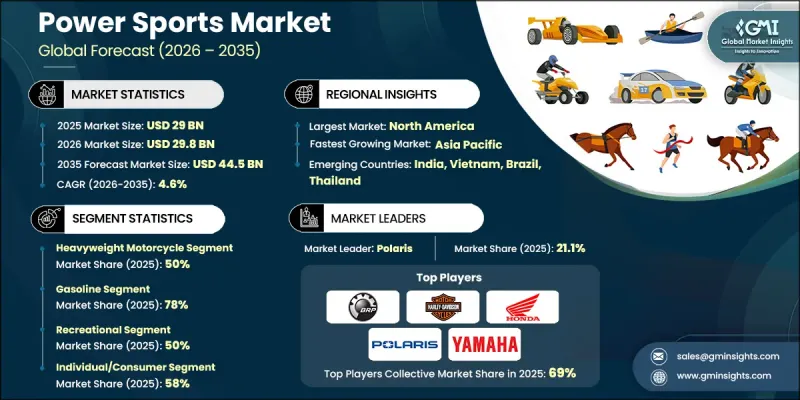
The Global Power Sports Market was valued at USD 29 billion in 2025 and is estimated to grow at a CAGR of 4.6% to reach USD 44.5 billion by 2035.
The industry is witnessing steady growth as outdoor recreation and adventure-driven activities continue to gain momentum worldwide. Rising consumer interest in exploration-based experiences and leisure mobility is encouraging greater participation in off-road and water-based activities. This trend is directly influencing the demand for power sports vehicles across multiple segments. Increasing engagement in outdoor lifestyles has also contributed to a broader consumer base seeking performance-oriented recreational equipment. In addition, improvements in vehicle durability and performance capabilities are enhancing product appeal among both enthusiasts and casual users. The market is further supported by growing awareness of recreational mobility solutions and the availability of a wide variety of vehicles tailored to different terrains and usage needs. Expanding distribution networks and strong replacement demand are also playing a key role in sustaining market expansion across regions.
| Market Scope | |
|---|---|
| Start Year | 2025 |
| Forecast Year | 2026-2035 |
| Start Value | $29 Billion |
| Forecast Value | $44.5 Billion |
| CAGR | 4.6% |
The expansion of the power sports industry is strongly influenced by continuous advancements in engineering and vehicle technology. Manufacturers are focusing on enhancing engine efficiency, refining suspension systems, and integrating advanced safety mechanisms to improve overall ride quality and durability. Modern drivetrain systems and electronic control features are being developed to optimize performance across varying terrains and operating conditions. These innovations are increasing the reliability and functionality of power sports vehicles, making them more appealing to a wider audience. Enhanced vehicle control, improved stability, and better handling capabilities are contributing to a more refined user experience, which continues to support long-term market growth.
The heavyweight motorcycle segment accounted for a share of 50% in 2025 and is expected to grow at a CAGR of 4.2% from 2026 to 2035. This segment continues to dominate due to its strong association with long-distance recreational riding and high-performance touring experiences. Motorcycles within this category are widely preferred for their engine capacity, stability, and ability to deliver a powerful riding experience. Consumers are increasingly drawn to these vehicles for leisure travel and performance-driven usage. Ongoing product enhancements focused on comfort, control, and durability are further strengthening demand within this segment. The segment's ability to cater to both recreational and enthusiast riders continues to reinforce its leading position in the market.
The gasoline segment held 78% share in 2025 and is projected to grow at a CAGR of 3.4% through 2035. Gasoline-powered vehicles remain dominant due to their strong performance characteristics, including higher power output and faster acceleration. These vehicles are widely used across different power sports categories because of their reliability and ability to operate efficiently over extended distances. Consumers continue to favor gasoline engines for their consistent performance across diverse terrains and challenging environments. Manufacturers are maintaining a strong focus on refining gasoline-powered systems to enhance fuel efficiency while preserving performance standards, ensuring sustained demand across the segment.
United States Power Sports Market accounted for 85% share, generating USD 13.1 billion in 2025. Market growth in the country is driven by a strong culture of outdoor recreation and a well-established ecosystem supporting recreational vehicle usage. Consumers actively engage in terrain-based and water-based activities, which continues to create consistent demand for power sports vehicles. The presence of an extensive dealership network and wide product availability further strengthens market penetration. Additionally, strong manufacturer presence and continuous product innovation contribute to maintaining steady growth. The combination of consumer interest, accessibility, and product diversity continues to position the United States as a leading market within the region.
Key players operating in the Global Power Sports Market include BRP, Yamaha Motor, Polaris, Honda Motor, Kawasaki Heavy, Suzuki Motor, Textron, CFMOTO, KYMCO, and Harley Davidson. Companies in the Global Power Sports Market are strengthening their position through continuous investment in product innovation and performance enhancement. They are focusing on developing advanced engine systems, improving fuel efficiency, and integrating smart technologies to deliver superior user experiences. Strategic expansion of distribution networks and dealership partnerships is helping companies increase market reach and customer accessibility. Firms are also emphasizing brand differentiation through design innovation and customization options to attract diverse consumer segments. In addition, manufacturers are prioritizing after-sales services and customer engagement initiatives to build long-term loyalty. Collaborations and partnerships aimed at technology development and supply chain optimization are further supporting competitive advantage and sustained growth.
Table of Contents
Chapter 1 Methodology
- 1.1 Research approach
- 1.2 Quality Commitments
- 1.2.1 GMI AI policy & data integrity commitment
- 1.2.1.1 Source consistency protocol
- 1.2.1 GMI AI policy & data integrity commitment
- 1.3 Research Trail & Confidence Scoring
- 1.3.1 Research Trail Components
- 1.3.2 Scoring Components
- 1.4 Data Collection
- 1.4.1 Partial list of primary sources
- 1.5 Data mining sources
- 1.5.1 Paid sources
- 1.5.1.1 Sources, by region
- 1.5.1 Paid sources
- 1.6 Base estimates and calculations
- 1.6.1 Base year calculation for any one approach
- 1.7 Forecast model
- 1.7.1 Quantified market impact analysis
- 1.7.1.1 Mathematical impact of growth parameters on forecast
- 1.7.1 Quantified market impact analysis
- 1.8 Research transparency addendum
- 1.8.1 Source attribution framework
- 1.8.2 Quality assurance metrics
- 1.8.3 Our commitment to trust
Chapter 2 Executive Summary
- 2.1 Industry 360° synopsis, 2022 - 2035
- 2.2 Key market trends
- 2.2.1 Regional
- 2.2.2 Vehicle
- 2.2.3 Propulsion
- 2.2.4 Application
- 2.2.5 End-User
- 2.3 TAM Analysis, 2026-2035
- 2.4 CXO perspectives: Strategic imperatives
Chapter 3 Industry Insights
- 3.1 Industry ecosystem analysis
- 3.1.1 Supplier landscape
- 3.1.2 Profit margin analysis
- 3.1.3 Cost structure
- 3.1.4 Value addition at each stage
- 3.1.5 Factor affecting the value chain
- 3.1.6 Disruptions
- 3.2 Industry impact forces
- 3.2.1 Growth drivers
- 3.2.1.1 Growth in outdoor recreation participation
- 3.2.1.2 Expansion of adventure tourism
- 3.2.1.3 Product innovation and vehicle performance improvements
- 3.2.1.4 Rising recreational vehicle ownership
- 3.2.2 Industry pitfalls and challenges
- 3.2.2.1 High purchase and maintenance costs
- 3.2.2.2 Safety concerns and accident risks
- 3.2.3 Market opportunities
- 3.2.3.1 Growth of electric power sports vehicles
- 3.2.3.2 Expansion of recreational tourism parks
- 3.2.3.3 Development of connected and smart vehicles
- 3.2.1 Growth drivers
- 3.3 Growth potential analysis
- 3.4 Regulatory landscape
- 3.4.1 North America
- 3.4.1.1 United States off road vehicle safety and CPSC regulations
- 3.4.1.2 Federal land access and off road vehicle management policies
- 3.4.1.3 EPA emission standards for off road engines
- 3.4.1.4 Canada off road vehicle safety and registration requirements
- 3.4.2 Europe
- 3.4.2.1 EU vehicle type approval for motorcycles and off road vehicles
- 3.4.2.2 UNECE vehicle safety and braking regulations
- 3.4.2.3 National vehicle homologation and usage restrictions
- 3.4.2.4 Environmental and noise emission standards
- 3.4.3 Asia Pacific
- 3.4.3.1 China off road vehicle manufacturing and emission regulations
- 3.4.3.2 India quadricycle and motorcycle homologation standards
- 3.4.3.3 Japan vehicle safety and mobility regulations
- 3.4.3.4 Australia off road vehicle safety standards
- 3.4.3.5 ASEAN vehicle certification frameworks
- 3.4.4 Latin America
- 3.4.4.1 Brazil off road vehicle safety and environmental regulations
- 3.4.4.2 Argentina off road vehicle registration regulations
- 3.4.4.3 Mexico vehicle manufacturing and safety standards
- 3.4.4.4 Regional recreational vehicle regulatory frameworks
- 3.4.5 Middle East & Africa
- 3.4.5.1 UAE off road vehicle licensing regulations
- 3.4.5.2 Saudi Arabia vehicle safety inspection standards
- 3.4.5.3 South Africa off road vehicle registration standards
- 3.4.1 North America
- 3.5 Porter's analysis
- 3.6 PESTEL analysis
- 3.7 Technology and innovation landscape
- 3.7.1 Current technological trends
- 3.7.2 Emerging technologies
- 3.8 Pricing Analysis (Driven by primary research)
- 3.8.1 Historical Price Trend Analysis
- 3.8.2 Pricing Strategy by Player Type
- 3.9 Trade Data Analysis (Driven by paid database)
- 3.9.1 Import/export volume & value trends
- 3.9.2 Key trade corridors & tariff impact
- 3.10 Capacity & Production Landscape (Driven by primary research)
- 3.10.1 Installed Capacity by Region & Key Producer
- 3.10.2 Capacity Utilization Rates & Expansion Pipelines
- 3.11 Cost breakdown analysis
- 3.12 Patent analysis (Driven by primary research)
- 3.13 Sustainability and environmental aspects
- 3.13.1 Sustainable practices
- 3.13.2 Waste reduction strategies
- 3.13.3 Energy efficiency in production
- 3.13.4 Eco-friendly Initiatives
- 3.13.5 Carbon footprint considerations
- 3.14 Impact of AI and Generative AI on the Market
- 3.14.1 AI Driven Disruption of Existing Business Models
- 3.14.2 GenAI Use Cases and Adoption Roadmap by Segment
- 3.14.3 Risks Limitations and Regulatory Considerations
- 3.15 Forecast assumptions & scenario analysis (Driven by primary research)
- 3.15.1 Base Case- Key Macro & Industry Variables Driving CAGR
- 3.15.2 Optimistic Scenarios- Favorable macro and industry tailwinds
- 3.15.3 Pessimistic Scenario - Macroeconomic slowdown or industry headwinds
Chapter 4 Competitive Landscape, 2025
- 4.1 Introduction
- 4.2 Company market share analysis
- 4.2.1 North America
- 4.2.2 Europe
- 4.2.3 Asia Pacific
- 4.2.4 LATAM
- 4.2.5 MEA
- 4.3 Competitive analysis of major market players
- 4.4 Competitive positioning matrix
- 4.5 Key developments
- 4.5.1 Mergers & acquisitions
- 4.5.2 Partnerships & collaborations
- 4.5.3 New Product Launches
- 4.5.4 Expansion Plans and funding
Chapter 5 Market Estimates & Forecast, By Vehicle, 2022 - 2035 (USD Mn, Units)
- 5.1 Key trends
- 5.2 Side By Side Vehicle
- 5.3 All-Terrain Vehicle
- 5.4 Heavyweight Motorcycle
- 5.5 Personal Watercrafts
- 5.6 Snowmobile
Chapter 6 Market Estimates & Forecast, By Propulsion, 2022 - 2035 (USD Mn, Units)
- 6.1 Key trends
- 6.2 Gasoline
- 6.3 Diesel
- 6.4 Electric
Chapter 7 Market Estimates & Forecast, By Application, 2022 - 2035 (USD Mn, Units)
- 7.1 Key trends
- 7.2 Recreational
- 7.3 Utility
- 7.4 Commercial
- 7.5 Sports
- 7.6 Construction
- 7.7 Defense
Chapter 8 Market Estimates & Forecast, By End-User, 2022 - 2035 (USD Mn, Units)
- 8.1 Key trends
- 8.2 Individual/Consumer
- 8.3 Commercial
- 8.4 Government/Military
- 8.5 Rental/Tour Operators
- 8.6 Others
Chapter 9 Market Estimates & Forecast, By Region, 2022 - 2035 (USD Mn, Units)
- 9.1 Key trends
- 9.2 North America
- 9.2.1 US
- 9.2.2 Canada
- 9.3 Europe
- 9.3.1 Germany
- 9.3.2 UK
- 9.3.3 France
- 9.3.4 Italy
- 9.3.5 Spain
- 9.3.6 Russia
- 9.3.7 Norway
- 9.3.8 Netherlands
- 9.3.9 Sweden
- 9.4 Asia Pacific
- 9.4.1 China
- 9.4.2 India
- 9.4.3 Japan
- 9.4.4 Australia
- 9.4.5 South Korea
- 9.4.6 Singapore
- 9.4.7 Thailand
- 9.4.8 Indonesia
- 9.4.9 Vietnam
- 9.5 Latin America
- 9.5.1 Brazil
- 9.5.2 Mexico
- 9.5.3 Argentina
- 9.6 MEA
- 9.6.1 South Africa
- 9.6.2 Saudi Arabia
- 9.6.3 UAE
- 9.6.4 Turkey
Chapter 10 Company Profiles
- 10.1 Global Players
- 10.1.1 BRP
- 10.1.2 CFMOTO
- 10.1.3 Harley Davidson
- 10.1.4 Honda Motor
- 10.1.5 Kawasaki
- 10.1.6 KYMCO
- 10.1.7 Polaris
- 10.1.8 Suzuki Motor
- 10.1.9 Textron
- 10.1.10 Yamaha Motor
- 10.2 Regional Players
- 10.2.1 Argo
- 10.2.2 Hisun Motors
- 10.2.3 Linhai
- 10.2.4 Massimo Motor
- 10.2.5 TGB Taiwan Golden Bee
- 10.2.6 Tracker Off Road
- 10.3 Emerging Players Disruptors
- 10.3.1 DRR USA
- 10.3.2 ODES Industries
- 10.3.3 Segway Powersports
- 10.3.4 Volcon

