PUBLISHER: Global Market Insights Inc. | PRODUCT CODE: 2019178

PUBLISHER: Global Market Insights Inc. | PRODUCT CODE: 2019178
Industrial Emission Control System Market Opportunity, Growth Drivers, Industry Trend Analysis, and Forecast 2026 - 2035
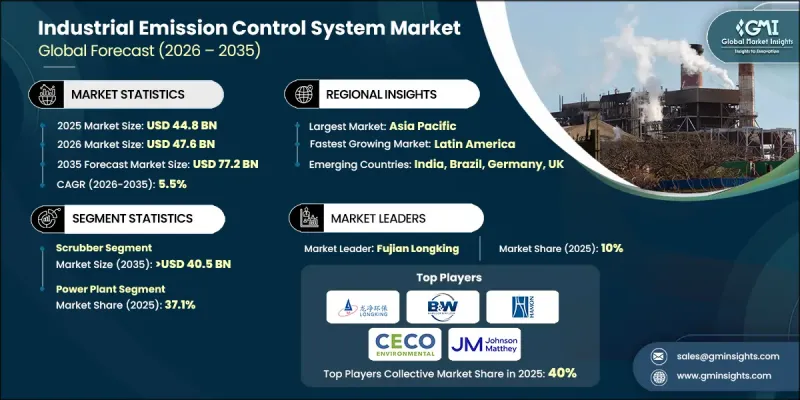
The Global Industrial Emission Control System Market was valued at USD 44.8 billion in 2025 and is estimated to grow at a CAGR of 5.5% to reach USD 77.2 billion by 2035.
The market growth is driven by stricter environmental regulations and emission limits across energy-intensive industries, including power generation, manufacturing, and chemical processing. Governments and environmental agencies worldwide are implementing rigorous standards to reduce pollutants such as sulfur oxides, nitrogen oxides, particulate matter, volatile organic compounds, and carbon emissions. As environmental awareness rises, companies are increasingly adopting advanced emission control solutions, including selective catalytic reduction (SCR) systems, electrostatic precipitators (ESPs), and carbon capture technologies. The push toward cleaner energy production, coupled with substantial investments in sustainable infrastructure, is further accelerating demand. Industries are integrating emission control systems into their operations not only to comply with regulations but also to achieve operational efficiency, reduce environmental impact, and align with corporate sustainability goals. The need for reliable, high-performance emission control solutions is more critical than ever as companies balance economic and ecological priorities.
| Market Scope | |
|---|---|
| Start Year | 2025 |
| Forecast Year | 2026-2035 |
| Start Value | $44.8 Billion |
| Forecast Value | $77.2 Billion |
| CAGR | 5.5% |
The scrubber segment is projected to reach USD 40.5 billion by 2035, with growth fueled by advancements in dust collection systems and increasing adoption of oil mist control technologies. These systems are essential for mitigating particulate emissions and improving operational safety in industrial applications.
The power generation sector captured 37.1% share in 2025 and is anticipated to grow at a CAGR of 5.4% by 2035. The growth is supported by expanding energy infrastructure worldwide and stricter enforcement of emission control standards. Investments in cleaner technologies, coupled with retrofitting existing facilities, are enabling plants to maintain regulatory compliance while optimizing operational efficiency. As industries adopt modern emission control equipment, they also benefit from reduced environmental penalties, enhanced energy efficiency, improved workplace safety, and further drive market adoption.
U.S. Industrial Emission Control System Market held a 67% share in 2025, generating USD 4.8 billion. The strong market position is supported by rapid industrial growth, stringent environmental legislation, and increasing focus on air quality. U.S. industries are actively deploying emission control solutions to comply with federal and state-level environmental mandates. The market is further bolstered by technological innovation, with companies investing in intelligent systems that integrate monitoring, predictive maintenance, and real-time emission reporting. The emphasis on cleaner production and sustainable energy practices in both the U.S. and Canada continues to create opportunities for market expansion, as industrial players prioritize compliance, efficiency, and environmental stewardship in their operations.
Key players in the Global Industrial Emission Control System Market include ACS Industries, A.C.T. Dust Collectors, Air Quality Engineering, Anguil Environmental Systems, APC Technologies, Airnord, Aquest Corporation, Babcock & Wilcox, CECO Environmental, Ducon Technologies, Durr Group, Fuel Tech, Fujian Longking, KC Cottrell, General Electric, Hamon, Honeywell International, Johnson Matthey, Mitsubishi Heavy Industries, Thermax. Companies operating in the Global Industrial Emission Control System Market employ several strategies to strengthen their market presence and competitive edge. Key approaches include heavy investment in research and development to advance emission reduction technologies, enhancing product efficiency, and ensuring compliance with evolving environmental standards. Strategic partnerships and collaborations with energy, manufacturing, and industrial firms allow companies to expand their installation networks and project portfolios. Firms are also focusing on geographic expansion into emerging markets with growing industrial bases and stricter environmental regulations. Mergers and acquisitions help consolidate capabilities, while sustainability-driven product innovation supports long-term growth. Providing digital monitoring solutions, predictive maintenance services, and integrated emission management platforms increases customer retention and accelerates adoption across sectors.
Table of Contents
Chapter 1 Methodology & Scope
- 1.1 Research approach
- 1.2 Quality commitment
- 1.2.1 GMI AI policy & data integrity commitment
- 1.2.1.1 Source consistency protocol
- 1.2.1 GMI AI policy & data integrity commitment
- 1.3 Research Trail & Confidence Scoring
- 1.3.1 Research Trail Components
- 1.3.2 Scoring Components
- 1.4 Data Collection
- 1.4.1 Partial list of primary sources
- 1.5 Data mining sources
- 1.5.1 Paid sources
- 1.5.1.1 Sources, by region
- 1.5.1 Paid sources
- 1.6 Base estimates and calculations
- 1.6.1 Base year calculation for any one approach
- 1.7 Forecast model
- 1.8 Research transparency addendum
- 1.8.1 Source attribution framework
- 1.8.2 Quality assurance metrics
- 1.8.3 Our commitment to trust
- 1.9 Market definitions
Chapter 2 Executive Summary
- 2.1 Industry synopsis, 2022 - 2035
- 2.1.1 Business trends
- 2.1.2 System trends
- 2.1.3 Industry trends
- 2.1.4 Regional trends
Chapter 3 Industry Insights
- 3.1 Industry ecosystem analysis
- 3.2 Regulatory landscape
- 3.3 Industry impact forces
- 3.3.1 Growth drivers
- 3.3.1.1 Stringent government framework and industry standards for emission control
- 3.3.1.2 Stricter government mandates toward reducing carbon footprint
- 3.3.2 Industry pitfalls & challenges
- 3.3.2.1 High installation & retrofitting cost and performance issues
- 3.3.1 Growth drivers
- 3.4 Growth potential analysis
- 3.5 Porter's analysis
- 3.5.1 Bargaining power of suppliers
- 3.5.2 Bargaining power of buyers
- 3.5.3 Threat of new entrants
- 3.5.4 Threat of substitutes
- 3.6 PESTEL analysis
- 3.6.1 Political factors
- 3.6.2 Economic factors
- 3.6.3 Social factors
- 3.6.4 Technology factors
- 3.6.5 environmental factors
- 3.6.6 Legal factors
- 3.7 Emerging opportunities & trends
- 3.7.1 Digitalization and IoT integration
- 3.7.2 Emerging market penetration
Chapter 4 Competitive landscape, 2026
- 4.1 Introduction
- 4.2 Company market share analysis, 2025
- 4.2.1 North America
- 4.2.2 Europe
- 4.2.3 Asia Pacific
- 4.2.4 Middle East & Africa
- 4.2.5 Latin America
- 4.3 Strategic initiatives
- 4.4 Competitive benchmarking
- 4.5 Strategic dashboard
- 4.6 Innovation & technology landscape
Chapter 5 Market Size and Forecast, By System, 2022 - 2035 (USD Million)
- 5.1 Key trends
- 5.2 Electrostatic precipitators
- 5.3 Catalytic systems
- 5.4 Absorbers
- 5.5 Scrubbers
- 5.6 Others
Chapter 6 Market Size and Forecast, By Industry, 2022 - 2035 (USD Million)
- 6.1 Key trends
- 6.2 Power Plants
- 6.3 Chemical & Petrochemical
- 6.4 Cement
- 6.5 Metal
- 6.6 Manufacturing
- 6.7 Others
Chapter 7 Market Size and Forecast, By Region, 2022 - 2035 (USD Million)
- 7.1 Key trends
- 7.2 North America
- 7.2.1 U.S.
- 7.2.2 Canada
- 7.2.3 Mexico
- 7.3 Europe
- 7.3.1 Germany
- 7.3.2 France
- 7.3.3 Spain
- 7.3.4 UK
- 7.3.5 Italy
- 7.3.6 Netherlands
- 7.4 Asia Pacific
- 7.4.1 China
- 7.4.2 India
- 7.4.3 Japan
- 7.4.4 Indonesia
- 7.4.5 Australia
- 7.4.6 South Korea
- 7.5 Middle East & Africa
- 7.5.1 Saudi Arabia
- 7.5.2 UAE
- 7.5.3 South Africa
- 7.6 Latin America
- 7.6.1 Brazil
- 7.6.2 Argentina
- 7.6.3 Chile
Chapter 8 Company Profiles
- 8.1 ACS Industries
- 8.2 A.C.T. Dust Collectors
- 8.3 Air Quality Engineering
- 8.4 Anguil Environmental Systems
- 8.5 APC Technologies
- 8.6 Airnord
- 8.7 Aquest Corporation
- 8.8 Babcock & Wilcox
- 8.9 CECO Environmental
- 8.10 Ducon Technologies
- 8.11 Durr Group
- 8.12 Fuel Tech
- 8.13 Fujian Longking
- 8.14 KC Cottrell
- 8.15 General Electric
- 8.16 Hamon
- 8.17 Honeywell International
- 8.18 Johnson Matthey
- 8.19 Mitsubishi Heavy Industries
- 8.20 Thermax

