
PUBLISHER: Global Market Insights Inc. | PRODUCT CODE: 2019197

PUBLISHER: Global Market Insights Inc. | PRODUCT CODE: 2019197
Cocoa Bean Derivatives Market Opportunity, Growth Drivers, Industry Trend Analysis, and Forecast 2026 - 2035
The Global Cocoa Bean Derivatives Market was valued at USD 53.9 billion in 2025 and is estimated to grow at a CAGR of 3.3% to reach USD 74.9 billion by 2035.
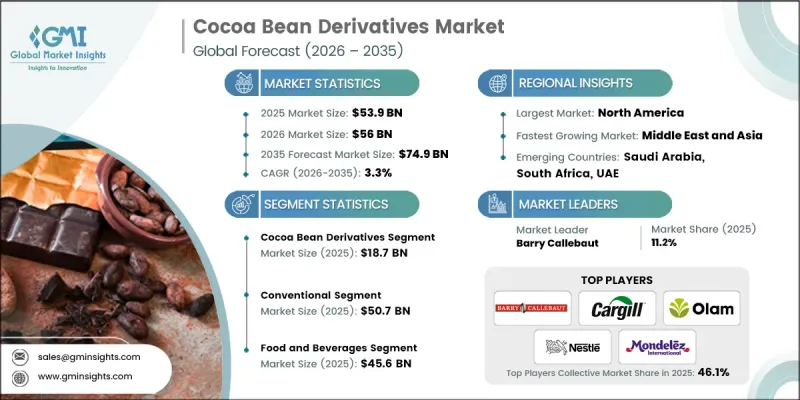
Growth is driven by the rising demand for cocoa-based products across food, beverage, personal care, and industrial applications. Cocoa derivatives, including cocoa liquor, cocoa butter, cocoa powder, cocoa cake, and cocoa shell by-products, are produced through post-fermentation processes such as drying, roasting, and grinding. Cocoa liquor, a semi-liquid paste of cocoa solids and cocoa butter, is pressed to separate cocoa butter from cocoa cake, which is further processed into cocoa powder. Modern processing technologies, including advanced roasting, hydraulic and mechanical pressing, and precise grinding systems, enhance extraction efficiency, flavor consistency, and texture uniformity. These innovations allow manufacturers to produce high-quality derivatives tailored to diverse industrial needs while maintaining process control and optimizing production efficiency.
| Market Scope | |
|---|---|
| Start Year | 2025 |
| Forecast Year | 2026-2035 |
| Start Value | $53.9 Billion |
| Forecast Value | $74.9 Billion |
| CAGR | 3.3% |
The conventional cocoa derivatives segment reached USD 50.7 billion in 2025, reflecting their widespread adoption across the global food, beverage, and personal care industries. These products remain the backbone of chocolate manufacturing, bakery items, confectionery, and other cocoa-based foods due to their consistent quality, availability, and cost-effectiveness. The dominance of conventional cocoa derivatives is supported by established processing techniques, including roasting, grinding, and pressing, which ensure reliable flavor, texture, and fat content for large-scale production. Additionally, manufacturers prefer conventional cocoa ingredients because they are easier to source in bulk and integrate into standardized formulations.
The food & beverage segment captured USD 45.6 billion in 2025. Cocoa derivatives contribute to chocolate, bakery, dairy, and beverage products by providing essential taste, texture, color, and stability. Beyond food, cocoa butter is widely used in personal care products for hydration and skin softening, while cocoa derivatives also find applications in nutraceuticals, pharmaceuticals, and industrial processes, demonstrating their versatility across multiple sectors.
North America Cocoa Bean Derivatives Market is projected to witness strong growth from USD 15.9 billion in 2025 to USD 21.7 billion in 2035. The region benefits from advanced processing infrastructure, robust retail and e-commerce channels, and increasing demand for functional and premium cocoa products. The United States drives the market through rising use of cocoa butter and powder in specialty chocolates, clean-label, and organic offerings.
Prominent players in the Global Cocoa Bean Derivatives Market include Barry Callebaut, Ferrero, Mondelez International, Nestle, Cargill, Cocoa Touton, ECOM Agroindustrial, Natra, JB Foods, Moner Cocoa, Indcre, Olam Group, CEMOI, Ecuakao Group, and United Cocoa Processor. Companies in the Cocoa Bean Derivatives Market are focusing on strategies such as expanding production capacity, investing in advanced processing technologies, and enhancing supply chain efficiency to strengthen their market presence. Firms are prioritizing sustainability and traceability initiatives to meet consumer demand for ethically sourced products. Product portfolio diversification, particularly with organic and specialty cocoa derivatives, helps cater to premium and functional product segments. Strategic partnerships with food, beverage, and personal care manufacturers allow market players to secure long-term contracts and improve market penetration. Companies also emphasize research and development to improve extraction efficiency, flavor consistency, and product quality while maintaining compliance with global food safety standards, creating a competitive advantage in the industry.
Table of Contents
Chapter 1 Methodology & Scope
- 1.1 Market scope and definition
- 1.2 Research design
- 1.2.1 Research approach
- 1.2.2 Data collection methods
- 1.3 Data mining sources
- 1.3.1 Global
- 1.3.2 Regional/Country
- 1.4 Base estimates and calculations
- 1.4.1 Base year calculation
- 1.4.2 Key trends for market estimation
- 1.5 Primary research and validation
- 1.5.1 Primary sources
- 1.6 Forecast model
- 1.7 Research assumptions and limitations
Chapter 2 Executive Summary
- 2.1 Industry 360° synopsis
- 2.2 Key market trends
- 2.2.1 Source
- 2.2.2 Type
- 2.2.3 Category
- 2.2.4 Application
- 2.2.5 Distribution Channel
- 2.2.6 Regional
- 2.3 TAM Analysis, 2026-2035
- 2.4 CXO perspectives: Strategic imperatives
- 2.5 Future outlook and strategic recommendations
Chapter 3 Industry Insights
- 3.1 Industry ecosystem analysis
- 3.1.1 Supplier landscape
- 3.1.2 Profit margin
- 3.1.3 Value addition at each stage
- 3.1.4 Factor affecting the value chain
- 3.1.5 Disruptions
- 3.2 Industry impact forces
- 3.2.1 Growth drivers
- 3.2.1.1 Rising consumer interest in collagen-rich functional nutrition
- 3.2.1.2 Increasing adoption of paleo and keto lifestyles
- 3.2.1.3 Demand for dairy-free protein alternatives
- 3.2.2 Industry pitfalls and challenges
- 3.2.2.1 High production and sourcing costs
- 3.2.2.2 Limited appeal among vegetarian and vegan consumers
- 3.2.3 Market opportunities
- 3.2.3.1 Expansion into ready-to-drink and convenience formats
- 3.2.3.2 Innovation in flavor enhancement and masking technologies
- 3.2.3.3 Growth in emerging health and wellness markets
- 3.2.1 Growth drivers
- 3.3 Growth potential analysis
- 3.4 Regulatory landscape
- 3.4.1 North America
- 3.4.2 Europe
- 3.4.3 Asia Pacific
- 3.4.4 Latin America
- 3.4.5 Middle East & Africa
- 3.5 Porter's analysis
- 3.6 PESTEL analysis
- 3.7 Technology and innovation landscape
- 3.7.1 Current technological trends
- 3.7.2 Emerging technologies
- 3.8 Price trends
- 3.8.1 By region
- 3.8.2 By type
- 3.9 Future market trends
- 3.10 Technology and innovation landscape
- 3.10.1 Current technological trends
- 3.10.2 Emerging technologies
- 3.11 Patent landscape
- 3.12 Trade statistics (HS code)
- 3.12.1 Major importing countries
- 3.12.2 Major exporting countries
- 3.13 Sustainability and environmental aspects
- 3.13.1 Sustainable practices
- 3.13.2 Waste reduction strategies
- 3.13.3 Energy efficiency in production
- 3.13.4 Eco-friendly initiatives
- 3.14 Carbon footprint consideration
Chapter 4 Competitive Landscape, 2025
- 4.1 Introduction
- 4.2 Company market share analysis
- 4.2.1 By region
- 4.2.1.1 North America
- 4.2.1.2 Europe
- 4.2.1.3 Asia Pacific
- 4.2.1.4 LATAM
- 4.2.1.5 MEA
- 4.2.1 By region
- 4.3 Company matrix analysis
- 4.4 Competitive analysis of major market players
- 4.5 Competitive positioning matrix
- 4.6 Key developments
- 4.6.1 Mergers & acquisitions
- 4.6.2 Partnerships & collaborations
- 4.6.3 New product launches
- 4.6.4 Expansion plans
Chapter 5 Market Estimates and Forecast, By Type, 2022-2035 (USD Billion) (Kilo Tons)
- 5.1 Key trends
- 5.2 Cocoa beans
- 5.3 Cocoa butter
- 5.4 Cocoa powder
- 5.5 Other cocoa derivatives
Chapter 6 Market Estimates and Forecast, By Category, 2022-2035 (USD Billion) (Kilo Tons)
- 6.1 Key trends
- 6.2 Organic
- 6.3 Conventional
Chapter 7 Market Estimates and Forecast, By Application, 2022-2035 (USD Billion) (Kilo Tons)
- 7.1 Key trends
- 7.2 Food and beverages
- 7.3 Personal care
- 7.4 Others
Chapter 8 Market Estimates and Forecast, By Distribution Channel, 2022-2035 (USD Billion) (Kilo Tons)
- 8.1 Key trends
- 8.2 Distributors / Wholesalers
- 8.3 Retail Channels
- 8.4 Online Channels
Chapter 9 Market Estimates and Forecast, By Region, 2022-2035 (USD Billion) (Kilo Tons)
- 9.1 Key trends
- 9.2 North America
- 9.2.1 U.S.
- 9.2.2 Canada
- 9.3 Europe
- 9.3.1 Germany
- 9.3.2 UK
- 9.3.3 France
- 9.3.4 Spain
- 9.3.5 Italy
- 9.3.6 Rest of Europe
- 9.4 Asia Pacific
- 9.4.1 China
- 9.4.2 India
- 9.4.3 Japan
- 9.4.4 Australia
- 9.4.5 South Korea
- 9.4.6 Rest of Asia Pacific
- 9.5 Latin America
- 9.5.1 Brazil
- 9.5.2 Mexico
- 9.5.3 Argentina
- 9.5.4 Rest of Latin America
- 9.6 Middle East and Africa
- 9.6.1 Saudi Arabia
- 9.6.2 South Africa
- 9.6.3 UAE
- 9.6.4 Rest of Middle East and Africa
Chapter 10 Company Profiles
- 10.1 Barry Callebaut
- 10.2 Cargill
- 10.3 CEMOI
- 10.4 Cocoa Touton
- 10.5 ECOM Agroindustrial
- 10.6 Ecuakao Group
- 10.7 Ferrero
- 10.8 Indcre
- 10.9 JB Foods
- 10.10 Mondelez International
- 10.11 Moner Cocoa
- 10.12 Natra
- 10.13 Nestle
- 10.14 Olam Group
- 10.15 United Cocoa Processor

