PUBLISHER: Global Market Insights Inc. | PRODUCT CODE: 2019215

PUBLISHER: Global Market Insights Inc. | PRODUCT CODE: 2019215
U.S. Sex Reassignment Hormone Therapy Market Opportunity, Growth Drivers, Industry Trend Analysis, and Forecast 2026 - 2035
U.S. Sex Reassignment Hormone Therapy Market was valued at USD 1.8 billion in 2025 and is estimated to grow at a CAGR of 5.8% to reach USD 3.1 billion by 2035.
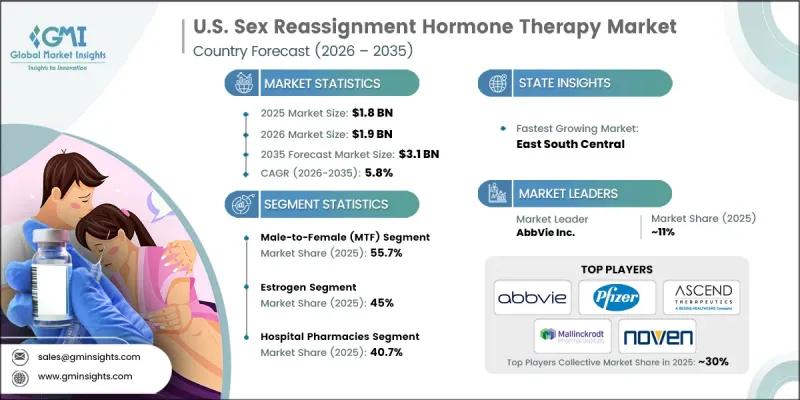
Market growth is driven by increasing awareness and broader social acceptance of gender-affirming treatments, alongside the expansion of specialized healthcare services focused on transgender care. Rising demand for gender-affirming procedures and improved access to hormone therapy are further strengthening market momentum. Advancements in hormone formulations, including long-acting injectables, transdermal delivery systems, and bio-identical therapies, have enhanced treatment safety, consistency, and patient convenience. These innovations help maintain stable hormone levels, reduce side effects, and enable more personalized care approaches, ultimately improving patient adherence and satisfaction. In parallel, expanding insurance coverage and growing clinical research on treatment outcomes are encouraging wider adoption. Pharmaceutical companies are also investing in advanced delivery technologies and sustained-release formulations, offering diverse treatment options that improve accessibility and clinician confidence, thereby supporting continued market expansion across the United States.
| Market Scope | |
|---|---|
| Start Year | 2025 |
| Forecast Year | 2026-2035 |
| Start Value | $1.8 Billion |
| Forecast Value | $3.1 Billion |
| CAGR | 5.8% |
The male-to-female segment accounted for 55.7% share in 2025, maintaining a leading position due to advancements in clinical protocols and growing access to specialized care. Hormone therapy in this segment focuses on developing feminine characteristics through estrogen-based treatments combined with androgen suppression. Increasing social inclusivity and the rising availability of trained healthcare professionals have contributed to higher treatment adoption rates. Additionally, earlier intervention supported by improved healthcare access and digital consultation platforms has enabled more individuals to pursue medically supervised transitions. The segment continues to benefit from evolving clinical standards, better patient education, and increasing confidence in treatment outcomes.
The estrogen segment captured 45% share in 2025, reflecting its central role in hormone-based transitioning therapies. Estrogen therapies are widely utilized due to their effectiveness in supporting physiological changes associated with gender-affirming care. Continuous improvements in delivery formats, including patches, injectables, and advanced formulations, have increased treatment adherence and patient comfort. The reliability and long-term applicability of estrogen therapies make them a cornerstone in ongoing treatment regimens. Growing clinical expertise and improved patient trust in hormone-based care have further strengthened demand for these therapies, ensuring their continued dominance within the market.
East South Central Sex Reassignment Hormone Therapy Market accounted for USD 460.9 million in 2025, reflecting steady growth supported by expanding access to inclusive healthcare services. Increasing awareness and broader acceptance have encouraged more individuals to seek medically supervised treatment options. The region has seen improved availability of trained healthcare providers and the gradual integration of inclusive care practices within primary healthcare systems. Expanding insurance coverage and affordability initiatives have also played a significant role in supporting treatment adoption. Additionally, the growing presence of specialized care networks and digital healthcare solutions has enhanced accessibility, reducing barriers to treatment and contributing to regional market growth.
Major players in the U.S. Sex Reassignment Hormone Therapy Market include AbbVie Inc., Eli Lilly and Company, Pfizer, Teva Pharmaceuticals, Halozyme Therapeutics, Mallinckrodt Pharmaceuticals, Noven, Azurity Pharmaceuticals, Inc., BIOTE MEDICAL, and ASCEND THERAPEUTICS. Companies operating in the U.S. Sex Reassignment Hormone Therapy Market are focusing on innovation, strategic collaborations, and patient-centric solutions to strengthen their competitive position. Investment in research and development is a key priority, with companies working to enhance hormone formulations, improve safety profiles, and develop advanced delivery mechanisms such as long-acting and sustained-release therapies. Strategic partnerships with healthcare providers, clinics, and telehealth platforms are expanding treatment accessibility and patient reach. Firms emphasize regulatory compliance, clinical validation, and education initiatives to build trust among both patients and healthcare professionals. Additionally, expanding insurance partnerships, improving distribution networks, and offering comprehensive support services contribute to long-term market presence and growth.
Table of Contents
Chapter 1 Research Methodology
- 1.1 Research approach
- 1.2 Quality commitments
- 1.2.1 GMI AI policy & data integrity commitment
- 1.2.1.1 Source consistency protocol
- 1.2.1 GMI AI policy & data integrity commitment
- 1.3 Research trail & confidence scoring
- 1.3.1 Research trail components
- 1.3.2 Scoring components
- 1.4 Data collection
- 1.4.1 Partial list of primary sources
- 1.5 Data mining sources
- 1.5.1 Paid sources
- 1.5.1.1 Sources, by zone
- 1.5.1 Paid sources
- 1.6 Base estimates and calculations
- 1.6.1 Base year calculation
- 1.7 Forecast model
- 1.7.1 Quantified market impact analysis
- 1.7.1.1 Mathematical impact of growth parameters on forecast
- 1.7.1 Quantified market impact analysis
- 1.8 Research transparency addendum
- 1.8.1 Source attribution framework
- 1.8.2 Quality assurance metrics
- 1.8.3 Our commitment to trust
Chapter 2 Executive Summary
- 2.1 Industry 360° synopsis
- 2.2 Key market trends
- 2.2.1 Zonal trends
- 2.2.2 Gender Transition trends
- 2.2.3 Type trends
- 2.2.4 Distribution channel trends
- 2.3 CXO perspectives: Strategic imperatives
Chapter 3 Industry Insights
- 3.1 Industry ecosystem analysis
- 3.2 Industry impact forces
- 3.2.1 Growth drivers
- 3.2.1.1 Increasing awareness and acceptance about sex reassignment treatments
- 3.2.1.2 Rise in availability of novel hormonal therapies with better efficacy
- 3.2.1.3 Surge in number of gender-affirming surgeries
- 3.2.2 Industry pitfalls and challenges
- 3.2.2.1 Ambiguous regulatory scenario for sex reassignment drugs
- 3.2.2.2 High initial cost and implementation complexity
- 3.2.3 Opportunities
- 3.2.3.1 Expansion of telemedicine-based hormone therapy platforms
- 3.2.3.2 Partnerships with LGBTQ+ advocacy groups for outreach
- 3.2.1 Growth drivers
- 3.3 Growth potential analysis
- 3.4 Regulatory landscape
- 3.5 Technology and innovation landscape
- 3.5.1 Current technological trends
- 3.5.2 Emerging technologies
- 3.6 Policy initiatives
- 3.7 Reimbursement scenario
- 3.8 Future market trends (Driven from Primary Research)
- 3.9 LGBT scenario
- 3.10 Porter's analysis
- 3.11 PESTEL analysis
- 3.12 Gap analysis
Chapter 4 Competitive Landscape, 2025
- 4.1 Introduction
- 4.2 Company matrix analysis
- 4.3 Company market share analysis
- 4.4 Competitive analysis of major market players
- 4.5 Key developments
- 4.5.1 Mergers & acquisitions
- 4.5.2 Partnerships & collaborations
- 4.5.3 New product launches
- 4.5.4 Expansion plans
Chapter 5 Market Estimates and Forecast, By Gender Transition, 2022 - 2035 ($ Mn)
- 5.1 Key trends
- 5.2 Male-To-Female (MTF)
- 5.3 Female-To-Male (FTM)
Chapter 6 Market Estimates and Forecast, By Type, 2022 - 2035 ($ Mn)
- 6.1 Key trends
- 6.2 Estrogen
- 6.3 Testosterone
- 6.4 Puberty blockers
Chapter 7 Market Estimates and Forecast, By Distribution Channel, 2022 - 2035 ($ Mn)
- 7.1 Key trends
- 7.2 Hospital pharmacies
- 7.3 Retail pharmacies
- 7.4 Online pharmacies
Chapter 8 Market Estimates and Forecast, By Zone, 2022 - 2035 ($ Mn)
- 8.1 Key trends
- 8.2 East South Central
- 8.3 West South Central
- 8.4 South Atlantic
- 8.5 Mountain States
- 8.6 East North Central
- 8.7 North East
- 8.8 Pacific Central
- 8.9 West North Central
Chapter 9 Company Profiles
- 9.1 AbbVie Inc.
- 9.2 ASCEND THERAPEUTICS
- 9.3 Azurity Pharmaceuticals, Inc.
- 9.4 BIOTE MEDICAL
- 9.5 Eli Lilly and Company
- 9.6 Halozyme Therapeutics
- 9.7 Mallinckrodt Pharmaceuticals
- 9.8 Noven
- 9.9 Pfizer
- 9.10 Teva Pharmaceuticals

