PUBLISHER: Mordor Intelligence | PRODUCT CODE: 2061715

PUBLISHER: Mordor Intelligence | PRODUCT CODE: 2061715
Sex Reassignment Surgery - Market Share Analysis, Industry Trends & Statistics, Growth Forecasts (2026 - 2031)
According to Mordor Intelligence, the sex reassignment surgery market size is projected to be USD 3.13 billion in 2025, USD 3.46 billion in 2026, and reach USD 5.72 billion by 2031, growing at a CAGR of 10.60% from 2026 to 2031.
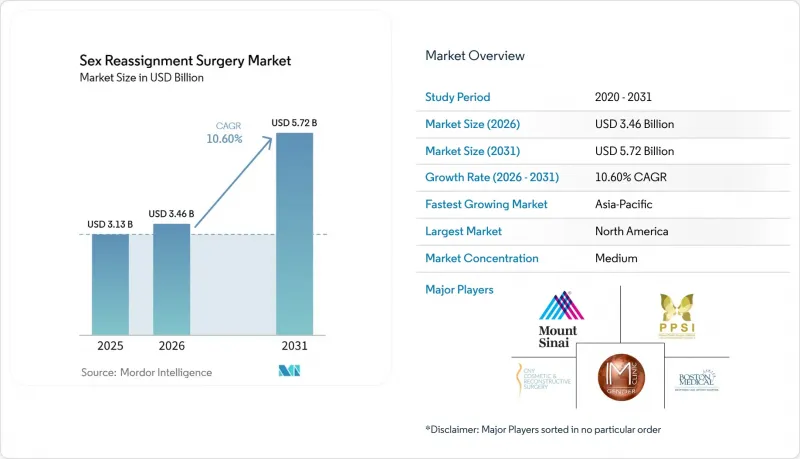
This report is Segmented by Surgery Type (Male-To-Female, Female-To-Male), Surgical Procedure (Augmentation Mammoplasty, Genital Surgery, and More), End User (Hospitals, Specialty Clinics, Ambulatory Surgery Centres, Others), and Geography (North America, Europe, Asia-Pacific, Middle East and Africa, South America). The Market Forecasts are Provided in Terms of Value (USD).
Global Sex Reassignment Surgery Market Trends and Insights
Rising Prevalence of Gender-Dysphoria Diagnoses & Broader Insurance Coverage
Between 2017 and 2021, healthcare providers in the United States diagnosed 121,882 children with gender dysphoria, including 42,000 cases in 2021 alone. Earlier recognition allows intervention at younger ages, improving surgical outcomes and lifetime quality of life . Insurance access has followed suit: Medicare began covering gender-affirming surgery in 2014, and Medicaid expansion laws such as Maryland's Trans Health Equity Act (effective January 2024) now require state programs to reimburse medically necessary procedures. These policies collectively remove historic affordability barriers and channel more patients into surgical pathways, sustaining double-digit growth for the sex reassignment surgery market.
Supportive Legislation & Government Initiatives
The ACA Section 1557 final rule bans discrimination based on gender identity in healthcare and compels covered entities to fund gender-affirming procedures. State-level measures reinforce momentum: California SB 923 mandates trans-inclusive plan requirements, while Oregon HB 2002 outlaws insurer denials for medically necessary care . Parallel legal challenges create a polarized landscape 26 U.S. states now limit care for minors driving interstate migration toward supportive jurisdictions. The pending Supreme Court case U.S. v. Skrmetti will decide the constitutional fate of such restrictions, adding near-term uncertainty to the sex reassignment surgery market.
High Out-of-Pocket Cost Despite Insurance Gaps
Surgery packages range from USD 25,000 to USD 75,000 in the United States, and even insured patients face 30% coinsurance under leading plans. This financial burden drives outbound medical tourism to Thailand, India, and Turkey, where comparable procedures cost USD 8,000-24,000. Lower prices come with travel, aftercare, and potential revision risks, limiting the total addressable market in low-income segments.
Other drivers and restraints analyzed in the detailed report include:
- Social-Media Visibility & Celebrity Transitions Normalising Procedures
- Expansion of Private-Insurance & Employer Health-Plan Reimbursement
- Shortage of Trained Gender-Affirmation Surgeons & Long Wait-Lists
For complete list of drivers and restraints, kindly check the Table Of Contents.
Segment Analysis
Male-to-female procedures captured a 63.68% sex reassignment surgery market share in 2025 as vaginoplasty, breast augmentation, and facial feminization remained the most requested interventions. However, female-to-male surgeries are expanding at an 11.18% CAGR through 2031, reflecting the younger age profile and increasing prevalence of birth-assigned females in new gender-dysphoria diagnoses. Microsurgical phalloplasty now offers improved nerve coaptation and urethral continuity, narrowing historic outcome gaps with male-to-female techniques.
Technological parity is altering demand dynamics. Robotic tissue-harvest systems shorten operative times for radial forearm free-flaps, while 3D-printed custom implants optimize chest masculinization aesthetics. Combined, these advances improve patient satisfaction and lower revision risks, propelling uptake among patients previously deterred by complexity. Institutions like Mount Sinai now conduct integrated male-to-female and female-to-male programs, enabling cross-specialty knowledge transfer that elevates overall outcomes in the gender reassignment surgery market.
Geography Analysis
North America's 55.92% revenue share in 2025 derives from advanced infrastructure, broad insurance uptake, and top-tier surgical programs. Yet legal fragmentation remains: 26 states restrict adolescent care, prompting migration to states like California and New York. Canadian provincial programs cover core surgeries but log 12-16 month wait times, mirroring U.S. capacity bottlenecks.
Asia-Pacific is forecast to pace the global sex reassignment surgery market at an 11.47% CAGR to 2031. Thailand's Joint Commission International-accredited hospitals offer vaginoplasty for USD 8,000-20,000 with outcomes comparable to Western centers. India's PriyaMED packages full surgical sequences plus lodging at USD 8,500-24,000, tapping into rising Western demand. South Korea dominates voice procedures, while Hong Kong's top court ruled that forcing full surgery for legal gender recognition violates rights, signaling liberalizing trends. Europe grows steadily under universal health systems, though wait lists stretch resources: U.K. patients endure 5-10 year delays for first appointments. Germany, France, and the Netherlands shorten queues through regional centers of excellence. Latin America's cost competitiveness draws U.S. and EU patients, with Brazil offering full vaginoplasty for around USD 9,700. Middle East and Africa show nascent potential as social acceptance rises.
- Mount Sinai Health System
- Boston Medical Center
- Cedars-Sinai Medical Center
- Rumer Cosmetic Surgery
- Rochester Regional Health
- GRS Montreal
- The London Transgender Clinic
- IM Gender Clinic (Spain)
- Phuket Plastic Surgery Institute
- Chettawut Plastic Surgery Center (Thailand)
- Gender Surgery Amsterdam (Netherlands)
- Yeson Voice Center (South Korea)
- Johns Hopkins Center for Transgender Health
- UCSF Transgender Care
- NYU Langone Gender Affirming Surgery
- Cleveland Clinic Center for LGBTQ+ Care
- Transgender Surgery Institute of America
- Papillon Gender Clinic (UK)
- Center for Gender Confirmation Serbia
- Kiev Gender Confirmation Center
Additional Benefits:
- The market estimate (ME) sheet in Excel format
- 3 months of analyst support
TABLE OF CONTENTS
1 Introduction
- 1.1 Study Assumptions & Market Definition
- 1.2 Scope of the Study
2 Research Methodology
3 Executive Summary
4 Market Landscape
- 4.1 Market Overview
- 4.2 Market Drivers
- 4.2.1 Rising prevalence of gender-dysphoria diagnoses & broader insurance coverage
- 4.2.2 Supportive legislation & government initiatives
- 4.2.3 Social-media visibility & celebrity transitions normalising procedures
- 4.2.4 Expansion of private?insurance & employer health-plan reimbursement
- 4.2.5 Microsurgical & robotic advances cutting OR time and boosting capacity
- 4.2.6 Cross-border tele-counselling funnels
- 4.3 Market Restraints
- 4.3.1 High out-of-pocket cost despite insurance gaps
- 4.3.2 Shortage of trained gender-affirmation surgeons & long wait-lists
- 4.3.3 High revision-surgery / complication incidence dampening demand
- 4.3.4 Escalating anti-trans legislation causing care-migration & uncertainty
- 4.4 Regulatory Landscape
- 4.5 Porters Five Forces Analysis
- 4.5.1 Threat of New Entrants
- 4.5.2 Bargaining Power of Buyers
- 4.5.3 Bargaining Power of Suppliers
- 4.5.4 Threat of Substitutes
- 4.5.5 Competitive Rivalry
5 Market Size & Growth Forecasts (Value, USD)
- 5.1 By Surgery Type
- 5.1.1 Male-to-Female
- 5.1.2 Female-to-Male
- 5.2 By Surgical Procedure
- 5.2.1 Augmentation Mammoplasty
- 5.2.2 Genital Surgery
- 5.2.3 Facial Feminisation Surgery
- 5.2.4 Facial Masculinisation Surgery
- 5.2.5 Voice & Airway Surgery
- 5.2.6 Body Contouring & Adjunct Procedures
- 5.2.7 Others
- 5.3 By End User
- 5.3.1 Hospitals
- 5.3.2 Specialty Clinics
- 5.3.3 Ambulatory Surgery Centres
- 5.3.4 Others
- 5.4 By Geography
- 5.4.1 North America
- 5.4.1.1 United States
- 5.4.1.2 Canada
- 5.4.1.3 Mexico
- 5.4.2 Europe
- 5.4.2.1 Germany
- 5.4.2.2 United Kingdom
- 5.4.2.3 France
- 5.4.2.4 Italy
- 5.4.2.5 Spain
- 5.4.2.6 Rest of Europe
- 5.4.3 Asia-Pacific
- 5.4.3.1 China
- 5.4.3.2 Japan
- 5.4.3.3 India
- 5.4.3.4 Australia
- 5.4.3.5 South Korea
- 5.4.3.6 Rest of Asia-Pacific
- 5.4.4 Middle East and Africa
- 5.4.4.1 GCC
- 5.4.4.2 South Africa
- 5.4.4.3 Rest of Middle East and Africa
- 5.4.5 South America
- 5.4.5.1 Brazil
- 5.4.5.2 Argentina
- 5.4.5.3 Rest of South America
- 5.4.1 North America
6 Competitive Landscape
- 6.1 Market Concentration
- 6.2 Market Share Analysis
- 6.3 Company Profiles (includes Global-level Overview, Market-level Overview, Core Segments, Financials, Strategic Info, Market Rank/Share, Products & Services, Recent Developments)
- 6.3.1 Mount Sinai Health System
- 6.3.2 Boston Medical Center
- 6.3.3 Cedars-Sinai Medical Center
- 6.3.4 Rumer Cosmetic Surgery
- 6.3.5 Rochester Regional Health
- 6.3.6 GRS Montreal
- 6.3.7 The London Transgender Clinic
- 6.3.8 IM Gender Clinic (Spain)
- 6.3.9 Phuket Plastic Surgery Institute
- 6.3.10 Chettawut Plastic Surgery Center (Thailand)
- 6.3.11 Gender Surgery Amsterdam (Netherlands)
- 6.3.12 Yeson Voice Center (South Korea)
- 6.3.13 Johns Hopkins Center for Transgender Health
- 6.3.14 UCSF Transgender Care
- 6.3.15 NYU Langone Gender Affirming Surgery
- 6.3.16 Cleveland Clinic Center for LGBTQ+ Care
- 6.3.17 Transgender Surgery Institute of America
- 6.3.18 Papillon Gender Clinic (UK)
- 6.3.19 Center for Gender Confirmation Serbia
- 6.3.20 Kiev Gender Confirmation Center
7 Market Opportunities & Future Outlook
- 7.1 White-space & Unmet-Need Assessment

