PUBLISHER: Global Market Insights Inc. | PRODUCT CODE: 2019217

PUBLISHER: Global Market Insights Inc. | PRODUCT CODE: 2019217
Industrial Rhamnolipid Market Opportunity, Growth Drivers, Industry Trend Analysis, and Forecast 2026 - 2035
The Global Industrial Rhamnolipid Market was valued at USD 467.8 million in 2025 and is estimated to grow at a CAGR of 8.4% to reach USD 950.5 million by 2035.
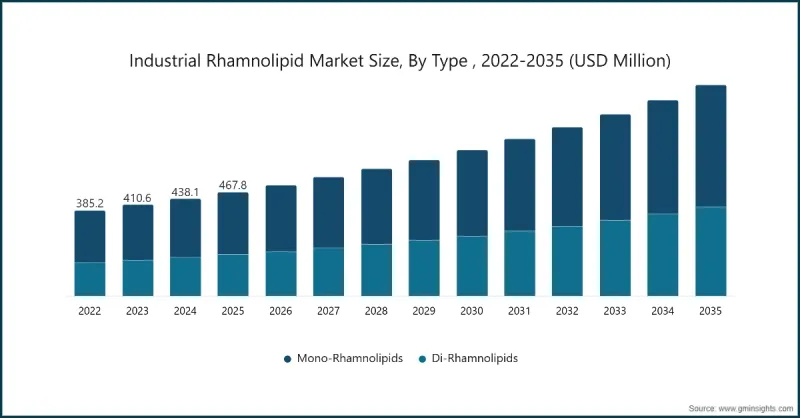
Industrial rhamnolipids initially emerged as niche bio-based surfactants but have evolved into critical components across multiple industrial sectors. Their functional applications now extend to improving process efficiency, enhancing material compatibility, and ensuring operational reliability in areas such as energy production, industrial cleaning, agriculture, and environmental remediation. Industrial procurement is increasingly favoring inputs that deliver high performance while being renewable, minimally toxic, and environmentally sustainable. Advancements in biotechnology, fermentation control, strain optimization, and downstream processing have elevated rhamnolipid performance to meet industrial standards. The combination of formulation compatibility, biodegradability, and low environmental persistence has accelerated adoption, particularly in regions with stringent regulatory oversight and sustainability mandates, driving steady growth in both established and emerging markets.
| Market Scope | |
|---|---|
| Start Year | 2025 |
| Forecast Year | 2026-2035 |
| Start Value | $467.8 Million |
| Forecast Value | $950.5 Million |
| CAGR | 8.4% |
The mono-rhamnolipids segment held a 60.4% share and is expected to grow at a CAGR of 7.8% through 2035. Their widespread use is attributed to superior surface activity, solubility, and formulation compatibility. Industries leverage mono-rhamnolipids for applications including cleaning, oilfield chemistry, and environmental remediation due to their cost-effective performance in reducing interfacial tension. Di-rhamnolipids, though smaller in market size, are gaining traction for their superior emulsification properties, stability under extreme conditions, and long-term functional durability.
The liquid formulations segment held a 70.6% share in 2025 and is projected to grow at a CAGR of 8.1% from 2026 to 2035. Liquid rhamnolipids are preferred for large-scale industrial applications due to ease of handling, immediate solubility, and seamless integration into processes like oilfield operations, industrial cleaning, and environmental treatment. Their suitability for continuous processing, accurate dosing, and flexible formulation development reinforces their industrial popularity.
North America Industrial Rhamnolipid Market held a 28.4% share in 2025, driven by its strategic role in deploying bio-based surfactants across energy production, industrial cleaning, and environmental protection sectors. Favorable market conditions, advanced industrial infrastructure, and high adoption of sustainable solutions make the region a key growth hub.
Leading players in the Global Industrial Rhamnolipid Market include TensioGreen, GlycoSurf, Evonik Industries AG, Shaanxi Deguan Biotechnology Co. Ltd, Stepan Company, Holiferm Ltd, Biotensidon GmbH, CD BioGlyco, Zhejiang Silver Elephant Bioengineering Co. Ltd, Jeneil Biotech Inc, and AGAE Technologies LLC. Key strategies adopted by companies to strengthen their market presence include investing heavily in R&D to enhance rhamnolipid yield, purity, and functionality. Firms are optimizing fermentation and downstream processing for scalable, cost-effective production. Strategic partnerships with industrial users in energy, agriculture, and environmental remediation are expanding adoption. Companies are focusing on regulatory compliance, sustainable production practices, and eco-label certifications to differentiate their products. Expanding regional manufacturing capabilities and distribution networks ensures faster delivery and localized support. Additionally, marketing initiatives highlighting biodegradability, performance efficiency, and multi-sector versatility help build brand credibility and capture emerging market opportunities worldwide.
Table of Contents
Chapter 1 Methodology & Scope
- 1.1 Market scope and definition
- 1.2 Research design
- 1.2.1 Research approach
- 1.2.2 Data collection methods
- 1.3 Data mining sources
- 1.3.1 Global
- 1.3.2 Regional/Country
- 1.4 Base estimates and calculations
- 1.4.1 Base year calculation
- 1.4.2 Key trends for market estimation
- 1.5 Primary research and validation
- 1.5.1 Primary sources
- 1.6 Forecast model
- 1.7 Research assumptions and limitations
Chapter 2 Executive Summary
- 2.1 Industry 360° synopsis
- 2.2 Key market trends
- 2.2.1 Regional
- 2.2.2 Type
- 2.2.3 Form
- 2.2.4 Grade
- 2.2.5 End-Use
- 2.3 TAM Analysis, 2026-2035
- 2.4 CXO perspectives: Strategic imperatives
- 2.4.1 Executive decision points
- 2.4.2 Critical success factors
- 2.5 Future Outlook and Strategic Recommendations
Chapter 3 Industry Insights
- 3.1 Industry ecosystem analysis
- 3.1.1 Supplier landscape
- 3.1.2 Profit margin
- 3.1.3 Value addition at each stage
- 3.1.4 Factor affecting the value chain
- 3.1.5 Disruptions
- 3.2 Industry impact forces
- 3.2.1 Growth drivers
- 3.2.1.1 Rising use in enhanced oil recovery (EOR) in the oil & gas industry
- 3.2.1.2 Growing applications in cosmetics and personal care industries
- 3.2.1.3 Rising demand for eco friendly & biodegradable surfactants
- 3.2.2 Industry pitfalls and challenges
- 3.2.2.1 High production cost
- 3.2.2.2 Limited availability of raw materials for rhamnolipid production
- 3.2.3 Market opportunities
- 3.2.3.1 Expansion in bioremediation & environmental applications
- 3.2.3.2 Pharmaceutical & drug delivery system development
- 3.2.1 Growth drivers
- 3.3 Growth potential analysis
- 3.4 Regulatory landscape
- 3.4.1 North America
- 3.4.2 Europe
- 3.4.3 Asia Pacific
- 3.4.4 Latin America
- 3.4.5 Middle East & Africa
- 3.5 Porter's analysis
- 3.6 PESTEL analysis
- 3.7 Price trends
- 3.7.1 By region
- 3.7.2 By type
- 3.8 Future market trends
- 3.9 Technology and Innovation landscape
- 3.9.1 Current technological trends
- 3.9.2 Emerging technologies
- 3.10 Patent Landscape
- 3.11 Trade statistics (HS code)
- 3.11.1 Major importing countries
- 3.11.2 Major exporting countries
- 3.12 Sustainability and environmental aspects
- 3.12.1 Sustainable practices
- 3.12.2 Waste reduction strategies
- 3.12.3 Energy efficiency in production
- 3.12.4 Eco-friendly initiatives
- 3.13 Carbon footprint consideration
Chapter 4 Competitive Landscape, 2025
- 4.1 Introduction
- 4.2 Company market share analysis
- 4.2.1 By region
- 4.2.1.1 North America
- 4.2.1.2 Europe
- 4.2.1.3 Asia Pacific
- 4.2.1.4 LATAM
- 4.2.1.5 MEA
- 4.2.1 By region
- 4.3 Company matrix analysis
- 4.4 Competitive analysis of major market players
- 4.5 Competitive positioning matrix
- 4.6 Key developments
- 4.6.1 Mergers & acquisitions
- 4.6.2 Partnerships & collaborations
- 4.6.3 New Product Launches
- 4.6.4 Expansion Plans
Chapter 5 Market Estimates and Forecast, By Type, 2022-2035 (USD Million) (Kilo Tons)
- 5.1 Key trends
- 5.2 Mono-Rhamnolipids
- 5.3 Di-Rhamnolipids
Chapter 6 Market Estimates and Forecast, By Form, 2022-2035 (USD Million) (Kilo Tons)
- 6.1 Key trends
- 6.2 Liquid
- 6.2.1 Ready to Use
- 6.2.2 Concentrated
- 6.2.3 Aqueous Suspensions
- 6.3 Powder
- 6.3.1 Spray Dried
- 6.3.2 Freeze Dried
- 6.3.3 Bulk Industrial
Chapter 7 Market Estimates and Forecast, By Grade, 2022-2035 (USD Million) (Kilo Tons)
- 7.1 Key trends
- 7.2 Technical Grade (85-90%)
- 7.3 High Purity Grade (90-95%)
- 7.4 Ultra-High Purity Grade (>95%)
Chapter 8 Market Estimates and Forecast, By End-User, 2022-2035 (USD Million) (Kilo Tons)
- 8.1 Key trends
- 8.2 Oil & Gas
- 8.3 Agriculture
- 8.4 Pharmaceuticals & Healthcare
- 8.5 Cosmetics & Personal Care
- 8.6 Others (Textiles, Household & Industrial Cleaners, etc)
Chapter 9 Market Estimates and Forecast, By Region, 2022-2035 (USD Million) (Kilo Tons)
- 9.1 Key trends
- 9.2 North America
- 9.2.1 U.S.
- 9.2.2 Canada
- 9.3 Europe
- 9.3.1 Germany
- 9.3.2 UK
- 9.3.3 France
- 9.3.4 Spain
- 9.3.5 Italy
- 9.3.6 Rest of Europe
- 9.4 Asia Pacific
- 9.4.1 China
- 9.4.2 India
- 9.4.3 Japan
- 9.4.4 Australia
- 9.4.5 South Korea
- 9.4.6 Rest of Asia Pacific
- 9.5 Latin America
- 9.5.1 Brazil
- 9.5.2 Mexico
- 9.5.3 Argentina
- 9.5.4 Rest of Latin America
- 9.6 Middle East and Africa
- 9.6.1 Saudi Arabia
- 9.6.2 South Africa
- 9.6.3 UAE
- 9.6.4 Rest of Middle East and Africa
Chapter 10 Company Profiles
- 10.1 Evonik Industries AG
- 10.2 Stepan Company
- 10.3 AGAE Technologies LLC
- 10.4 Jeneil Biotech Inc
- 10.5 Biotensidon GmbH
- 10.6 GlycoSurf
- 10.7 TensioGreen
- 10.8 Zhejiang Silver Elephant Bio-engineering Co. Ltd
- 10.9 Shaanxi Deguan Biotechnology Co. Ltd
- 10.10 Holiferm Ltd
- 10.11 CD BioGlyco

