PUBLISHER: Mordor Intelligence | PRODUCT CODE: 2121457

PUBLISHER: Mordor Intelligence | PRODUCT CODE: 2121457
Industrial Enzymes - Market Share Analysis, Industry Trends & Statistics, Growth Forecasts (2026 - 2031)
According to Mordor Intelligence, the industrial enzymes market size is projected to expand from USD 9.09 billion in 2025 and USD 9.65 billion in 2026 to USD 13.02 billion by 2031, registering a CAGR of 6.17% between 2026 to 2031.
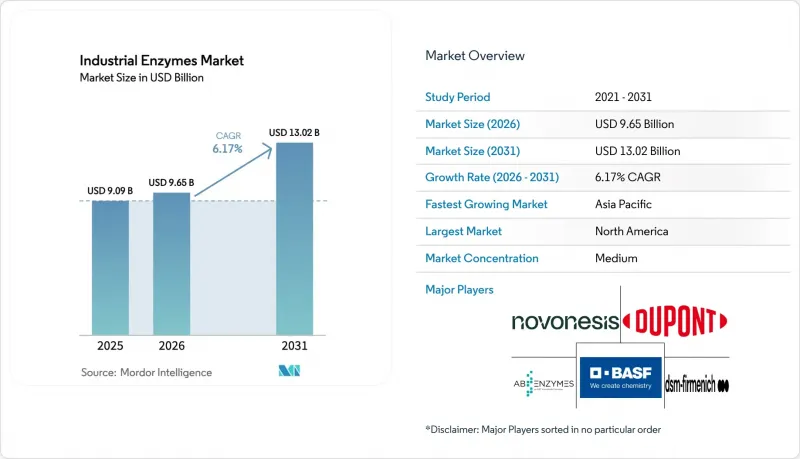
This report is Segmented by Type (Carbohydrases, Proteases, Lipases, and Other Types), Application (Food Processing, Animal Feed, Healthcare, Detergents and Cleaners, Leather Processing, Biofuels, Textiles, Pulp and Paper, Cosmetics, and More), and Geography (Asia-Pacific, North America, Europe, South America, and Middle East and Africa). The Market Forecasts are Provided in Terms of Value (USD).
Global Industrial Enzymes Market Trends and Insights
Biofuel Mandates Boosting Demand, Especially in Starch and Cellulosic Ethanol
Legislation such as the U.S. Renewable Fuel Standard targets 36 billion gallons of renewable fuel by 2027, of which 16 billion must be cellulosic, driving multi-enzyme cocktails that push glucose yields beyond 85%. Brazil's RenovaBio program rewards ethanol plants that cut lifecycle emissions, encouraging enzyme formulations that lower pretreatment severity. The International Energy Agency expects global biofuel output to climb 28% between 2024 and 2030, keeping enzymes at 10-15% of conversion costs. U.S. Corn Belt producers already dose thermostable alpha-amylases that tolerate >=95 °C, trimming enzyme spend per gallon. Consolidated bioprocessing initiatives aim to halve enzyme costs by 2028, supporting wider cellulosic rollout.
Increasing Adoption for Industrial Enzymes in Food Processing
The EU Food Information to Consumers Regulation obliges clear labeling of processing aids, nudging bakeries, breweries, and dairies toward "natural" enzyme solutions. Amylases and xylanases appear in more than 70% of Western European bread recipes, extending shelf life by up to three days without emulsifiers. Pectinases shorten juice clarification times by 40%, easing capital on membrane equipment. Transglutaminase use in yogurt replaces carrageenan while preserving texture, meeting minimal-ingredient expectations. The US FDA granted GRAS status to 30 new enzyme preparations during 2024-2025, accelerating commercialization.
Narrow Operating pH and Temperature Windows for Most Commercial Enzymes
Proteases, lipases, and carbohydrases rapidly lose activity outside pH 4.5-8.5 and above 65°C, limiting use in cotton scouring at 100°C and leather pickling below pH 3. Textile mills forced to drop temperature extend cycle times and face higher energy bills when reverting to caustic soda. Directed evolution has produced enzymes with two-hour half-lives at 80°C, yet premiums of 30-50% over wild-type variants hinder uptake in price-sensitive plants. Immobilization extends enzyme life but adds reactor cost and 10-20% activity loss during bonding. Broader deployment awaits scale-neutral thermostable formulations that meet cost parity.
Other drivers and restraints analyzed in the detailed report include:
- Stricter Environmental Regulations Favoring Bio-Based Processing Aids
- Precision-Fermentation Cost Breakthroughs Enabling Smaller-Batch Customized Enzymes
- High Upstream Production and Downstream Purification Costs
For complete list of drivers and restraints, kindly check the Table Of Contents.
Segment Analysis
Carbohydrases represented 47.50% of 2025 revenue, the highest share within the industrial enzymes market, and will grow at a 6.96% CAGR to 2031. Thermostable alpha-amylase adoption in US ethanol facilities supports high-temperature liquefaction that lowers steam costs and contamination risk. Cellulase loadings of 15-25 FPU g-1 dry biomass remain vital for second-generation biofuels, with on-site production forecasts aiming to halve costs by 2028. Bakery manufacturers rely on amylases, xylanases, and glucose oxidases to extend freshness and eliminate chemical emulsifiers, meeting clean-label rules in Europe where usage tops 70% of bread lines.
Proteases follow as the second-largest contributor to the industrial enzymes market. They drive premium detergent formulations and leather bating, while pharma-grade trypsin fills a lucrative niche at prices above USD 5,000 kg-1. Lipases gain traction in biodiesel transesterification and structured-lipid production for infant formula. Smaller but rapidly expanding categories such as polymerases, laccases, and oxidases serve molecular diagnostics, pulp bleaching, and eco-friendly denim finishing, illustrating the segment's diversification path.
Complete Report Scope:
- By Type
- Carbohydrases
- Amylases
- Cellulases
- Proteases
- Trypsins (API and Non-API)
- Other Proteases
- Lipases
- Other Types (Polymerases, Oxidases, etc.)
- Carbohydrases
- By Application
- Food Processing
- Animal Feed
- Healthcare
- Detergents and Cleaners
- Leather Processing
- Biofuels
- Textiles
- Pulp and Paper
- Cosmetics
- Other Applications
- By Geography
- Asia-Pacifc
- China
- India
- Japan
- South Korea
- ASEAN Countries
- Australia and New-Zealand
- Rest of Asia-Pacific
- North America
- United States
- Canada
- Mexico
- Europe
- Germany
- United Kingdom
- France
- Italy
- Russia
- Rest of Europe
- South America
- Brazil
- Argentina
- Rest of South America
- Middle East and Africa
- Saudi Arabia
- United Arab Emirates
- South Africa
- Rest of Middle East and Africa
- Asia-Pacifc
Geography Analysis
North America captured 35.91% of the Industrial Enzymes market revenue in 2025, led by US ethanol plants that alone absorb more than 40% of regional volume. The FDA's expedited GRAS pathway saw 30 new enzyme approvals over 2024-2025, keeping the region at the forefront of novel launches. Canada's pulp-and-paper mills and Mexico's livestock producers contribute incremental demand, yet together remain below 10% of regional totals. USDA BioPreferred procurement preferences further nudge detergent reformulations toward enzyme systems.
Asia-Pacific is the fastest-growing region at 6.91% CAGR through 2031. China and India benefit from 20-30% lower enzyme production costs due to competitive feedstock and labor structures. China's 2024 wastewater limits spurred enzyme adoption in the textile and leather sectors in Zhejiang and Guangdong. India's push to cut post-harvest losses fosters enzyme use in dairy, bakery, and beverage plants. High per-capita consumption in Japan and South Korea stems from healthcare and premium detergent demand, while ASEAN nations grow through palm-oil processing and feed applications.
In Europe, Germany, France, and the United Kingdom lead detergent and bakery consumption, while Scandinavia pioneers pulp-bleaching enzymes that reduce chlorine dioxide by 30%. The EU Circular Economy Action Plan's 30% renewable chemical target secures long-term demand signals. South America, driven by Brazil's ethanol program, and the Middle East & Africa, anchored by South African food processing, round out the global landscape, though adoption levels vary with infrastructure and policy support.
- AB Enzymes
- Adisseo
- Advanced Enzyme Technologies
- Amano Enzyme Inc.
- Aumgene Biosciences
- BASF
- Biocatalysts
- Boli Bioproducts
- Codexis
- DuPont
- DSM-Firmenich N.V.
- Dyadic Applied Biosolutions
- Enzyme Development Corporation
- Kemin Industries, Inc.
- Kerry Group, plc
- Novozymes A/S
Additional Benefits:
- The market estimate (ME) sheet in Excel format
- 3 months of analyst support
TABLE OF CONTENTS
1 Introduction
- 1.1 Study Assumptions and Market Definition
- 1.2 Scope of the Study
2 Research Methodology
3 Executive Summary
4 Market Landscape
- 4.1 Market Overview
- 4.2 Market Drivers
- 4.2.1 Biofuel mandates boosting demand, especially in starch and cellulosic ethanol
- 4.2.2 Increasing Adoption for Industrial Enzymes in Food Processing
- 4.2.3 Stricter environmental regulations favouring bio-based processing aids
- 4.2.4 Precision-fermentation cost breakthroughs enabling smaller-batch customised enzymes
- 4.2.5 Healthcare shift to multi-enzymatic cleaners for infection-control compliance
- 4.3 Market Restraints
- 4.3.1 Narrow operating pH and temperature windows for most commercial enzymes
- 4.3.2 High upstream production and downstream purification costs
- 4.3.3 Feedstock-supply concerns across various geographies
- 4.4 Value Chain Analysis
- 4.5 Porter's Five Forces
- 4.5.1 Bargaining Power of Suppliers
- 4.5.2 Bargaining Power of Consumers
- 4.5.3 Threat of New Entrants
- 4.5.4 Threat of Substitute Products and Services
- 4.5.5 Degree of Competition
5 Market Size and Growth Forecasts (Value)
- 5.1 By Type
- 5.1.1 Carbohydrases
- 5.1.1.1 Amylases
- 5.1.1.2 Cellulases
- 5.1.2 Proteases
- 5.1.2.1 Trypsins (API and Non-API)
- 5.1.2.2 Other Proteases
- 5.1.3 Lipases
- 5.1.4 Other Types (Polymerases, Oxidases, etc.)
- 5.1.1 Carbohydrases
- 5.2 By Application
- 5.2.1 Food Processing
- 5.2.2 Animal Feed
- 5.2.3 Healthcare
- 5.2.4 Detergents and Cleaners
- 5.2.5 Leather Processing
- 5.2.6 Biofuels
- 5.2.7 Textiles
- 5.2.8 Pulp and Paper
- 5.2.9 Cosmetics
- 5.2.10 Other Applications
- 5.3 By Geography
- 5.3.1 Asia-Pacifc
- 5.3.1.1 China
- 5.3.1.2 India
- 5.3.1.3 Japan
- 5.3.1.4 South Korea
- 5.3.1.5 ASEAN Countries
- 5.3.1.6 Australia and New-Zealand
- 5.3.1.7 Rest of Asia-Pacific
- 5.3.2 North America
- 5.3.2.1 United States
- 5.3.2.2 Canada
- 5.3.2.3 Mexico
- 5.3.3 Europe
- 5.3.3.1 Germany
- 5.3.3.2 United Kingdom
- 5.3.3.3 France
- 5.3.3.4 Italy
- 5.3.3.5 Russia
- 5.3.3.6 Rest of Europe
- 5.3.4 South America
- 5.3.4.1 Brazil
- 5.3.4.2 Argentina
- 5.3.4.3 Rest of South America
- 5.3.5 Middle East and Africa
- 5.3.5.1 Saudi Arabia
- 5.3.5.2 United Arab Emirates
- 5.3.5.3 South Africa
- 5.3.5.4 Rest of Middle East and Africa
- 5.3.1 Asia-Pacifc
6 Competitive Landscape
- 6.1 Market Concentration
- 6.2 Strategic Moves (M&A, JVs, Partnerships)
- 6.3 Market Share(%)/Ranking Analysis
- 6.4 Company Profiles (includes Global level Overview, Market level overview, Core Segments, Financials as available, Strategic Information, Market Rank/Share, Products and Services, Recent Developments)
- 6.4.1 AB Enzymes
- 6.4.2 Adisseo
- 6.4.3 Advanced Enzyme Technologies
- 6.4.4 Amano Enzyme Inc.
- 6.4.5 Aumgene Biosciences
- 6.4.6 BASF
- 6.4.7 Biocatalysts
- 6.4.8 Boli Bioproducts
- 6.4.9 Codexis
- 6.4.10 DuPont
- 6.4.11 DSM-Firmenich N.V.
- 6.4.12 Dyadic Applied Biosolutions
- 6.4.13 Enzyme Development Corporation
- 6.4.14 Kemin Industries, Inc.
- 6.4.15 Kerry Group, plc
- 6.4.16 Novozymes A/S
7 Market Opportunities and Future Outlook
- 7.1 White-space and Unmet-Need Assessment
- 7.2 Increasing Product Innovation and Expansion of Application Base

