PUBLISHER: Global Market Insights Inc. | PRODUCT CODE: 2019225

PUBLISHER: Global Market Insights Inc. | PRODUCT CODE: 2019225
Airport Sleeping Pods Market Opportunity, Growth Drivers, Industry Trend Analysis, and Forecast 2026 - 2035
The Global Airport Sleeping Pods Market was valued at USD 87.9 million in 2025 and is estimated to grow at a CAGR of 7.3% to reach USD 176.2 million by 2035.
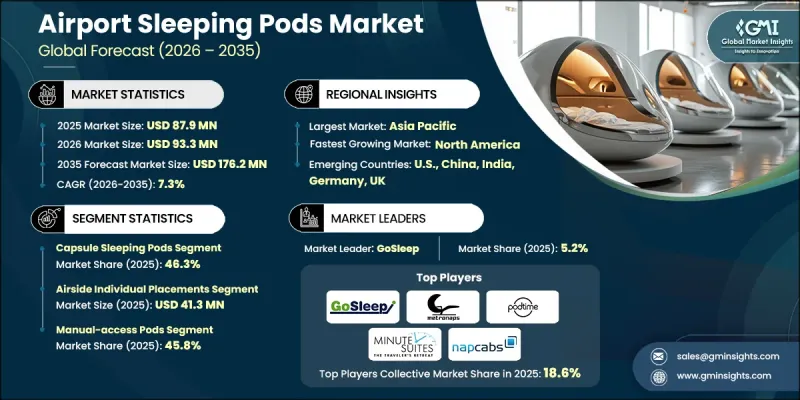
Expansion in the airport sleeping pods industry is fueled by rising global air passenger traffic and the increasing need for comfortable rest solutions during transit. Longer layover durations and evolving passenger expectations for enhanced airport experiences are encouraging the adoption of premium rest facilities. Airports are also focusing on diversifying their revenue streams by introducing value-added services, which further accelerates market growth. The integration of digital platforms for seamless booking and access, along with advancements in smart technologies, is transforming the overall user experience. Additionally, the development of intelligent sleeping pods equipped with advanced automation and connectivity features is strengthening market appeal. Growing emphasis on passenger convenience, coupled with investments in modern airport infrastructure, is expected to support sustained growth in the airport sleeping pods market over the coming years.
| Market Scope | |
|---|---|
| Start Year | 2025 |
| Forecast Year | 2026-2035 |
| Start Value | $87.9 Million |
| Forecast Value | $176.2 Million |
| CAGR | 7.3% |
The market is driven by the increasing volume of air travelers seeking convenient and comfortable rest options during transit periods. Rising passenger dwell time and the need for efficient utilization of waiting hours are contributing to the adoption of sleeping pods across airports. Enhanced demand for comfort-focused amenities, along with the introduction of hybrid rest solutions, is further supporting market expansion. In addition, the incorporation of digital booking systems and personalized service features is improving accessibility and user engagement, while also enabling airports to optimize operational efficiency and generate additional revenue.
The capsule sleeping pods segment held a 46.3% share in 2025. Their compact structure, privacy features, and efficient use of limited space make them highly suitable for busy airport environments. These pods provide secure and ergonomically designed resting areas that improve passenger comfort during transit. Their adaptability, ease of deployment, and compatibility with integrated booking technologies contribute to their widespread adoption, particularly in high-traffic terminals where space optimization and passenger flow management are critical.
The airside individual placements segment reached USD 41.3 million in 2025. These installations are strategically positioned within secure airport zones, allowing passengers to access rest facilities conveniently without leaving transit areas. Their proximity to boarding gates enhances usability for travelers with limited connection times, while also improving operational efficiency for airport authorities. This placement strategy supports increased utilization rates, encourages premium service uptake, and contributes to higher non-aeronautical revenue generation, while also enhancing overall passenger satisfaction and travel experience.
North America Airport Sleeping Pods Market held a 30.6% share in 2025. Growth in the region is being driven by increasing passenger volumes and the emphasis on enhancing airport service offerings. Airports are investing in advanced rest solutions to improve traveler comfort and overall experience, while also leveraging technology-driven systems to streamline access and management. Continuous investments in infrastructure, combined with strong demand for premium transit services, are expected to sustain the region's leading position in the market.
Key players operating in the Global Airport Sleeping Pods Market include Aviserv, GoSleep, JPODS, KOTOBUKI SEATING CO., LTD., Metronaps, Minute Suites, Nap York, NapCabs GmbH, Podtime, Sleep 'n fly, Urban Naps, and ZZZleepandGo. Companies in the Airport Sleeping Pods Market are focusing on integrating advanced technologies such as automated access systems and digital booking platforms to enhance user convenience and operational efficiency. They are investing in product innovation to develop compact, ergonomic, and smart-enabled pods that cater to evolving passenger expectations. Strategic collaborations with airport authorities are helping companies expand their presence across major transit hubs. Businesses are also emphasizing customization, premium features, and flexible pricing models to attract diverse traveler segments. Additionally, firms are strengthening their global footprint through partnerships and expansion strategies, while enhancing customer experience through improved design, comfort, and seamless service integration.
Table of Contents
Chapter 1 Methodology and Scope
- 1.1 Market scope and definition
- 1.2 Research design
- 1.2.1 Research approach
- 1.2.2 Data collection methods
- 1.3 Data mining sources
- 1.3.1 Global
- 1.3.2 Regional/Country
- 1.4 Base estimates and calculations
- 1.4.1 Base year calculation
- 1.4.2 Key trends for market estimation
- 1.5 Primary research and validation
- 1.5.1 Primary sources
- 1.6 Forecast model
- 1.7 Research assumptions and limitations
Chapter 2 Executive Summary
- 2.1 Industry 360° synopsis, 2022 - 2035
- 2.2 Key market trends
- 2.2.1 Pod hardware format trends
- 2.2.2 Deployment zone & facility model trends
- 2.2.3 Technology & access system trends
- 2.2.4 End-user application trends
- 2.2.5 Regional trends
- 2.3 TAM Analysis, 2026-2035
- 2.4 CXO perspectives: Strategic imperatives
Chapter 3 Industry Insights
- 3.1 Industry ecosystem analysis
- 3.1.1 Supplier Landscape
- 3.1.2 Profit Margin
- 3.1.3 Cost structure
- 3.1.4 Value addition at each stage
- 3.1.5 Factor affecting the value chain
- 3.1.6 Disruptions
- 3.2 Industry impact forces
- 3.2.1 Growth drivers
- 3.2.1.1 Rising global air passenger traffic demand rest facilities
- 3.2.1.2 Extended layovers increase need for short-term rest spaces
- 3.2.1.3 Airports optimize non-aeronautical revenue streams
- 3.2.1.4 Digital booking and contactless access adoption
- 3.2.1.5 Competitive differentiation among premium airports
- 3.2.2 Industry pitfalls and challenges
- 3.2.2.1 Operational maintenance and hygiene complexity
- 3.2.2.2 Space constraints within crowded terminals
- 3.2.3 Market opportunities
- 3.2.3.1 AI/IoT smart pods for personalized rest
- 3.2.3.2 Hybrid models combining work/rest amenities
- 3.2.1 Growth drivers
- 3.3 Growth potential analysis
- 3.4 Regulatory landscape
- 3.4.1 North America
- 3.4.2 Europe
- 3.4.3 Asia Pacific
- 3.4.4 Latin America
- 3.4.5 Middle East & Africa
- 3.5 Porter's analysis
- 3.6 PESTEL analysis
- 3.7 Technology and Innovation landscape
- 3.7.1 Current technological trends
- 3.7.2 Emerging technologies
- 3.8 Price trends
- 3.8.1 By region
- 3.8.2 By product
- 3.9 Pricing Strategies
- 3.10 Emerging Business Models
- 3.11 Compliance Requirements
- 3.12 Patent and IP analysis
Chapter 4 Competitive Landscape, 2025
- 4.1 Introduction
- 4.2 Company market share analysis
- 4.2.1 By region
- 4.2.1.1 North America
- 4.2.1.2 Europe
- 4.2.1.3 Asia Pacific
- 4.2.1.4 Latin America
- 4.2.1.5 Middle East & Africa
- 4.2.2 Market concentration analysis
- 4.2.1 By region
- 4.3 Competitive benchmarking of key players
- 4.3.1 Financial performance comparison
- 4.3.1.1 Revenue
- 4.3.1.2 Profit margin
- 4.3.1.3 R&D
- 4.3.2 Product portfolio comparison
- 4.3.2.1 Product range breadth
- 4.3.2.2 Technology
- 4.3.2.3 Innovation
- 4.3.3 Geographic presence comparison
- 4.3.3.1 Global footprint analysis
- 4.3.3.2 Service network coverage
- 4.3.3.3 Market penetration by region
- 4.3.4 Competitive positioning matrix
- 4.3.4.1 Leaders
- 4.3.4.2 Challengers
- 4.3.4.3 Followers
- 4.3.4.4 Niche players
- 4.3.5 Strategic outlook matrix
- 4.3.1 Financial performance comparison
- 4.4 Key developments
- 4.4.1 Mergers and acquisitions
- 4.4.2 Partnerships and collaborations
- 4.4.3 Technological advancements
- 4.4.4 Expansion and investment strategies
- 4.4.5 Digital transformation initiatives
- 4.5 Emerging/ startup competitors landscape
Chapter 5 Market Estimates and Forecast, By Pod Hardware Format, 2022 - 2035 (USD Million)
- 5.1 Key trends
- 5.2 Capsule sleeping pods
- 5.3 Recliner nap pods / sleep chairs
- 5.4 Micro-cabin pods
Chapter 6 Market Estimates and Forecast, By Deployment Zone & Facility Model, 2022 - 2035 (USD Million)
- 6.1 Key trends
- 6.2 Airside individual placements
- 6.3 Landside individual placements
- 6.4 Dedicated capsule hotel facilities
Chapter 7 Market Estimates and Forecast, By Technology & Access System, 2022 - 2035 (USD Million)
- 7.1 Key trends
- 7.2 Manual-access pods
- 7.3 Digitally reserved pods
- 7.4 Fully automated smart pods
Chapter 8 Market Estimates and Forecast, By End-User Application, 2022 - 2035 (USD Million)
- 8.1 Key trends
- 8.2 Primary demand segments
- 8.3 Transit passengers
- 8.4 Delayed or overnight passengers
- 8.5 Secondary demand segments
- 8.6 Airport staff & crew
- 8.7 Premium / business travelers
Chapter 9 Market Estimates and Forecast, By Region, 2022 - 2035 (USD Million)
- 9.1 Key trends
- 9.2 North America
- 9.2.1 U.S.
- 9.2.2 Canada
- 9.3 Europe
- 9.3.1 Germany
- 9.3.2 UK
- 9.3.3 France
- 9.3.4 Spain
- 9.3.5 Italy
- 9.4 Asia Pacific
- 9.4.1 China
- 9.4.2 India
- 9.4.3 Japan
- 9.4.4 Australia
- 9.4.5 South Korea
- 9.5 Latin America
- 9.5.1 Brazil
- 9.5.2 Mexico
- 9.5.3 Argentina
- 9.6 Middle East and Africa
- 9.6.1 South Africa
- 9.6.2 Saudi Arabia
- 9.6.3 UAE
Chapter 10 Company Profiles
- 10.1 Global Key Players
- 10.1.1 GoSleep
- 10.1.2 Minute Suites
- 10.1.3 NapCabs GmbH
- 10.2 Regional key players
- 10.2.1 North America
- 10.2.1.1 Aviserv
- 10.2.1.2 Nap York
- 10.2.2 Asia Pacific
- 10.2.2.1 KOTOBUKI SEATING CO., LTD.
- 10.2.2.2 JPODS
- 10.2.3 Europe
- 10.2.3.1 ZZZleepandGo
- 10.2.3.2 Podtime
- 10.2.1 North America
- 10.3 Niche Players/Disruptors
- 10.3.1 Metronaps
- 10.3.2 Sleep 'n fly
- 10.3.3 Urban Naps

