PUBLISHER: Global Market Insights Inc. | PRODUCT CODE: 2019227

PUBLISHER: Global Market Insights Inc. | PRODUCT CODE: 2019227
Autonomous Tractors Market Opportunity, Growth Drivers, Industry Trend Analysis, and Forecast 2026 - 2035
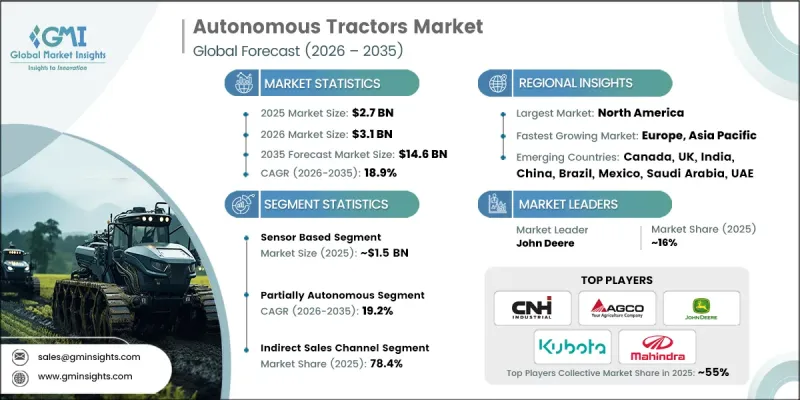
The Global Autonomous Tractors Market was valued at USD 2.7 billion in 2025 and is estimated to grow at a CAGR of 18.9% to reach USD 14.6 billion by 2035.
The rapid growth is reshaping modern agriculture, driven largely by labor shortages and the increasing demand for efficient farming operations. In many regions, particularly in developed economies, the farming workforce is aging, and fewer young farmers are entering the industry. Autonomous tractors address these challenges by reducing dependence on human labor, allowing machinery to operate long hours without fatigue, manage repetitive or tedious tasks, and enable farmers to oversee large-scale farms more efficiently. Rising labor costs and scarce workforce availability make autonomous tractors essential for timely planting, fertilizing, and harvesting operations, while also improving productivity and resource management.
| Market Scope | |
|---|---|
| Start Year | 2025 |
| Forecast Year | 2026-2035 |
| Start Value | $2.7 Billion |
| Forecast Value | $14.6 Billion |
| CAGR | 18.9% |
The adoption of precision agriculture is another key growth factor. Farmers are increasingly integrating technologies such as advanced GPS, artificial intelligence, and sensor systems, which allow tractors to operate with high accuracy. Autonomous tractors use these technologies to optimize crop yields, reduce waste, and ensure efficient use of water, seeds, and fertilizers.
The sensor-based systems segment reached USD 1.5 billion in 2025, are expected to grow at a CAGR of 19.5% from 2026 to 2035. Sensors such as LiDAR, ultrasonic, infrared, and proximity systems enable real-time monitoring of soil conditions, crop health, and obstacle detection, guiding tractors safely through complex field environments. As digital farming expands, demand for intelligent systems capable of interpreting environmental data and autonomously adjusting operations is rising sharply.
The partially autonomous tractors segment held 57% share in 2025 and is projected to grow at a CAGR of 19.2% from 2026 to 2035. These models combine GPS-assisted steering, auto-speed control, and guided navigation with human oversight for decision-making, offering a cost-effective alternative to fully autonomous units. Their compatibility with existing infrastructure and farming practices reduces adoption barriers and shortens the learning curve, making them especially attractive to farmers in developing regions where budgets are constrained.
U.S. Autonomous Tractors Market captured USD 0.7 billion in 2025, and is expected to grow at a CAGR of 19.2% through 2035. U.S. farmers are early adopters of automation and precision farming technologies to enhance productivity, lower labor dependence, and optimize resource usage. A strong ecosystem of agri-tech providers, including companies that integrate AI, IoT, GPS, and data analytics into autonomous tractors, facilitates adoption and drives innovation in smart farming.
Prominent players in the Global Autonomous Tractors Market include AGCO, Argo Tractors, AutoNxt Automation, Autonomous Tractor Corporation, CNH Industrial, Dutch Power Company, John Deere, Kubota Corporation, Mahindra and Mahindra Ltd, Raven Industries, SDF Group, Trimble, TYM Corporation, Yanmar Co. Ltd, and Zimeno Inc. (DBA Monarch Tractor). Companies in the autonomous tractor market strengthen their position by focusing on continuous R&D and technology integration, offering partially and fully autonomous models to cater to varying farm sizes and budgets, and providing end-to-end solutions combining hardware, software, and data analytics. Partnerships and strategic collaborations with tech firms enable rapid innovation and adoption of AI, sensor, and IoT technologies. Firms also expand through geographical diversification, targeting emerging markets with customized offerings suitable for local agricultural practices. Enhancing customer support, training programs, and providing flexible financing options further improve accessibility, building trust and long-term customer loyalty while sustaining market growth.
Table of Contents
Chapter 1 Methodology & Scope
- 1.1 Market scope and definition
- 1.2 Research design
- 1.2.1 Research approach
- 1.2.2 Data collection methods
- 1.3 Data mining sources
- 1.3.1 Global
- 1.3.2 Regional/Country
- 1.4 Base estimates and calculations
- 1.4.1 Base year calculation
- 1.4.2 Key trends for market estimation
- 1.5 Primary research and validation
- 1.5.1 Primary sources
- 1.6 Forecast model
- 1.7 Research assumptions and limitations
Chapter 2 Executive Summary
- 2.1 Industry 360° synopsis
- 2.2 Key market trends
- 2.2.1 Regional
- 2.2.2 Technology
- 2.2.3 Automation
- 2.2.4 Power output
- 2.2.5 Crop type
- 2.2.6 Application
- 2.2.7 Distribution channel
- 2.3 CXO perspectives: Strategic imperatives
- 2.3.1 Key decision points for industry executives
- 2.3.2 Critical success factors for market players
- 2.4 Future outlook and strategic recommendations
Chapter 3 Industry Insights
- 3.1 Industry ecosystem analysis
- 3.1.1 Supplier landscape
- 3.1.2 Profit margin
- 3.1.3 Value addition at each stage
- 3.1.4 Factor affecting the value chain
- 3.2 Industry impact forces
- 3.2.1 Growth drivers
- 3.2.1.1 Labor shortages in agriculture
- 3.2.1.2 Rising demand for precision agriculture
- 3.2.1.3 Increasing farm productivity and efficiency
- 3.2.1.4 Sustainability and environmental concerns
- 3.2.2 Industry pitfalls & challenges
- 3.2.2.1 High initial investment costs
- 3.2.2.2 Technical complexity and skill gaps
- 3.2.1 Growth drivers
- 3.3 Growth potential analysis
- 3.4 Future market trends
- 3.5 Technology and innovation landscape
- 3.5.1 Current technological trends
- 3.5.2 Emerging technologies
- 3.6 Price trends
- 3.6.1 By region
- 3.6.2 By technology
- 3.7 Regulatory landscape
- 3.7.1 Standards and compliance requirements
- 3.7.2 Regional regulatory frameworks
- 3.7.3 Certification standards
- 3.8 Trade statistics
- 3.8.1 Major importing countries
- 3.8.2 Major exporting countries
- 3.9 Porter's analysis
- 3.10 PESTEL analysis
Chapter 4 Competitive Landscape, 2025
- 4.1 Introduction
- 4.2 Company market share analysis
- 4.2.1 By Region
- 4.2.1.1 North America
- 4.2.1.2 Europe
- 4.2.1.3 Asia Pacific
- 4.2.1.4 Latin America
- 4.2.1.5 Middle East & Africa
- 4.2.1 By Region
- 4.3 Company matrix analysis
- 4.4 Competitive analysis of major market players
- 4.5 Competitive positioning matrix
- 4.6 Key developments
- 4.6.1 Mergers & acquisitions
- 4.6.2 Partnerships & collaborations
- 4.6.3 New product launches
- 4.6.4 Expansion plans
Chapter 5 Market Estimates & Forecast, By Technology, 2022 - 2035, (USD Billion) (Thousand Units)
- 5.1 Key trends
- 5.2 GPS guidance
- 5.3 Sensor based
- 5.4 Remote control
Chapter 6 Market Estimates & Forecast, By Automation, 2022 - 2035, (USD Billion) (Thousand Units)
- 6.1 Key trends
- 6.2 Fully autonomous
- 6.3 Partially autonomous
- 6.4 Highly autonomous
Chapter 7 Market Estimates & Forecast, By Power Output, 2022 - 2035, (USD Billion) (Thousand Units)
- 7.1 Key trends
- 7.2 Light duty (<50 HP)
- 7.3 Medium-duty (50-100 HP)
- 7.4 Heavy-duty (>100 HP)
Chapter 8 Market Estimates & Forecast, By Crop Type, 2022 - 2035, (USD Billion) (Thousand Units)
- 8.1 Key trends
- 8.2 Cereal crops
- 8.3 Row crops
- 8.4 Specialty crops
- 8.5 Forage crops
Chapter 9 Market Estimates & Forecast, By Application, 2022 - 2035, (USD Billion) (Thousand Units)
- 9.1 Key trends
- 9.2 Agriculture
- 9.2.1 Tillage and soil preparation
- 9.2.2 Planting and seeding
- 9.2.3 Crop monitoring and management
- 9.2.4 Harvesting operations
- 9.3 Mining
- 9.3.1 Material handling and transport
- 9.3.2 Site preparation and maintenance
- 9.4 Waste management
- 9.4.1 Collection and sorting
- 9.4.2 Site maintenance and operations
Chapter 10 Market Estimates & Forecast, By Distribution Channel, 2022 - 2035, (USD Billion) (Thousand Units)
- 10.1 Key trends
- 10.2 Direct
- 10.3 Indirect
Chapter 11 Market Estimates & Forecast, By Region, 2022 - 2035, (USD Billion) (Thousand Units)
- 11.1 Key trends
- 11.2 North America
- 11.2.1 U.S.
- 11.2.2 Canada
- 11.3 Europe
- 11.3.1 Germany
- 11.3.2 UK
- 11.3.3 France
- 11.3.4 Italy
- 11.3.5 Spain
- 11.4 Asia Pacific
- 11.4.1 China
- 11.4.2 India
- 11.4.3 Japan
- 11.4.4 South Korea
- 11.4.5 Australia
- 11.4.6 Indonesia
- 11.4.7 Malaysia
- 11.5 Latin America
- 11.5.1 Brazil
- 11.5.2 Mexico
- 11.5.3 Argentina
- 11.6 MEA
- 11.6.1 Saudi Arabia
- 11.6.2 UAE
- 11.6.3 South Africa
Chapter 12 Company Profiles
- 12.1 AGCO
- 12.2 Argo Tractors
- 12.3 AutoNext Automation
- 12.4 Autonomous Tractor Corporation
- 12.5 CNH Industrial
- 12.6 Dutch Power Company
- 12.7 John Deere
- 12.8 Kubota Corporation
- 12.9 Mahindra and Mahindra Ltd
- 12.10 Raven Industries
- 12.11 SDF Group
- 12.12 Trimble
- 12.13 TYM Corporation
- 12.14 Yanmar Co. Ltd
- 12.15 Zimeno Inc.

