PUBLISHER: Global Market Insights Inc. | PRODUCT CODE: 2019238

PUBLISHER: Global Market Insights Inc. | PRODUCT CODE: 2019238
Ambient Light Sensor Market Opportunity, Growth Drivers, Industry Trend Analysis, and Forecast 2026 - 2035
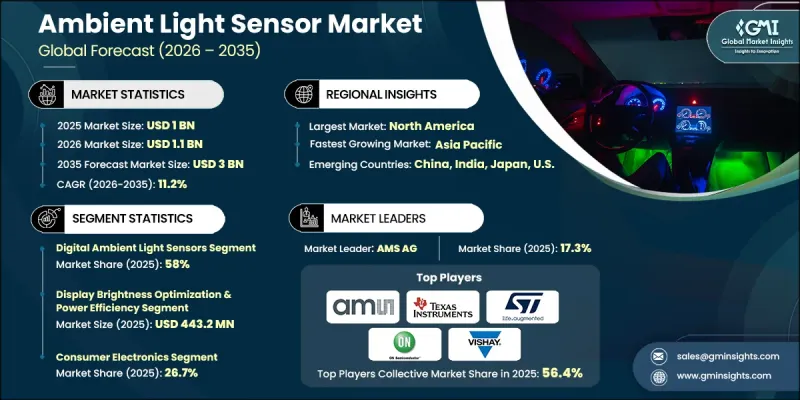
The Global Ambient Light Sensor (ALS) Market was valued at USD 1 billion in 2025 and is estimated to grow at a CAGR of 11.2% to reach USD 3 billion by 2035.
Rising adoption of ALS for adaptive display management, energy optimization, and enhanced user experience in smartphones, tablets, laptops, and industrial devices is fueling demand. Technological advancements in AI-enabled and multispectral sensing allow devices to intelligently adjust displays, optimize camera performance, and support contextual behavior, boosting ALS applications beyond simple brightness control. The proliferation of smart homes, smart buildings, and connected industrial systems has further solidified ALS as a critical component in modern sensing platforms. As manufacturers standardize automatic brightness and energy-efficient features, the market is strengthening its presence across consumer electronics, automotive, and IoT sectors.
| Market Scope | |
|---|---|
| Start Year | 2025 |
| Forecast Year | 2026-2035 |
| Start Value | $1 Billion |
| Forecast Value | $3 Billion |
| CAGR | 11.2% |
The digital ambient light sensors segment held a 58% share in 2025 owing to their high precision, built-in ADCs, and seamless compatibility with microcontrollers and display drivers. These sensors are essential in devices requiring accurate lux detection under varying lighting conditions and are critical for OLED and high-resolution displays.
The environmental context detection segment is projected to grow at a CAGR of 12.9% through 2035, driven by the integration of ALS in sensor fusion systems alongside motion, proximity, and color sensors. Applications such as adaptive user interfaces, AR/VR devices, and smart wearables increasingly rely on real-time environmental light data to enhance user experience and device responsiveness.
North America Ambient Light Sensor (ALS) Market accounted for 31.3% share in 2025. Growth in the region is fueled by the rapid adoption of adaptive displays in consumer electronics, automotive cockpits, and smart building systems. Smart home adoption and connected lighting solutions drive demand for automated illumination control using ALS technology. The presence of leading semiconductor and consumer electronics firms and ongoing research initiatives accelerates technological advancements in the region.
Prominent players in the Global Ambient Light Sensor (ALS) Market include AMS AG, Broadcom Inc., Honeywell International Inc., ON Semiconductor Corporation, Texas Instruments Incorporated, Maxim Integrated, OmniVision Technologies, Inc., STMicroelectronics, Sony Semiconductor Solutions Corporation, Microchip Technology Inc., Vishay Intertechnology, Panasonic Corporation, ROHM Semiconductor, Renesas Electronics Corporation, Silicon Labs, Everlight Electronics Co., Ltd., LITEON Technology, Sharp Corporation, Melexis NV, and ACADEMY MEDICAL INSTRUMENTS Limited Company. Companies in the Global Ambient Light Sensor (ALS) Market are focusing on multiple strategies to strengthen their foothold and expand market presence. They are investing heavily in R&D to enhance sensor accuracy, energy efficiency, and AI-enabled functionalities. Strategic partnerships with consumer electronics, automotive, and industrial IoT manufacturers help integrate ALS into end devices. Firms are expanding product portfolios to cover both digital and analog sensors, along with environmental context detection solutions. Collaborations with smart home and smart building solution providers enable market penetration in connected infrastructure.
Table of Contents
Chapter 1 Methodology and Scope
- 1.1 Market scope and definition
- 1.2 Research design
- 1.2.1 Research approach
- 1.2.2 Data collection methods
- 1.3 Data mining sources
- 1.3.1 Global
- 1.3.2 Regional/Country
- 1.4 Base estimates and calculations
- 1.4.1 Base year calculation
- 1.4.2 Key trends for market estimation
- 1.5 Primary research and validation
- 1.5.1 Primary sources
- 1.6 Forecast model
- 1.7 Research assumptions and limitations
Chapter 2 Executive Summary
- 2.1 Industry 360° synopsis, 2022 - 2035
- 2.2 Key market trends
- 2.2.1 Sensor technology type trends
- 2.2.2 Application trends
- 2.2.3 End-user industry trends
- 2.2.4 Regional trends
- 2.3 TAM Analysis, 2026-2035
- 2.4 CXO perspectives: Strategic imperatives
Chapter 3 Industry Insights
- 3.1 Industry ecosystem analysis
- 3.1.1 Supplier Landscape
- 3.1.2 Profit Margin
- 3.1.3 Cost structure
- 3.1.4 Value addition at each stage
- 3.1.5 Factor affecting the value chain
- 3.1.6 Disruptions
- 3.2 Industry impact forces
- 3.2.1 Growth drivers
- 3.2.1.1 Smart device sensor integration rising global demand
- 3.2.1.2 Multispectral and AI-enabled sensing advancements
- 3.2.1.3 Automotive adaptive lighting and safety tech uptake
- 3.2.1.4 IoT and connected smart home lighting expansion
- 3.2.1.5 Miniaturization and low-power sensor innovation
- 3.2.2 Industry pitfalls and challenges
- 3.2.2.1 Complex integration/miniaturization engineering hurdles
- 3.2.2.2 Sensor performance limits in mixed light conditions
- 3.2.3 Market opportunities
- 3.2.3.1 Smart city / energy-efficient building installations
- 3.2.3.2 Healthcare & wearable device ambient sensing
- 3.2.1 Growth drivers
- 3.3 Growth potential analysis
- 3.4 Regulatory landscape
- 3.4.1 North America
- 3.4.2 Europe
- 3.4.3 Asia Pacific
- 3.4.4 Latin America
- 3.4.5 Middle East & Africa
- 3.5 Porter's analysis
- 3.6 PESTEL analysis
- 3.7 Technology and Innovation landscape
- 3.7.1 Current technological trends
- 3.7.2 Emerging technologies
- 3.8 Price trends
- 3.8.1 By region
- 3.8.2 By product
- 3.9 Pricing Strategies
- 3.10 Emerging Business Models
- 3.11 Compliance Requirements
- 3.12 Patent and IP analysis
Chapter 4 Competitive Landscape, 2025
- 4.1 Introduction
- 4.2 Company market share analysis
- 4.2.1 By region
- 4.2.1.1 North America
- 4.2.1.2 Europe
- 4.2.1.3 Asia Pacific
- 4.2.1.4 Latin America
- 4.2.1.5 Middle East & Africa
- 4.2.2 Market concentration analysis
- 4.2.1 By region
- 4.3 Competitive benchmarking of key players
- 4.3.1 Financial performance comparison
- 4.3.1.1 Revenue
- 4.3.1.2 Profit margin
- 4.3.1.3 R&D
- 4.3.2 Product portfolio comparison
- 4.3.2.1 Product range breadth
- 4.3.2.2 Technology
- 4.3.2.3 Innovation
- 4.3.3 Geographic presence comparison
- 4.3.3.1 Global footprint analysis
- 4.3.3.2 Service network coverage
- 4.3.3.3 Market penetration by region
- 4.3.4 Competitive positioning matrix
- 4.3.4.1 Leaders
- 4.3.4.2 Challengers
- 4.3.4.3 Followers
- 4.3.4.4 Niche players
- 4.3.5 Strategic outlook matrix
- 4.3.1 Financial performance comparison
- 4.4 Key developments
- 4.4.1 Mergers and acquisitions
- 4.4.2 Partnerships and collaborations
- 4.4.3 Technological advancements
- 4.4.4 Expansion and investment strategies
- 4.4.5 Digital transformation initiatives
- 4.5 Emerging/ startup competitors landscape
Chapter 5 Market Estimates and Forecast, By Sensor Technology Type, 2022 - 2035 (USD Million)
- 5.1 Key trends
- 5.2 Analog ambient light sensors
- 5.2.1 Legacy consumer electronics applications
- 5.2.2 Low-cost industrial HMI panels
- 5.3 Digital ambient light sensors
- 5.3.1 Standard digital ALS (lux measurement only)
- 5.3.2 Advanced digital ALS (multi-spectral, color, flicker detection)
Chapter 6 Market Estimates and Forecast, By Application, 2022 - 2035 (USD Million)
- 6.1 Key trends
- 6.2 Display brightness optimization & power efficiency
- 6.3 Camera & imaging assistance
- 6.4 Environmental context detection
- 6.5 Industrial & specialized sensing
Chapter 7 Market Estimates and Forecast, By End-User Industry, 2022 - 2035 (USD Million)
- 7.1 Key trends
- 7.2 Consumer electronics
- 7.3 Automotive
- 7.4 Industrial
- 7.5 Manufacturing
- 7.6 Healthcare
- 7.7 Commercial
- 7.8 Others
Chapter 8 Market Estimates and Forecast, By Region, 2022 - 2035 (USD Million)
- 8.1 Key trends
- 8.2 North America
- 8.2.1 U.S.
- 8.2.2 Canada
- 8.3 Europe
- 8.3.1 Germany
- 8.3.2 UK
- 8.3.3 France
- 8.3.4 Spain
- 8.3.5 Italy
- 8.3.6 Netherlands
- 8.4 Asia Pacific
- 8.4.1 China
- 8.4.2 India
- 8.4.3 Japan
- 8.4.4 Australia
- 8.4.5 South Korea
- 8.5 Latin America
- 8.5.1 Brazil
- 8.5.2 Mexico
- 8.5.3 Argentina
- 8.6 Middle East and Africa
- 8.6.1 South Africa
- 8.6.2 Saudi Arabia
- 8.6.3 UAE
Chapter 9 Company Profiles
- 9.1 Global Key Players
- 9.1.1 AMS AG
- 9.1.2 STMicroelectronics
- 9.1.3 Texas Instruments Incorporated
- 9.1.4 ON Semiconductor Corporation
- 9.1.5 Vishay Intertechnology
- 9.1.6 Broadcom Inc.
- 9.1.7 Renesas Electronics Corporation
- 9.2 Regional key players
- 9.2.1 North America
- 9.2.1.1 Microchip Technology Inc.
- 9.2.1.2 Silicon Labs
- 9.2.1.3 OmniVision Technologies, Inc.
- 9.2.1.4 Honeywell International Inc.
- 9.2.2 Asia Pacific
- 9.2.2.1 Samsung Electronics Co., Ltd.
- 9.2.2.2 Sony Semiconductor Solutions Corporation
- 9.2.2.3 ROHM Semiconductor
- 9.2.2.4 Sharp Corporation
- 9.2.2.5 Panasonic Corporation
- 9.2.2.6 Everlight Electronics Co., Ltd.
- 9.2.2.7 LITEON Technology
- 9.2.3 Europe
- 9.2.3.1 Melexis NV
- 9.2.1 North America
- 9.3 Niche Players/Disruptors
- 9.3.1 Maxim Integrated

