PUBLISHER: Mordor Intelligence | PRODUCT CODE: 2124109

PUBLISHER: Mordor Intelligence | PRODUCT CODE: 2124109
Light Sensors - Market Share Analysis, Industry Trends & Statistics, Growth Forecasts (2026 - 2031)
According to Mordor Intelligence, the light sensor market size in 2026 is estimated at USD 4.39 billion, growing from 2025 value of USD 4.1 billion with 2031 projections showing USD 6.08 billion, growing at 6.75% CAGR over 2026-2031.
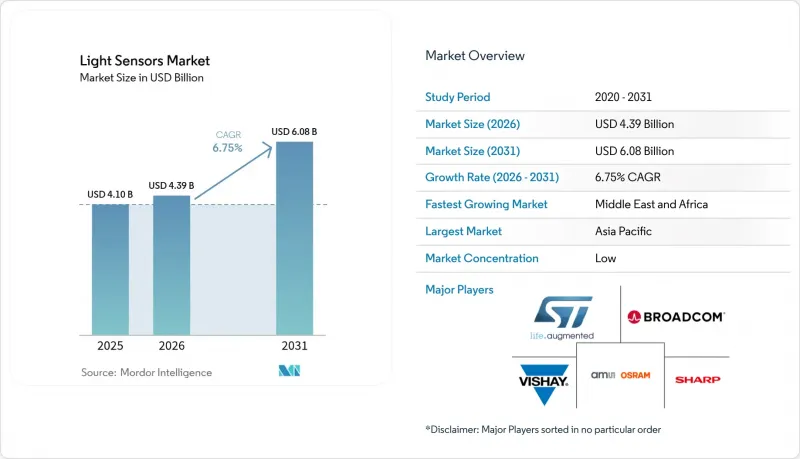
This report is Segmented by Function (Ambient Light, Proximity, RGB Color, Gesture Recognition, UV, IR), Output (Digital, Analog), Technology (CMOS, CCD/Photo-IC, Photodiodes, MEMS), Spectrum (Visible, Infrared, UV), Integration (Discrete, Combo), End-Use (Consumer Electronics, Automotive, Industrial, Smart Home, Healthcare), and Geography. The Market Forecasts are Provided in Terms of Value (USD).
Global Light Sensors Market Trends and Insights
Accelerating Integration of Ambient & Proximity Sensors in OLED Smartphones (Asia)
Behind-display sensing allows phone makers to remove front-panel cut-outs without sacrificing auto-brightness or proximity features. ams-OSRAM's TCS3701 measures ambient light through OLED pixels and entered mass production in 2024, quickly adopted by leading Chinese and Korean OEMs. Volume adoption accelerates supply-chain investments in ultra-thin optical stacks, reinforcing Asia's leadership in smartphone engineering.
Mandatory Daylight-Running & Adaptive Headlamp Regulations Boosting Sensor Demand (Europe)
European automotive lighting regulations have created sustained demand for sophisticated light sensors as vehicle manufacturers comply with ECE and NHTSA standards for adaptive headlamp systems. The UN ECE Regulation No. 48 mandates specific lighting functions that require continuous ambient light monitoring to optimize beam patterns and intensity levels. This regulatory framework has driven automotive suppliers to integrate multiple sensor types within single modules, creating opportunities for companies that can deliver integrated solutions combining ambient light detection, proximity sensing, and spectral analysis capabilities. The regulations' emphasis on adaptive functionality has particularly benefited suppliers offering CMOS-integrated sensors that can process multiple light conditions simultaneously while meeting automotive reliability standards. European OEMs have responded by standardizing sensor specifications across model lines, creating volume opportunities for suppliers capable of meeting AEC-Q100 Grade 2 qualification requirements.
Photodiode Linearity Limits Under Low-Illuminance Automotive Cabins
Photodiode performance degradation in low-illuminance automotive environments has emerged as a technical constraint limiting sensor accuracy in premium vehicle applications where precise ambient light measurement is critical for advanced lighting systems. Research demonstrates that conventional silicon photodiodes exhibit non-linear response characteristics below 10 lux, creating measurement errors that compromise adaptive headlamp performance and interior lighting optimization. This limitation has forced automotive suppliers to implement complex calibration algorithms and multi-sensor architectures to maintain accuracy across the full dynamic range required for vehicle applications. The constraint particularly affects luxury vehicle segments where customers expect seamless lighting transitions and precise color temperature control, creating differentiation challenges for sensor manufacturers unable to deliver consistent low-light performance.
Other drivers and restraints analyzed in the detailed report include:
- ADAS-Driven Camera & LiDAR Light Sensor Uptake (North America)
- Smart Lighting Codes Driving UV/IR Sensors in Commercial Buildings (Middle East)
- Severe Price Erosion from White-Label Chinese Vendors
For complete list of drivers and restraints, kindly check the Table Of Contents.
Segment Analysis
Ambient detectors retained 34.50% revenue in 2025, confirming their ubiquity in back-light dimming and energy management. Gesture sensors, however, are scaling at 13.50% CAGR on the back of touchless control in healthcare and premium consumer devices. The light sensor market size for gesture modules is projected to reach USD 1.18 billion by 2031, underpinned by dual-axis designs such as Analog Devices' CN0569. Hospitals prefer contact-free interfaces, and carmakers are adding hand-wave controls to dashboards. In parallel, proximity and RGB sensors remain indispensable for ear-in detection and camera white-balance, ensuring diversified demand streams.
Suppliers combine gesture, ambient, and proximity functions into single die to save board area. This combo design reshapes procurement toward multi-function contracts, boosting switching costs and reinforcing brand loyalty. Precision agriculture fuels UV sensors for PAR tracking, while multispectral detectors capture premium industrial and medical niches where defect detection or tissue characterization commands high ASPs. The light sensor market continues to reward firms that balance high-volume ambient products with specialized gesture and spectral devices.
Digital-output devices comprised 59.40% sales in 2025 and are on course for 9.10% CAGR through 2031. Smartphone OEMs view direct I2C or SPI connectivity as essential to shrink BOM count. Advanced on-chip ADCs and histogram engines further tilt preference toward digital. Analog devices persist in time-critical or safety-related domains such as brake-light switching, yet the gap narrows as low-latency digital pipelines emerge.
System integrators prize calibrated lux outputs and built-in flicker detection that digital parts deliver. These traits simplify procurement by moving characterization tasks upstream to the silicon vendor. Conversely, analog parts keep a foothold in heavy-duty machinery and legacy PLC environments. Vendor differentiation increasingly centers on embedded intelligence-noise filtering and automatic gain-rather than raw photodiode performance.
Complete Report Scope:
- By Function
- Ambient Light Sensors
- Proximity Sensors
- RGB Color Sensors
- Gesture Recognition Sensors
- UV Light Sensors
- Infrared Light Sensors
- Multispectral and Spectral Sensors
- By Output
- Digital Output
- Analog Output
- By Technology
- CMOS Integration
- CCD/Photo-IC
- Photodiodes and Phototransistors
- MEMS-based Technologies
- By Spectrum
- Visible Light (390-700 nm)
- Infrared (Greater than 700 nm)
- Ultraviolet (Less than 390 nm)
- By Integration Level
- Stand-Alone Discrete Sensors
- Integrated Combo Sensors and Modules
- By End-use Industry
- Consumer Electronics
- Automotive and Transportation
- Industrial Automation and Robotics
- Smart Home and Building Automation
- Healthcare and Medical Devices
- Agriculture and Environmental Monitoring
- Aerospace and Defense
- Others
- By Geography
- North America
- United States
- Canada
- Mexico
- South America
- Brazil
- Argentina
- Rest of South America
- Europe
- Germany
- United Kingdom
- France
- Italy
- Spain
- Nordics (Sweden, Norway, Denmark, Finland)
- Benelux (Belgium, Netherlands, Luxembourg)
- Middle East
- Saudi Arabia
- United Arab Emirates
- Israel
- Turkey
- Africa
- South Africa
- Nigeria
- Kenya
- Rest of Africa
- Asia-Pacific
- China
- Japan
- India
- South Korea
- ASEAN (Singapore, Malaysia, Thailand, Indonesia, Philippines, Vietnam)
- North America
Geography Analysis
Asia-Pacific commanded 40.10% revenues in 2025 due to intense smartphone assembly in China, semiconductor leadership in Taiwan, and burgeoning EV production in South Korea. Taiwan produces 63.8% of global semiconductors, granting regional vendors proximity to advanced 5 nm and 3 nm nodes taiwanembassy.org. Chinese suppliers leverage government incentives to enter mid-range ambient sensor tiers, placing pricing pressure on established brands.
North America's growth outlook brightens as automakers re-tool plants for electrification and Level-3 autonomy. U.S. CHIPS and Science Act allocates USD 52.7 billion to domestic foundries, potentially shortening sensor lead times commerce.gov. Tier-1 suppliers open satellite design centers near Detroit and Austin to secure local content mandates.
Europe remains a regulation-driven market; strict lighting and safety codes ensure steady sensor pull-through, though wafer-fab scarcity limits indigenous supply. The EUR 43 billion European Chips Act aims to double the region's semiconductor share to 20% by 2030 ec.europa.eu. Meanwhile, Middle Eastern smart-city initiatives create pockets of demand for UV/IR detectors within green-building projects. Nordic vertical farms also boost UV-PAR sensor uptake, proving that niche geographies can punch above their size in specialized categories.
- ams-OSRAM AG
- Sharp Corporation
- STMicroelectronics N.V.
- Broadcom Inc.
- Vishay Intertechnology Inc.
- Analog Devices Inc. (Maxim Integrated)
- Apple Inc.
- Elan Microelectronics Corp.
- Everlight Electronics Co., Ltd.
- Samsung Electronics Co., Ltd.
- Sitronix Technology Corporation
- ROHM Co., Ltd.
- Texas Instruments Incorporated
- onsemi Corporation
- Sony Semiconductor Solutions Corporation
- Omron Corporation
- Panasonic Holdings Corporation
- Alps Alpine Co., Ltd.
- Lite-On Technology Corporation
- Melexis NV
- TE Connectivity Ltd.
- Partron Co., Ltd.
- Himax Technologies, Inc.
- Hella GmbH and Co. KGaA
- Murata Manufacturing Co., Ltd.
Additional Benefits:
- The market estimate (ME) sheet in Excel format
- 3 months of analyst support
TABLE OF CONTENTS
1 INTRODUCTION
- 1.1 Study Assumptions and Market Definition
- 1.2 Scope of the Study
2 RESEARCH METHODOLOGY
3 EXECUTIVE SUMMARY
4 MARKET LANDSCAPE
- 4.1 Market Overview
- 4.2 Market Drivers
- 4.2.1 Accelerating Integration of Ambient and Proximity Sensors in OLED Smartphones (Asia)
- 4.2.2 Mandatory Daylight-Running and Adaptive Headlamp Regulations Boosting Sensor Demand (Europe)
- 4.2.3 ADAS-Driven Camera and LiDAR Light Sensor Uptake (North America)
- 4.2.4 Smart Lighting Codes Driving UV/IR Sensors in Commercial Buildings (Middle East)
- 4.2.5 Precision Indoor Farming Requiring PAR and UV Sensors (Nordics and East Asia)
- 4.2.6 Miniaturized Low-Power CMOS Architectures Enabling Wearables and AR Devices (Global)
- 4.3 Market Restraints
- 4.3.1 Photodiode Linearity Limits Under Low-Illuminance Automotive Cabins
- 4.3.2 Severe Price Erosion from White-Label Chinese Vendors
- 4.3.3 Thermal Crosstalk in Multi-Sensor Smartphone Modules
- 4.3.4 EU Regulatory Delays on Public-Space IR Gesture Spectrum Allocation
- 4.4 Value / Supply-Chain Analysis
- 4.5 Regulatory or Technological Outlook
- 4.5.1 Global Photodiode Roadmap and Miniaturization Trends
- 4.5.2 Automotive Headlamp and Ambient Lighting Regulations (ECE, NHTSA)
- 4.6 Porter's Five Forces
- 4.6.1 Bargaining Power of Suppliers
- 4.6.2 Bargaining Power of Consumers
- 4.6.3 Threat of New Entrants
- 4.6.4 Threat of Substitutes
- 4.6.5 Intensity of Competitive Rivalry
- 4.7 Investment Analysis (Capex, VC, MandA)
5 MARKET SIZE AND GROWTH FORECASTS (VALUE)
- 5.1 By Function
- 5.1.1 Ambient Light Sensors
- 5.1.2 Proximity Sensors
- 5.1.3 RGB Color Sensors
- 5.1.4 Gesture Recognition Sensors
- 5.1.5 UV Light Sensors
- 5.1.6 Infrared Light Sensors
- 5.1.7 Multispectral and Spectral Sensors
- 5.2 By Output
- 5.2.1 Digital Output
- 5.2.2 Analog Output
- 5.3 By Technology
- 5.3.1 CMOS Integration
- 5.3.2 CCD/Photo-IC
- 5.3.3 Photodiodes and Phototransistors
- 5.3.4 MEMS-based Technologies
- 5.4 By Spectrum
- 5.4.1 Visible Light (390-700 nm)
- 5.4.2 Infrared (Greater than 700 nm)
- 5.4.3 Ultraviolet (Less than 390 nm)
- 5.5 By Integration Level
- 5.5.1 Stand-Alone Discrete Sensors
- 5.5.2 Integrated Combo Sensors and Modules
- 5.6 By End-use Industry
- 5.6.1 Consumer Electronics
- 5.6.2 Automotive and Transportation
- 5.6.3 Industrial Automation and Robotics
- 5.6.4 Smart Home and Building Automation
- 5.6.5 Healthcare and Medical Devices
- 5.6.6 Agriculture and Environmental Monitoring
- 5.6.7 Aerospace and Defense
- 5.6.8 Others
- 5.7 By Geography
- 5.7.1 North America
- 5.7.1.1 United States
- 5.7.1.2 Canada
- 5.7.1.3 Mexico
- 5.7.2 South America
- 5.7.2.1 Brazil
- 5.7.2.2 Argentina
- 5.7.2.3 Rest of South America
- 5.7.3 Europe
- 5.7.3.1 Germany
- 5.7.3.2 United Kingdom
- 5.7.3.3 France
- 5.7.3.4 Italy
- 5.7.3.5 Spain
- 5.7.3.6 Nordics (Sweden, Norway, Denmark, Finland)
- 5.7.3.7 Benelux (Belgium, Netherlands, Luxembourg)
- 5.7.4 Middle East
- 5.7.4.1 Saudi Arabia
- 5.7.4.2 United Arab Emirates
- 5.7.4.3 Israel
- 5.7.4.4 Turkey
- 5.7.5 Africa
- 5.7.5.1 South Africa
- 5.7.5.2 Nigeria
- 5.7.5.3 Kenya
- 5.7.5.4 Rest of Africa
- 5.7.6 Asia-Pacific
- 5.7.6.1 China
- 5.7.6.2 Japan
- 5.7.6.3 India
- 5.7.6.4 South Korea
- 5.7.6.5 ASEAN (Singapore, Malaysia, Thailand, Indonesia, Philippines, Vietnam)
- 5.7.1 North America
6 COMPETITIVE LANDSCAPE
- 6.1 Market Concentration
- 6.2 Strategic Moves
- 6.3 Market Share Analysis
- 6.4 Company Profiles {(includes Global level Overview, Market level overview, Core Segments, Financials as available, Strategic Information, Market Rank/Share for key companies, Products and Services, and Recent Developments)}
- 6.4.1 ams-OSRAM AG
- 6.4.2 Sharp Corporation
- 6.4.3 STMicroelectronics N.V.
- 6.4.4 Broadcom Inc.
- 6.4.5 Vishay Intertechnology Inc.
- 6.4.6 Analog Devices Inc. (Maxim Integrated)
- 6.4.7 Apple Inc.
- 6.4.8 Elan Microelectronics Corp.
- 6.4.9 Everlight Electronics Co., Ltd.
- 6.4.10 Samsung Electronics Co., Ltd.
- 6.4.11 Sitronix Technology Corporation
- 6.4.12 ROHM Co., Ltd.
- 6.4.13 Texas Instruments Incorporated
- 6.4.14 onsemi Corporation
- 6.4.15 Sony Semiconductor Solutions Corporation
- 6.4.16 Omron Corporation
- 6.4.17 Panasonic Holdings Corporation
- 6.4.18 Alps Alpine Co., Ltd.
- 6.4.19 Lite-On Technology Corporation
- 6.4.20 Melexis NV
- 6.4.21 TE Connectivity Ltd.
- 6.4.22 Partron Co., Ltd.
- 6.4.23 Himax Technologies, Inc.
- 6.4.24 Hella GmbH and Co. KGaA
- 6.4.25 Murata Manufacturing Co., Ltd.
7 MARKET OPPORTUNITIES AND FUTURE OUTLOOK
- 7.1 White-space and Unmet-Need Assessment

