
PUBLISHER: Global Market Insights Inc. | PRODUCT CODE: 2027455

PUBLISHER: Global Market Insights Inc. | PRODUCT CODE: 2027455
Middle East and Africa Stationery Products Market Opportunity, Growth Drivers, Industry Trend Analysis, and Forecast 2026 - 2035
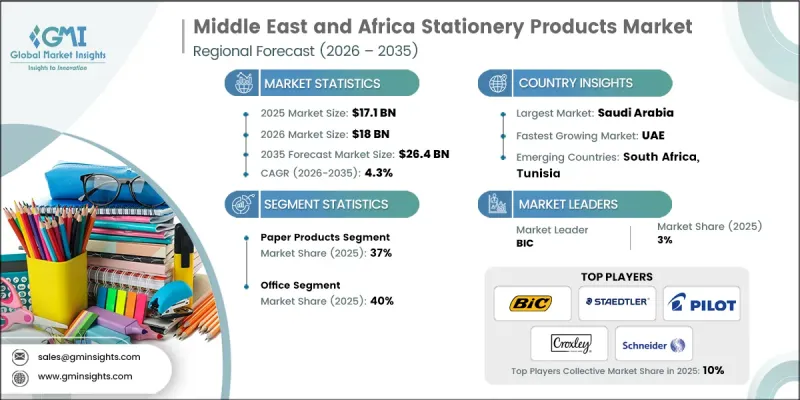
Middle East and Africa Stationery Products Market was valued at USD 17.1 billion in 2025 and is estimated to grow at a CAGR of 4.3% to reach USD 26.4 billion by 2035.
The market is shaped by a combination of rising educational demand, expanding commercial infrastructure, and evolving consumer purchasing behavior across the region. Increasing investments in education systems across multiple countries are creating sustained demand for essential learning materials, ensuring a consistent consumption cycle within academic environments. At the same time, rapid urban development is driving the expansion of corporate offices and administrative institutions, which is significantly boosting the need for workplace stationery and organizational supplies. This growing professional ecosystem is contributing to a broader and more diverse consumer base. In addition, the region's role as a key trade corridor is facilitating the steady movement of stationery goods, supporting both domestic consumption and cross-border distribution. While traditional stationery items remain indispensable, the market is gradually adapting to changing user preferences influenced by digitalization, leading to increased demand for products that offer enhanced usability and align with modern work and study habits.
| Market Scope | |
|---|---|
| Start Year | 2025 |
| Forecast Year | 2026-2035 |
| Start Value | $17.1 Billion |
| Forecast Value | $26.4 Billion |
| CAGR | 4.3% |
The market continues to evolve as manufacturers respond to shifting consumer expectations and technological influence. Although conventional stationery products remain central to daily usage, there is a noticeable transition toward items that offer improved functionality and adaptability. This shift reflects a growing preference for products that can complement both traditional and modern usage patterns, particularly in environments where digital tools are increasingly present. At the same time, consistent demand from educational institutions and workplaces ensures that foundational stationery categories remain relevant. The balance between traditional demand and innovation-driven product development is shaping the competitive dynamics of the market, encouraging companies to refine their offerings while maintaining affordability and accessibility across diverse consumer segments.
The paper products segment held a 37% share in 2025. This segment continues to lead due to its essential role in routine academic and professional activities, where consistent usage remains deeply embedded in daily operations. The widespread reliance on paper-based materials across institutional and corporate environments ensures stable and recurring demand, reinforcing its dominant position. The segment benefits from its versatility and broad application across multiple use cases, making it a fundamental component of the stationery industry. Its established presence and continuous consumption patterns contribute significantly to overall market revenue, highlighting its importance as a core category within the regional landscape.
The office segment held a 40% share in 2025, generating USD 6.9 billion. This dominance is driven by the extensive use of stationery products within corporate, administrative, and organizational settings, where a steady supply of materials is essential for daily operations. The expansion of businesses and institutional establishments across the region continues to drive consistent demand for office-related supplies, supporting long-term growth within this segment. The ongoing need for documentation, communication, and operational management further strengthens its position, making it a critical contributor to overall market performance. As more enterprises establish a presence in the region, the reliance on office stationery is expected to remain strong and continue driving revenue growth.
Saudi Arabia Stationery Products Market captured 32% share in 2025, generating USD 5.5 billion. The country's strong market position is supported by its large population base, expanding student population, and substantial government spending on education. High levels of investment in academic infrastructure continue to drive consistent demand for stationery products across educational institutions. In addition, the country's growing corporate sector and increasing consumer purchasing power further contribute to sustained demand across both academic and professional segments. This combination of institutional support and economic growth reinforces Saudi Arabia's leadership within the regional market.
Key companies operating in the Middle East and Africa Stationery Products Market include BIC, Staedtler, Pilot, Schneider Pen, Zebra Pen, Bantex, Croxley/Bidvest, Freedom Stationery, Penflex, Stadex, CTP Stationery, Palm Stationery, Statesman Industries, Farook International Stationery, and Bedaya. Companies in the Middle East and Africa Stationery Products Market are adopting a range of strategies to strengthen their market position and expand their footprint. A key focus area is the development of diversified product portfolios that cater to both academic and professional users, ensuring relevance across multiple segments. Firms are also investing in distribution channel optimization to improve product availability across urban and rural areas. Strategic partnerships and regional collaborations are helping companies enhance their market reach and operational efficiency. In addition, there is a growing emphasis on cost-effective manufacturing and competitive pricing to attract a wider consumer base. Companies are also exploring product innovation to align with evolving consumer preferences, including the integration of functional and user-friendly designs.
Table of Contents
Chapter 1 Research Methodology
- 1.1 Research approach
- 1.2 Quality Commitments
- 1.2.1 GMI AI policy & data integrity commitment
- 1.2.1.1 Source consistency protocol
- 1.2.1 GMI AI policy & data integrity commitment
- 1.3 Research Trail & Confidence Scoring
- 1.3.1 Research Trail Components
- 1.3.2 Scoring Components
- 1.4 Data Collection
- 1.4.1 Partial list of primary sources
- 1.5 Data mining sources
- 1.5.1 Paid sources
- 1.5.1.1 Sources, by region
- 1.5.1 Paid sources
- 1.6 Base estimates and calculations
- 1.6.1 Base year calculation for any one approach
- 1.7 Forecast model
- 1.7.1 Quantified market impact analysis
- 1.7.1.1 Mathematical impact of growth parameters on forecast
- 1.7.1 Quantified market impact analysis
- 1.8 Research transparency addendum
- 1.8.1 Source attribution framework
- 1.8.2 Quality assurance metrics
- 1.8.3 Our commitment to trust
Chapter 2 Executive Summary
- 2.1 Industry 360° synopsis, 2022 - 2035
- 2.2 Key market trends
- 2.2.1 Regional
- 2.2.2 Product type
- 2.2.3 Price Range
- 2.2.4 Application
- 2.2.5 Distribution channel
Chapter 3 Industry Insights
- 3.1 Industry ecosystem analysis
- 3.1.1 Raw material suppliers (paper mills, ink manufacturers)
- 3.1.2 Product manufacturers and converters
- 3.1.3 Importers and distributors
- 3.1.4 Retail channels (offline and online)
- 3.1.5 End users (schools, offices, consumers)
- 3.1.6 Profit margin analysis by value chain stage
- 3.1.7 Value chain disruptions and bottlenecks
- 3.2 Industry impact forces
- 3.2.1 Growth drivers
- 3.2.1.1 Expansion of educational institutions across the region
- 3.2.1.2 Rising formalization of businesses and office setups
- 3.2.1.3 Growth of organized retail and e-commerce channels
- 3.2.2 Industry pitfalls & challenges
- 3.2.2.1 Heavy reliance on imports and fluctuating currency conditions
- 3.2.2.2 Inconsistent supply chains and logistics constraints
- 3.2.3 Opportunities
- 3.2.3.1 Rising demand for affordable, locally manufactured products
- 3.2.3.2 Growing interest in eco-friendly and sustainable stationery
- 3.2.1 Growth drivers
- 3.3 Growth potential analysis
- 3.4 Future market trends
- 3.5 Technology and innovation landscape
- 3.5.1 Current technological trends
- 3.5.2 Emerging technologies
- 3.6 Price trends (Driven by Primary Research)
- 3.6.1 Historical price trend analysis (driven by primary research)
- 3.6.2 Pricing strategy by player type (premium/value plus/costplus) (driven by primary research)
- 3.6.3 Regional price variations across Middle East and Africa
- 3.7 Regulatory landscape
- 3.7.1 Import/export regulations and tariffs
- 3.7.2 Environmental standards (plastic reduction, recycled content)
- 3.7.3 Education procurement policies
- 3.8 Distribution Infrastructure & Channel Penetration Landscape (Driven by Primary Research)
- 3.8.1 A Channel coverage by region and format (modern versus traditional trade) (driven by primary research)
- 3.8.2 Last-mile infrastructure gaps and emerging channel shifts (driven by primary research)
- 3.9 Trade Data Analysis (Driven by Paid Database) (HS Code - 4820)
- 3.9.1 Import/export volume and value trends (driven by primary research)
- 3.9.2 Key trade corridors and tariff impact (driven by primary research)
- 3.10 Impact of AI & Generative AI on the Market
- 3.10.1 AI-driven disruption of existing business models
- 3.10.2 GenAI use cases & adoption roadmap by segment
- 3.10.3 Risks, limitations & regulatory considerations
- 3.11 Porter’s analysis
- 3.12 PESTEL analysis
Chapter 4 Competitive Landscape, 2025
- 4.1 Introduction
- 4.2 Company market share analysis
- 4.2.1 By Country
- 4.3 Company matrix analysis
- 4.4 Competitive analysis of major market players
- 4.5 Competitive positioning matrix
- 4.6 Key developments
- 4.6.1 Mergers & acquisitions
- 4.6.2 Partnerships & collaborations
- 4.6.3 New product launches
- 4.6.4 Expansion plans
Chapter 5 Market Estimates & Forecast, By Product Type, 2022-2035 (USD Billion) (Million Units)
- 5.1 Key trends
- 5.2 Writing instruments
- 5.2.1 Pens
- 5.2.2 Pencils
- 5.2.3 Markers & highlighters
- 5.2.4 Erasers & correction tools
- 5.2.5 Others
- 5.3 Paper products
- 5.3.1 Notebooks
- 5.3.2 Loose paper
- 5.3.3 Files & folders
- 5.3.4 Envelopes
- 5.3.5 Greeting cards & calendars
- 5.3.6 Others
- 5.4 Office supplies
- 5.4.1 Fastening tools
- 5.4.2 Cutting & measuring tools
- 5.4.3 Desk accessories
- 5.4.4 Hole punchers
- 5.4.5 Stamps & ink pads
- 5.4.6 Others
- 5.5 Art supplies
- 5.5.1 Paints
- 5.5.2 Brushes & applicators
- 5.5.3 Canvas & art paper
- 5.5.4 Drawing media
- 5.5.5 Sculpting materials
- 5.5.6 Others
- 5.6 Others
Chapter 6 Market Estimates & Forecast, By Price Range, 2022-2035 (USD Billion) (Million Units)
- 6.1 Key trends
- 6.2 Low
- 6.3 Medium
- 6.4 High
Chapter 7 Market Estimates & Forecast, By Application, 2022-2035 (USD Billion) (Million Units)
- 7.1 Key trends
- 7.2 School
- 7.3 Office
- 7.4 Home
Chapter 8 Market Estimates & Forecast, By Distribution Channel, 2022-2035 (USD Billion) (Million Units)
- 8.1 Key trends
- 8.2 Online Channels
- 8.3 Offline Channels
Chapter 9 Market Estimates & Forecast, By Region, 2022 - 2035 ($Bn) (Thousand Units)
- 9.1 Key trends
- 9.2 Saudi Arabia
- 9.3 UAE
- 9.4 South Africa
- 9.5 Rest of Middle East and Africa
Chapter 10 Company Profiles
- 10.1 BIC
- 10.2 CTP Stationery
- 10.3 Schneider Pen
- 10.4 Zebra Pen
- 10.5 Croxley/Bidvest
- 10.6 Freedom Stationery
- 10.7 Penflex
- 10.8 Stadex
- 10.9 Bantex
- 10.10 Palm Stationery
- 10.11 Statesman Industries
- 10.12 Staedtler
- 10.13 Pilot
- 10.14 Farook International Stationery
- 10.15 Bedaya

