
PUBLISHER: Global Market Insights Inc. | PRODUCT CODE: 2027471

PUBLISHER: Global Market Insights Inc. | PRODUCT CODE: 2027471
Africa Stationery Products Market Opportunity, Growth Drivers, Industry Trend Analysis, and Forecast 2026 - 2035
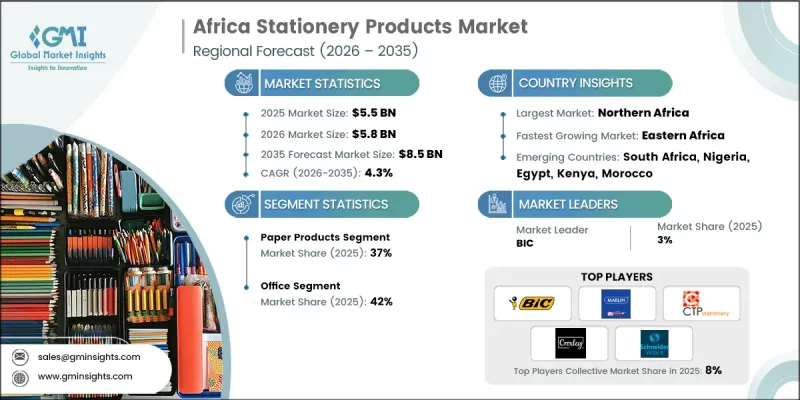
Africa Stationery Products Market was valued at USD 5.5 billion in 2025 and is estimated to grow at a CAGR of 4.3% to reach USD 8.5 billion by 2035.
The market continues to evolve alongside changing patterns in education, professional environments, and business activities. Demand for essential stationery items remains stable, largely supported by rising school enrollment rates, expanding access to education, and increasing institutional focus on improving learning infrastructure. At the same time, the growth of small enterprises and expanding corporate sectors is contributing to higher consumption of everyday office supplies. Despite the growing adoption of digital tools, traditional stationery products maintain strong relevance, as they remain essential for documentation, communication, and organizational tasks. Consumer preferences are also shifting toward products that balance functionality, affordability, and durability. As a result, manufacturers are adapting to changing expectations while maintaining the core value proposition of stationery products. This combination of consistent demand, evolving consumer behavior, and expanding institutional needs continues to support the long-term growth of the Africa stationery industry.
| Market Scope | |
|---|---|
| Start Year | 2025 |
| Forecast Year | 2026-2035 |
| Start Value | $5.5 Billion |
| Forecast Value | $8.5 Billion |
| CAGR | 4.3% |
Conventional stationery products continue to hold a strong position across the region. Domestic manufacturers in several African countries are increasing their market presence by offering cost-effective solutions tailored to the needs of students and small businesses. Their ability to align with emerging trends, including sustainable materials and practical designs, allows them to compete effectively with imported alternatives. At the same time, global brands maintain a significant presence, particularly in urban markets where consumers often prioritize quality and specialized product offerings. The retail landscape is also undergoing transformation, as traditional sales channels remain widely used while modern retail formats are gradually expanding access and convenience for consumers purchasing stationery products.
The paper products segment accounted for 37% share in 2025. This segment continues to dominate due to its extensive application across educational, professional, and personal use. The recurring nature of demand, driven by frequent replacement needs, ensures steady consumption levels. In addition, affordability and widespread availability make paper-based products a primary choice for both institutions and individual users, reinforcing their strong presence in overall purchasing patterns.
The office segment held a 42% share in 2025, generating USD 2.3 billion. The dominance of this segment is attributed to the ongoing need for essential supplies required to support daily operations within businesses, government institutions, and professional organizations. Office stationery plays a critical role in documentation, communication, and record management, making it indispensable despite the increasing integration of digital solutions. Furthermore, as organizations continue to establish structured work environments and expand administrative functions, demand for reliable and high-quality office supplies remains consistent, with many businesses favoring branded products to reflect professionalism.
Northern Africa Stationery Products Market held a 32% share, generating USD 1.8 billion in 2025. Regional demand patterns are influenced by developments in education systems, economic activity, and consumer purchasing behavior. Ongoing improvements in educational frameworks and institutional systems are contributing to sustained demand for learning materials and office-related stationery products. At the same time, business expansion across the region continues to support the consumption of writing instruments, paper products, and other essential office supplies.
Key companies operating in the Africa Stationery Products Market include BIC (BIC South Africa), CTP Stationery Manufacturers (Pty) Ltd, Schneider Schreibgerate (Schneider Pen), Zebra Co., Ltd., Croxley (Silveray Stationery), Freedom Stationery (Marlin brand), Penflex (Pty) Ltd, Stadex Stationery, Bantex South Africa (Pty) Ltd, Trefoil Manufacturing (Pty) Ltd, Butterfly Products (Pty) Ltd, Palm Stationery Manufacturers (Pty) Ltd, Johannesburg Pen Company (Broad and Cambridge Pty Ltd), PC Plastics, and Statesman Stationery. Companies in the Africa Stationery Products Market are strengthening their market position by focusing on product affordability, durability, and alignment with regional demand patterns. Manufacturers are investing in efficient production processes and sourcing strategies to remain price-competitive while maintaining quality standards. Expanding distribution networks, including both traditional and modern retail channels, is helping companies improve market reach and accessibility. Firms are also introducing environmentally conscious materials and designs to meet evolving consumer preferences. In addition, branding and product differentiation strategies are being used to capture diverse customer segments, while partnerships and localized manufacturing initiatives are supporting long-term growth and a stronger regional presence.
Table of Contents
Chapter 1 Research Methodology
- 1.1 Research approach
- 1.2 Quality Commitments
- 1.2.1 GMI AI policy & data integrity commitment
- 1.2.1.1 Source consistency protocol
- 1.2.1 GMI AI policy & data integrity commitment
- 1.3 Research Trail & Confidence Scoring
- 1.3.1 Research Trail Components
- 1.3.2 Scoring Components
- 1.4 Data Collection
- 1.4.1 Partial list of primary sources
- 1.5 Data mining sources
- 1.5.1 Paid sources
- 1.5.1.1 Sources, by region
- 1.5.1 Paid sources
- 1.6 Base estimates and calculations
- 1.6.1 Base year calculation for any one approach
- 1.7 Forecast model
- 1.7.1 Quantified market impact analysis
- 1.7.1.1 Mathematical impact of growth parameters on forecast
- 1.7.1 Quantified market impact analysis
- 1.8 Research transparency addendum
- 1.8.1 Source attribution framework
- 1.8.2 Quality assurance metrics
- 1.8.3 Our commitment to trust
Chapter 2 Executive Summary
- 2.1 Industry 360° synopsis, 2022 - 2035
- 2.2 Key market trends
- 2.2.1 Regional
- 2.2.2 Product type
- 2.2.3 Price Range
- 2.2.4 Application
- 2.2.5 Distribution channel
Chapter 3 Industry Insights
- 3.1 Industry ecosystem analysis
- 3.1.1 Raw material suppliers (paper mills, ink manufacturers)
- 3.1.2 Product manufacturers and converters
- 3.1.3 Importers and distributors
- 3.1.4 Retail channels (offline and online)
- 3.1.5 End users (schools, offices, consumers)
- 3.1.6 Profit margin analysis by value chain stage
- 3.1.7 Value chain disruptions and bottlenecks
- 3.2 Industry impact forces
- 3.2.1 Growth drivers
- 3.2.1.1 Expansion of educational institutions across the region
- 3.2.1.2 Rising formalization of businesses and office setups
- 3.2.1.3 Growth of organized retail and e-commerce channels
- 3.2.2 Industry pitfalls & challenges
- 3.2.2.1 Heavy reliance on imports and fluctuating currency conditions
- 3.2.2.2 Inconsistent supply chains and logistics constraints
- 3.2.3 Opportunities
- 3.2.3.1 Rising demand for affordable, locally manufactured products
- 3.2.3.2 Growing interest in eco-friendly and sustainable stationery
- 3.2.1 Growth drivers
- 3.3 Growth potential analysis
- 3.4 Future market trends
- 3.5 Technology and innovation landscape
- 3.5.1 Current technological trends
- 3.5.2 Emerging technologies
- 3.6 Price trends (Driven by Primary Research)
- 3.6.1 Historical price trend analysis (driven by primary research)
- 3.6.2 Pricing strategy by player type (premium/value/cost-plus) (driven by primary research)
- 3.6.3 Regional price variations across Africa
- 3.7 Regulatory landscape
- 3.7.1 Import/export regulations and tariffs
- 3.7.2 Environmental standards (plastic reduction, recycled content)
- 3.7.3 Education procurement policies
- 3.7.4 AfCFTA (African Continental Free Trade Area) impact
- 3.8 Distribution Infrastructure & Channel Penetration Landscape (Driven by Primary Research)
- 3.8.1 A Channel coverage by region and format (modern versus traditional trade) (driven by primary research)
- 3.8.2 Last-mile infrastructure gaps and emerging channel shifts (driven by primary research)
- 3.9 Trade Data Analysis (Driven by Paid Database) (HS Code - 4820)
- 3.9.1 Import/export volume and value trends
- 3.9.2 Key trade corridors and tariff impact
- 3.9.3 Intra-African trade under AfCFTA
- 3.10 Impact of AI & Generative AI on the Market
- 3.10.1 AI-driven disruption of existing business models
- 3.10.2 GenAI use cases & adoption roadmap by segment
- 3.10.3 Risks, limitations & regulatory considerations
- 3.11 Porter’s analysis
- 3.12 PESTEL analysis
Chapter 4 Competitive Landscape, 2025
- 4.1 Introduction
- 4.2 Company market share analysis
- 4.2.1 By Region
- 4.3 Company matrix analysis
- 4.4 Competitive analysis of major market players
- 4.5 Competitive positioning matrix
- 4.6 Key developments
- 4.6.1 Mergers & acquisitions
- 4.6.2 Partnerships & collaborations
- 4.6.3 New product launches
- 4.6.4 Expansion plans
Chapter 5 Market Estimates & Forecast, By Product Type, 2022-2035 (USD Billion) (Million Units)
- 5.1 Key trends
- 5.2 Writing instruments
- 5.2.1 Pens
- 5.2.2 Pencils
- 5.2.3 Markers & highlighters
- 5.2.4 Erasers & correction tools
- 5.2.5 Others
- 5.3 Paper products
- 5.3.1 Notebooks
- 5.3.2 Loose paper
- 5.3.3 Files & folders
- 5.3.4 Envelopes
- 5.3.5 Greeting cards & calendars
- 5.3.6 Others
- 5.4 Office supplies
- 5.4.1 Fastening tools
- 5.4.2 Cutting & measuring tools
- 5.4.3 Desk accessories
- 5.4.4 Hole punchers
- 5.4.5 Stamps & ink pads
- 5.4.6 Others
- 5.5 Art supplies
- 5.5.1 Paints
- 5.5.2 Brushes & applicators
- 5.5.3 Canvas & art paper
- 5.5.4 Drawing media
- 5.5.5 Sculpting materials
- 5.5.6 Others
- 5.6 Others
Chapter 6 Market Estimates & Forecast, By Price Range, 2022-2035 (USD Billion) (Million Units)
- 6.1 Key trends
- 6.2 Low
- 6.3 Medium
- 6.4 High
Chapter 7 Market Estimates & Forecast, By Application, 2022-2035 (USD Billion) (Million Units)
- 7.1 Key trends
- 7.2 School
- 7.3 Office
- 7.4 Home
Chapter 8 Market Estimates & Forecast, By Distribution Channel, 2022-2035 (USD Billion) (Million Units)
- 8.1 Key trends
- 8.2 Online Channels
- 8.3 Offline Channels
Chapter 9 Market Estimates & Forecast, By Region, 2022 - 2035 ($Bn) (Thousand Units)
- 9.1 Key trends
- 9.2 Southern Africa
- 9.2.1 South Africa
- 9.2.1.1 Gauteng
- 9.2.1.2 Western Cape
- 9.2.1.3 KwaZulu-Natal
- 9.2.1.4 Eastern Cape
- 9.2.1.5 Other Provinces
- 9.2.2 Botswana
- 9.2.3 Namibia
- 9.2.4 Zimbabwe
- 9.2.5 Rest of Southern Africa
- 9.2.1 South Africa
- 9.3 Eastern Africa
- 9.3.1 Kenya
- 9.3.2 Tanzania
- 9.3.3 Uganda
- 9.3.4 Ethiopia
- 9.3.5 Rest of Eastern Africa
- 9.4 Western Africa
- 9.4.1 Nigeria
- 9.4.2 Ghana
- 9.4.3 Cote d'Ivoire
- 9.4.4 Rest of Western Africa
- 9.5 Northern Africa
- 9.5.1 Egypt
- 9.5.2 Morocco
- 9.5.3 Algeria
- 9.5.4 Rest of Western Africa
- 9.6 Central Africa
- 9.6.1 Democratic Republic of Congo (DRC)
- 9.6.2 Cameroon
- 9.6.3 Angola
- 9.6.4 Rest of Central Africa
Chapter 10 Company Profiles
- 10.1 BIC (BIC South Africa)
- 10.2 CTP Stationery Manufacturers (Pty) Ltd
- 10.3 Schneider Schreibgerate (Schneider Pen)
- 10.4 Zebra Co., Ltd.
- 10.5 Croxley (Silveray Stationery)
- 10.6 Freedom Stationery (Marlin brand)
- 10.7 Penflex (Pty) Ltd
- 10.8 Stadex Stationery
- 10.9 Bantex South Africa (Pty) Ltd
- 10.10 Trefoil Manufacturing (Pty) Ltd
- 10.11 Butterfly Products (Pty) Ltd
- 10.12 Palm Stationery Manufacturers (Pty) Ltd
- 10.13 Johannesburg Pen Company (Broad and Cambridge Pty Ltd)
- 10.14 PC Plastics
- 10.15 Statesman Stationery

