PUBLISHER: Global Market Insights Inc. | PRODUCT CODE: 2027461

PUBLISHER: Global Market Insights Inc. | PRODUCT CODE: 2027461
Latin America Musical Instruments Market Opportunity, Growth Drivers, Industry Trend Analysis, and Forecast 2026 - 2035
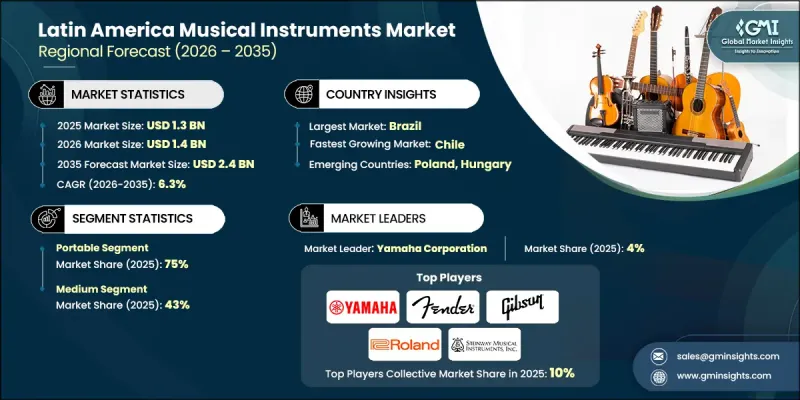
Latin America Musical Instruments Market was valued at USD 1.3 billion in 2025 and is estimated to grow at a CAGR of 6.3% to reach USD 2.4 billion by 2035.
Across the region, music continues to play a central role in cultural identity, driving consistent demand for a wide variety of instruments. Evolving consumer preferences reflect a balance between heritage and modern musical expression, with increasing interest in both traditional craftsmanship and contemporary sound production. The growing influence of digital platforms has made music education more accessible, encouraging beginners to explore instruments with ease. At the same time, experienced musicians are seeking higher-quality products that offer superior sound performance and durability. Purchasing behavior is also shifting, as consumers increasingly favor online channels for convenience and broader selection, while physical retail stores remain relevant for hands-on experience and personalized guidance. This combination of cultural engagement, digital accessibility, and evolving retail dynamics continues to shape the region's musical instruments industry.
| Market Scope | |
|---|---|
| Start Year | 2025 |
| Forecast Year | 2026-2035 |
| Start Value | $1.3 Billion |
| Forecast Value | $2.4 Billion |
| CAGR | 6.3% |
The portable segment accounted for 75% share in 2025, making it the leading category. Demand in this segment is accelerating due to the flexibility it offers users in integrating music into daily routines. Consumers across different skill levels prefer instruments that are easy to transport and require minimal setup. The rise in music education has further supported this trend, as learners favor instruments that can be conveniently carried to lessons and practice sessions.
In 2025, the mid-range price segment held a 43% share, generating USD 300 million in revenue. This category is gaining traction as it offers a balance between affordability and performance. Consumers transitioning from entry-level products often gravitate toward mid-range instruments, while hobbyists and semi-professional players seek improved quality without the cost of premium offerings.
Brazil Musical Instruments Market held 35% share, generating USD 450.9 million in 2025. The country's strong musical culture, large population, and diverse styles contribute to sustained demand across product categories. Growth is supported by both offline retail activity in urban centers and expanding online engagement, alongside long-term demand driven by educational initiatives and community participation.
Key players in the Latin America Musical Instruments Market include Buffet Crampon Group, Casio Computer Co., Fender Musical Instruments, Gibson, Gretsch, Kawai Musical Instruments, Korg Inc., Mapex Drums, Pearl Corporation, Roland Corporation, Sabian, Samick Musical Instruments, Steinway & Sons, Taylor Guitars, and Yamaha Corporation. Companies in the Latin America Musical Instruments Market are strengthening their presence by focusing on product innovation, expanding digital sales channels, and forming strategic partnerships. Many players are enhancing their portfolios with technologically advanced and user-friendly instruments to attract both beginners and experienced musicians. E-commerce platforms are being prioritized to improve accessibility and reach a broader customer base. Additionally, companies are investing in localized marketing strategies to align with regional musical preferences and cultural influences. Collaborations with educational institutions and music programs are also being leveraged to build long-term demand.
Table of Contents
Chapter 1 Methodology & Scope
- 1.1 Research approach
- 1.2 Quality Commitments
- 1.2.1 GMI AI policy & data integrity commitment
- 1.2.1.1 Source consistency protocol
- 1.2.1 GMI AI policy & data integrity commitment
- 1.3 Research Trail & Confidence Scoring
- 1.3.1 Research Trail Components
- 1.3.2 Scoring Components
- 1.4 Data Collection
- 1.4.1 Partial list of primary sources
- 1.5 Data mining sources
- 1.5.1 Paid sources
- 1.5.1.1 Sources, by region
- 1.5.1 Paid sources
- 1.6 Base estimates and calculations
- 1.6.1 Base year calculation for any one approach
- 1.7 Forecast model
- 1.7.1 Quantified market impact analysis
- 1.7.1.1 Mathematical impact of growth parameters on forecast
- 1.7.1 Quantified market impact analysis
- 1.8 Research transparency addendum
- 1.8.1 Source attribution framework
- 1.8.2 Quality assurance metrics
- 1.8.3 Our commitment to trust
Chapter 2 Executive Summary
- 2.1 Industry 360° synopsis
- 2.2 Key market trends
- 2.2.1 Regional
- 2.2.2 Product type
- 2.2.3 Type
- 2.2.4 Price
- 2.2.5 Consumer
- 2.2.6 End user
- 2.2.7 Distribution channel
Chapter 3 Industry Insights
- 3.1 Industry ecosystem analysis
- 3.1.1 Supplier Landscape
- 3.1.2 Profit Margin
- 3.1.3 Value addition at each stage
- 3.1.4 Factor affecting the value chain
- 3.2 Industry impact forces
- 3.2.1 Growth drivers
- 3.2.2 Industry pitfalls & challenges
- 3.2.3 Opportunities
- 3.3 Growth potential analysis
- 3.4 Patent landscape (driven by primary research)
- 3.5 Regulatory landscape
- 3.6 Major market trends and disruptions
- 3.7 Technological and innovation landscape
- 3.7.1 Current technological trends
- 3.7.2 Emerging technologies
- 3.8 Pricing analysis, 2025 (driven by primary research)
- 3.8.1 Product type cost
- 3.8.2 Raw material cost
- 3.9 Future market trends
- 3.10 Risk assessment and mitigation
- 3.10.1 Regulatory compliance risks
- 3.10.2 Capacity constraint impact analysis
- 3.10.3 Technology transition risks
- 3.10.4 Pricing volatility and cost escalation risks
- 3.11 Trade statistics (HS code-9207)
- 3.11.1 Major importing countries
- 3.11.2 Major exporting countries
- 3.12 Porter’s analysis
- 3.13 PESTEL analysis
- 3.14 Distribution infrastructure and channel penetration landscape(driven by primary research)
- 3.14.1 Channel coverage by region and format (modern vs. traditional trade)
- 3.14.2 Last-mile infrastructure gaps and emerging channel shifts
- 3.15 Consumer behaviour analysis
- 3.15.1 Purchasing patterns
- 3.15.2 Preference analysis
- 3.15.3 Regional variations in consumer behaviour
- 3.15.4 Impact of e-commerce on buying decisions
Chapter 4 Competitive Landscape, 2025
- 4.1 Introduction
- 4.2 Company market share analysis
- 4.3 Company matrix analysis
- 4.4 Competitive analysis of major market players
- 4.5 Competitive positioning matrix
- 4.6 Key developments
- 4.6.1 Mergers & acquisitions
- 4.6.2 Partnerships & collaborations
- 4.6.3 New Product Launches
- 4.6.4 Expansion Plan
Chapter 5 Market Estimates & Forecast, By Product Type, 2022-2035 (USD Billion) (Thousand Units)
- 5.1 Key trends
- 5.2 String instruments
- 5.3 Electronic & electromechanical musical instruments
- 5.4 Percussion instruments
- 5.5 Wind instruments
- 5.6 Acoustic pianos & stringed keyboard instruments
- 5.7 Parts & accessories of musical instruments
Chapter 6 Market Estimates & Forecast, By Type, 2022-2035 (USD Billion) (Thousand Units)
- 6.1 Key trends
- 6.2 Portable
- 6.3 Fixed
Chapter 7 Market Estimates & Forecast, By Price 2022-2035 (USD Billion) (Thousand Units)
- 7.1 Key trends
- 7.2 Low
- 7.3 Medium
- 7.4 High
Chapter 8 Market Estimates & Forecast, By Consumer 2022-2035 (USD Billion) (Thousand Units)
- 8.1 Key trends
- 8.2 Beginner
- 8.3 Intermediate players
- 8.4 Advanced or professional musicians
Chapter 9 Market Estimates & Forecast, By End Use 2022-2035 (USD Billion) (Thousand Units)
- 9.1 Key trends
- 9.2 Commercial music
- 9.3 Events personal use
- 9.4 Production/ direction
- 9.5 Education
- 9.6 Others
Chapter 10 Market Estimates & Forecast, By Distribution Channel, 2022-2035 (USD Billion) (Thousand Units)
- 10.1 Key trends
- 10.2 Online
- 10.2.1 E-commerce
- 10.2.2 Company website
- 10.3 Offline
- 10.3.1 Advanced or professional musicians
- 10.3.2 Multi-brand stores or specialty shops
- 10.3.3 Others (departmental stores, etc.)
Chapter 11 Market Estimates & Forecast, By Region, 2022-2035 (USD Billion) (Thousand Units)
- 11.1 Key trends
- 11.2 Latin America
- 11.2.1 Brazil
- 11.2.2 Mexico
- 11.2.3 Chile
- 11.2.4 Colombia
- 11.2.5 Argentina
- 11.2.6 Peru
Chapter 12 Company Profiles
- 12.1 Buffet Crampon Group
- 12.2 Casio Computer Co.
- 12.3 Fender Musical Instruments
- 12.4 Gibson
- 12.5 Gretsch
- 12.6 Kawai Musical Instruments
- 12.7 Korg Inc.
- 12.8 Mapex Drums
- 12.9 Pearl Corporation
- 12.10 Roland Corporation
- 12.11 Sabian
- 12.12 Samick Musical Instruments
- 12.13 Steinway & Sons
- 12.14 Taylor Guitars
- 12.15 Yamaha Corporation

