
PUBLISHER: Global Market Insights Inc. | PRODUCT CODE: 2027466

PUBLISHER: Global Market Insights Inc. | PRODUCT CODE: 2027466
North America Cosmetics and Personal Care Products Market Opportunity, Growth Drivers, Industry Trend Analysis, and Forecast 2026 - 2035
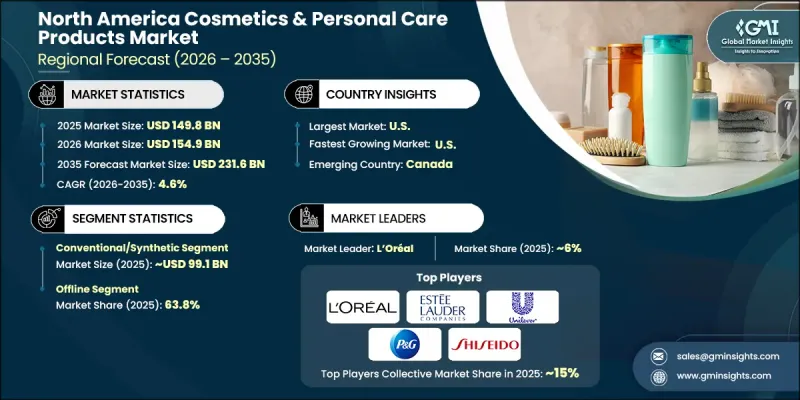
North America Cosmetics & Personal Care Products Market was valued at USD 149.8 billion in 2025 and is estimated to grow at a CAGR of 4.6% to reach USD 231.6 billion by 2035.
North America cosmetics and personal care products industry is witnessing steady expansion as consumers increasingly prioritize skin health and holistic wellness. Skincare and personal care are now widely perceived as essential elements of preventive health, driving demand for products that target specific skin concerns and improve overall well-being. This evolving mindset is encouraging the adoption of scientifically formulated and performance-driven solutions that deliver measurable results. Consumers across age groups are becoming more proactive, with growing awareness around maintaining healthy skin over time. At the same time, lifestyle-driven wellness trends are reshaping product preferences, influencing purchasing decisions across a wide range of categories within the North America cosmetics & personal care products market. As innovation accelerates and awareness deepens, manufacturers are responding with advanced formulations that align with changing expectations around quality, safety, and effectiveness.
| Market Scope | |
|---|---|
| Start Year | 2025 |
| Forecast Year | 2026-2035 |
| Start Value | $149.8 Billion |
| Forecast Value | $231.6 Billion |
| CAGR | 4.6% |
The conventional/synthetic segment generated USD 99.1 billion in 2025 and is projected to grow at a CAGR of 4.2% between 2026 and 2035. The widespread use of synthetic ingredients is attributed to their formulation stability, extended shelf life, and consistent performance outcomes. These attributes make them suitable for large-scale production as well as premium product development. Additionally, established supply networks and reduced variability in raw materials allow manufacturers to maintain cost efficiency while meeting rising demand. The flexibility offered by these ingredients also supports the development of diverse product formulations with reliable quality standards.
The offline distribution channel accounted for 63.8% share in 2025 and is expected to grow at a CAGR of 4.3% through 2035. Physical retail continues to play a vital role in influencing consumer purchasing behavior by offering direct product interaction and experiential engagement. In-store environments contribute to stronger consumer trust by enabling informed decision-making and enhancing brand perception. Retailers are also focusing on integrating seamless shopping experiences that combine convenience with personalized service, strengthening long-term customer relationships, and driving consistent foot traffic.
United States Cosmetics & Personal Care Products Market captured USD 82 billion in 2025 and is projected to grow at a CAGR of 5% from 2026 to 2035. The country benefits from a highly developed ecosystem that includes established global brands, emerging companies, and innovation-driven enterprises focused on continuous product advancement. Strong consumer awareness regarding personal care and wellness continues to support market growth. In addition, a well-integrated retail infrastructure ensures broad accessibility and sustained consumer engagement across multiple purchasing channels.
Key players in the North America Cosmetics & Personal Care Products Market include Amorepacific, Avon, Beiersdorf, Chanel, Coty Inc., Estee Lauder Companies, Fenty Beauty, Johnson & Johnson, Kao Corporation, L'Oreal, LVMH (Beauty Division), Procter & Gamble (P&G), Revlon, Shiseido, and Unilever. Companies operating in the North America Cosmetics & Personal Care Products Market are reinforcing their market position through continuous innovation and strategic expansion initiatives. They are prioritizing research and development to introduce advanced formulations that meet evolving consumer expectations. Partnerships, acquisitions, and collaborations are being utilized to broaden product portfolios and strengthen distribution networks. Many firms are investing in digital transformation and omnichannel strategies to enhance customer engagement and streamline purchasing experiences. In addition, companies are focusing on brand differentiation through premiumization, targeted marketing, and personalized solutions. Sustainability initiatives, including responsible sourcing and eco-friendly packaging, are also gaining importance as businesses aim to align with shifting consumer values and regulatory expectations.
Table of Contents
Chapter 1 Methodology & Scope
- 1.1 Market scope and definition
- 1.2 Research design
- 1.2.1 Research approach
- 1.2.2 Data collection methods
- 1.3 Data mining sources
- 1.3.1 Global
- 1.3.2 Regional/Country
- 1.4 Base estimates and calculations
- 1.4.1 Base year calculation
- 1.4.2 Key trends for market estimation
- 1.5 Primary research and validation
- 1.5.1 Primary sources
- 1.6 Forecast model
- 1.7 Research assumptions and limitations
Chapter 2 Executive Summary
- 2.1 Industry 360° synopsis
- 2.2 Key market trends
- 2.2.1 Country
- 2.2.2 Product type
- 2.2.3 Ingredient type
- 2.2.4 Consumer group
- 2.2.5 Price
- 2.2.6 Distribution channel
Chapter 3 Industry Insights
- 3.1 Industry ecosystem analysis
- 3.1.1 Supplier landscape
- 3.1.2 Profit margin
- 3.1.3 Value addition at each stage
- 3.1.4 Factor affecting the value chain
- 3.2 Industry impact forces
- 3.2.1 Growth drivers
- 3.2.1.1 Rising consumer focus on skin health and wellness
- 3.2.1.2 Demand for clean, natural, and sustainable products
- 3.2.1.3 Product innovation and multifunctionality
- 3.2.2 Industry pitfalls & challenges
- 3.2.2.1 Intense market saturation and competition
- 3.2.2.2 Rising raw material and production costs
- 3.2.1 Growth drivers
- 3.3 Growth potential analysis
- 3.4 Future market trends
- 3.5 Technology and innovation landscape
- 3.5.1 Current technological trends
- 3.5.2 Emerging technologies
- 3.6 Price trends
- 3.6.1 By region
- 3.6.2 By ingredient type
- 3.7 Regulatory landscape
- 3.7.1 Standards and compliance requirements
- 3.7.2 Regional regulatory frameworks
- 3.7.3 Certification standards
- 3.8 Trade statistics
- 3.8.1 Major importing countries
- 3.8.2 Major exporting countries
- 3.9 Porter's analysis
- 3.10 PESTEL analysis
- 3.11 Consumer behavior analysis
- 3.11.1 Purchasing patterns
- 3.11.2 Preference analysis
- 3.11.3 Regional variations in consumer behavior
- 3.11.4 Impact of e-commerce on buying decisions
Chapter 4 Competitive Landscape, 2025
- 4.1 Introduction
- 4.2 Company market share analysis
- 4.3 Company matrix analysis
- 4.4 Competitive analysis of major market players
- 4.5 Competitive positioning matrix
- 4.6 Key developments
- 4.6.1 Mergers & acquisitions
- 4.6.2 Partnerships & collaborations
- 4.6.3 New product launches
- 4.6.4 Expansion plans
Chapter 5 Market Estimates & Forecast, By Product Type, 2022 - 2035, (USD Billion) (Million Units)
- 5.1 Key trends
- 5.2 Personal care
- 5.2.1 Skincare
- 5.2.2 Body care
- 5.2.3 Sun care
- 5.2.4 Haircare
- 5.2.5 Bath & shower
- 5.2.6 Oral care
- 5.2.7 Deodorants & antiperspirants
- 5.2.8 Men's grooming
- 5.2.9 Fragrances & perfumes
- 5.2.10 Feminine hygiene
- 5.3 Makeup & color cosmetics
- 5.3.1 Facial cosmetics
- 5.3.2 Eye cosmetics
- 5.3.3 Lip cosmetics
- 5.3.4 Nail cosmetics
- 5.4 Services
- 5.4.1 Spa & wellness services
- 5.4.2 Hair salons
- 5.4.3 Nail salons
- 5.4.4 Beauty clinics & aesthetic Treatments
- 5.4.5 Makeup services
Chapter 6 Market Estimates & Forecast, By Ingredient Type, 2022 - 2035, (USD Billion) (Million Units)
- 6.1 Key trends
- 6.2 Natural & organic
- 6.3 Conventional/Synthetic
Chapter 7 Market Estimates & Forecast, By Consumer group, 2022 - 2035, (USD Billion) (Million Units)
- 7.1 Key trends
- 7.2 Female
- 7.3 Male
- 7.4 Kids
Chapter 8 Market Estimates & Forecast, By Price, 2022 - 2035, (USD Billion) (Million Units)
- 8.1 Key trends
- 8.2 Low
- 8.3 Medium
- 8.4 High
Chapter 9 Market Estimates & Forecast, By Distribution Channel, 2022 - 2035, (USD Billion) (Million Units)
- 9.1 Key trends
- 9.2 Online
- 9.2.1 E-commerce
- 9.2.2 Company website
- 9.3 Offline
- 9.3.1 Specialty stores
- 9.3.2 Pharmacies
- 9.3.3 Salons
- 9.3.4 Others (departmental stores, etc.)
Chapter 10 Market Estimates & Forecast, By Country, 2022 - 2035, (USD Billion) (Million Units)
- 10.1 Key trends
- 10.2 U.S.
- 10.3 Canada
Chapter 11 Company Profiles
- 11.1 Amorepacific
- 11.2 Avon
- 11.3 Beiersdorf
- 11.4 Chanel
- 11.5 Coty Inc.
- 11.6 Estee Lauder Companies
- 11.7 Fenty Beauty
- 11.8 Johnson & Johnson
- 11.9 Kao Corporation
- 11.10 L'Oreal
- 11.11 LVMH (Beauty Division)
- 11.12 Procter & Gamble (P&G)
- 11.13 Revlon
- 11.14 Shiseido
- 11.15 Unilever

