PUBLISHER: Global Market Insights Inc. | PRODUCT CODE: 2027472

PUBLISHER: Global Market Insights Inc. | PRODUCT CODE: 2027472
Africa Consumer Electronics Manufacturing Equipment Market Opportunity, Growth Drivers, Industry Trend Analysis, and Forecast 2026 - 2035
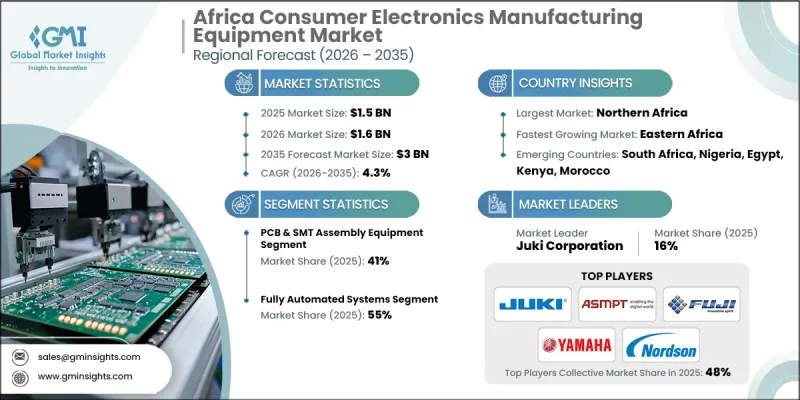
Africa Consumer Electronics Manufacturing Equipment Market was valued at USD 1.5 billion in 2025 and is estimated to grow at a CAGR of 4.3% to reach USD 3 billion by 2035.
The industry is steadily evolving into a more structured and professional landscape, driven by a growing base of ambitious local enterprises and heightened interest from international manufacturers. Public institutions and private collaborations across the region are actively working to strengthen domestic production capabilities and limit dependence on imported components. Companies are directing substantial capital toward advanced machinery that supports the production of fully assembled and tested electronic goods. Rising demand for consumer electronic products is encouraging manufacturers to upgrade infrastructure and scale operations. At the same time, producers are prioritizing equipment that improves operational reliability, ensures consistent output, and reduces reliance on manual processes. Businesses entering the African market are aligning their systems with customer expectations centered on efficiency, ease of use, and dependable performance, which are becoming standard requirements across the value chain.
| Market Scope | |
|---|---|
| Start Year | 2025 |
| Forecast Year | 2026-2035 |
| Start Value | $1.5 Billion |
| Forecast Value | $3 Billion |
| CAGR | 4.3% |
The PCB and SMT assembly equipment segment accounted for 41% share in 2025, owing to its critical role in modern electronics manufacturing. The demand for compact, efficient, and high-performance electronic components continues to drive adoption of these systems. Manufacturers are emphasizing precision and speed in assembling increasingly complex and miniaturized components, making advanced assembly equipment essential for maintaining production efficiency. These systems support continuous workflows and enhance overall manufacturing competitiveness by delivering accuracy and consistency at scale.
The fully automated systems segment held a 55% share in 2025, generating USD 0.82 billion. These systems are increasingly preferred for their ability to deliver consistent, high-quality output while minimizing human intervention. Automation enables manufacturers to streamline production, reduce operational errors, and improve efficiency in repetitive processes. Additionally, such systems offer flexibility in adapting to evolving product designs and shifting production requirements. Their durability and reduced likelihood of breakdowns further strengthen their value proposition compared to traditional manual setups.
Northern Africa Consumer Electronics Manufacturing Equipment Market held a 32% share generating USD 476.8 million in 2025. The broader African market reflects varied regional dynamics, with different areas focusing on strengthening their manufacturing ecosystems through industrial development, investment inflows, and expanding assembly capabilities. These regional efforts are collectively contributing to the continent's growing role in electronics manufacturing.
Key companies operating in the Africa Consumer Electronics Manufacturing Equipment Market include ASM Pacific Technology (ASMPT), Juki Corporation, Fuji Corporation, Yamaha Motor Corp (Robotics), Nordson Corporation, Mycronic AB, Essemtec AG, Ersa GmbH, Viscom AG, Siemens Digital Industries, Bosch Rexroth AG, HELLER Industries, ZESTRON, Gravotech, and LPKF Laser & Electronics. Companies in the Africa Consumer Electronics Manufacturing Equipment Market are strengthening their market position by investing in advanced automation technologies and expanding their regional footprints. They are forming strategic partnerships with local firms and governments to support domestic manufacturing initiatives and improve supply chain efficiency. Many players are focusing on product innovation to deliver high-precision, reliable, and cost-effective equipment tailored to regional needs. Additionally, firms are enhancing after-sales services, including maintenance and training, to build long-term customer relationships. Capacity expansion and localized production strategies are also being adopted to reduce operational costs and improve responsiveness to demand fluctuations, enabling companies to remain competitive in a rapidly evolving market environment.
Table of Contents
Chapter 1 Research Methodology
- 1.1 Research approach
- 1.2 Quality Commitments
- 1.2.1 GMI AI policy & data integrity commitment
- 1.2.1.1 Source consistency protocol
- 1.2.1 GMI AI policy & data integrity commitment
- 1.3 Research Trail & Confidence Scoring
- 1.3.1 Research Trail Components
- 1.3.2 Scoring Components
- 1.4 Data Collection
- 1.4.1 Partial list of primary sources
- 1.5 Data mining sources
- 1.5.1 Paid sources
- 1.5.1.1 Sources, by region
- 1.5.1 Paid sources
- 1.6 Base estimates and calculations
- 1.6.1 Base year calculation for any one approach
- 1.7 Forecast model
- 1.7.1 Quantified market impact analysis
- 1.7.1.1 Mathematical impact of growth parameters on forecast
- 1.7.1 Quantified market impact analysis
- 1.8 Research transparency addendum
- 1.8.1 Source attribution framework
- 1.8.2 Quality assurance metrics
- 1.8.3 Our commitment to trust
Chapter 2 Executive Summary
- 2.1 Industry 360° synopsis
- 2.2 Key market trends
- 2.2.1 Regional
- 2.2.2 Equipment type
- 2.2.3 Technology
- 2.2.4 Motion component
- 2.2.5 End Use
- 2.2.6 Distribution channel
Chapter 3 Industry Insights
- 3.1 Industry ecosystem analysis
- 3.1.1 Supplier landscape
- 3.1.2 Profit margin analysis by value chain stage
- 3.1.3 Value addition at each stage
- 3.1.4 Factors affecting the value chain in Africa
- 3.1.5 Import dependency & local assembly economics
- 3.2 Industry impact forces
- 3.2.1 Growth drivers
- 3.2.2 Industry pitfalls & challenges
- 3.2.3 Opportunities
- 3.3 Growth potential analysis
- 3.4 Future market trends
- 3.5 Technology and innovation landscape
- 3.5.1 Current technological trends in African electronics manufacturing
- 3.5.2 Emerging technologies (Industry 4.0, smart factory, IoT integration)
- 3.5.3 Technology transfer requirements & localization mandates
- 3.5.4 Automation vs manual systems economics in the African context
- 3.6 Regulatory landscape
- 3.6.1 Regulatory framework
- 3.6.1.1 Standards & compliance requirements (IEC, ISO, SONCAP, SABS)
- 3.6.2 Africa regional regulatory frameworks
- 3.6.2.1 North Africa (Egypt, Morocco, Tunisia standards)
- 3.6.2.2 West Africa (ECOWAS regulations, SONCAP Nigeria)
- 3.6.2.3 East Africa (COMESA, EAC standards)
- 3.6.2.4 Southern Africa (SADC, SABS South Africa)
- 3.6.2.5 Central Africa regulatory environment
- 3.6.2.6 Certification standards & homologation requirements
- 3.6.2.7 Local content requirements & investment incentives
- 3.6.1 Regulatory framework
- 3.7 Trade statistics (driven by paid database) (HS:85)
- 3.7.1 Import volume & value trends by Africa sub-region
- 3.7.2 Key trade corridors & tariff impact
- 3.7.3 Major exporting countries to Africa (China, Germany, Japan, South Korea)
- 3.7.4 HS code classification & customs duty structure
- 3.7.5 AfCFTA implementation impact on cross-border equipment movement
- 3.8 Porter's analysis
- 3.9 PESTEL analysis
- 3.10 Impact of AI & generative AI on the market
- 3.10.1 AI-driven disruption of electronics manufacturing processes
- 3.10.2 GenAI use cases & adoption roadmap by African manufacturers
- 3.10.3 Risks, limitations & regulatory considerations in the Africa context
- 3.11 Capacity & production landscape (driven by primary research)
- 3.11.1 Installed manufacturing capacity by Africa sub-region & key producer
- 3.11.2 Capacity utilization rates & expansion pipelines (Egypt, Morocco, South Africa, Kenya, Nigeria)
- 3.11.3 Electronics assembly plants: location mapping & equipment deployment status
- 3.12 Supply chain analysis
- 3.12.1 Equipment import logistics & lead times
- 3.12.2 Port infrastructure & customs clearance challenges
- 3.12.3 After-sales service & spare parts availability
- 3.12.4 Local technical support & training infrastructure
- 3.13 Pricing analysis (driven by primary research)
- 3.13.1 Historical price trend analysis (2022-2024)
- 3.13.2 Pricing strategy by player type (premium / value / cost-plus)
- 3.13.3 Africa price premium vs global markets
- 3.13.4 Total cost of ownership (TCO) comparison: import vs regional assembly
Chapter 4 Competitive Landscape, 2025
- 4.1 Introduction
- 4.2 Company market share analysis
- 4.3 Company matrix analysis
- 4.4 Competitive analysis of major market players
- 4.5 Competitive positioning matrix
- 4.6 Key developments
- 4.6.1 Mergers & acquisitions
- 4.6.2 Partnerships & collaborations
- 4.6.3 New product launches
- 4.6.4 Expansion plans
Chapter 5 Market Estimates & Forecast, By Equipment type, 2022 - 2035, (USD Billion) (Million Units)
- 5.1 Key trends
- 5.2 PCB & SMT assembly equipment
- 5.3 Testing & inspection equipment
- 5.4 Assembly & integration systems
- 5.5 Coating & dispensing equipment
- 5.6 Cleaning & surface preparation equipment
- 5.7 Marking & labelling equipment
- 5.8 Cutting & singulation equipment
Chapter 6 Market Estimates & Forecast, By Technology, 2022 - 2035, (USD Billion) (Million Units)
- 6.1 Key trends
- 6.2 Fully automated systems
- 6.3 Semi-automated systems
- 6.4 Manual/basic systems
Chapter 7 Market Estimates & Forecast, By Motion component, 2022 - 2035, (USD Billion) (Million Units)
- 7.1 Key trends
- 7.2 Linear guides
- 7.3 Telescopic rails
- 7.4 Linear actuators
- 7.5 Ball screws
- 7.6 Integrated motion systems
Chapter 8 Market Estimates & Forecast, By End Use, 2022 - 2035, (USD Billion) (Million Units)
- 8.1 Key trends
- 8.2 Consumer electronics manufacturers
- 8.3 OSAT (outsourced semiconductor assembly & test) providers
- 8.4 Telecommunications electronics
- 8.5 Automotive electronics
- 8.6 Industrial & IoT electronics
Chapter 9 Market Estimates & Forecast, By Distribution Channel, 2022 - 2035, (USD Billion) (Million Units)
- 9.1 Key trends
- 9.2 Direct
- 9.3 Indirect
Chapter 10 Market Estimates & Forecast, By Region, 2022 - 2035, (USD Billion) (Million Units)
- 10.1 Key trends
- 10.2 Southern Africa
- 10.2.1 South Africa
- 10.2.2 Botswana
- 10.2.3 Namibia
- 10.2.4 Zimbabwe
- 10.2.5 Rest of Southern Africa
- 10.3 Eastern Africa
- 10.3.1 Kenya
- 10.3.2 Tanzania
- 10.3.3 Uganda
- 10.3.4 Ethiopia
- 10.3.5 Rest of Eastern Africa
- 10.4 Western Africa
- 10.4.1 Nigeria
- 10.4.2 Ghana
- 10.4.3 Cote d'Ivoire
- 10.4.4 Rest of Western Africa
- 10.5 Northern Africa
- 10.5.1 Egypt
- 10.5.2 Morocco
- 10.5.3 Algeria
- 10.5.4 Rest of Western Africa
- 10.6 Central Africa
- 10.6.1 Democratic Republic of Congo (DRC)
- 10.6.2 Cameroon
- 10.6.3 Angola
- 10.6.4 Rest of Central Africa
Chapter 11 Company Profiles
- 11.1 ASM Pacific Technology (ASMPT)
- 11.2 Juki Corporation
- 11.3 Fuji Corporation
- 11.4 Yamaha Motor Corp (Robotics)
- 11.5 Nordson Corporation
- 11.6 Mycronic AB
- 11.7 Essemtec AG
- 11.8 Ersa GmbH
- 11.9 Viscom AG
- 11.10 Siemens Digital Industries
- 11.11 Bosch Rexroth AG
- 11.12 HELLER Industries
- 11.13 ZESTRON
- 11.14 Gravotech
- 11.15 LPKF Laser & Electronics

