PUBLISHER: Global Market Insights Inc. | PRODUCT CODE: 2027474

PUBLISHER: Global Market Insights Inc. | PRODUCT CODE: 2027474
North America Household Composters Market Opportunity, Growth Drivers, Industry Trend Analysis, and Forecast 2026 - 2035
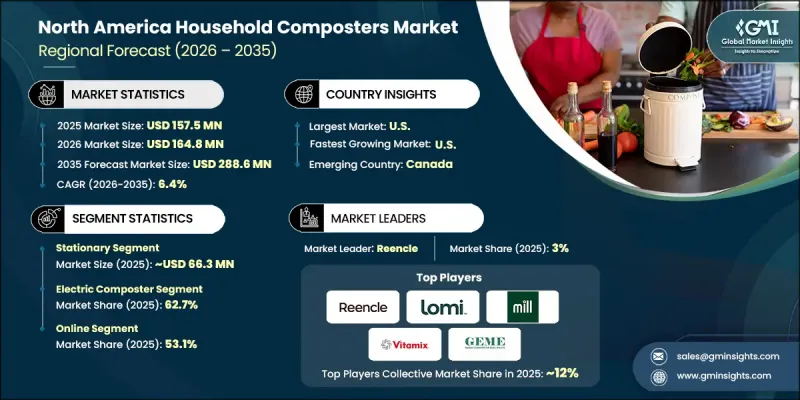
North America Household Composters Market was valued at USD 157.5 million in 2025 and is estimated to grow at a CAGR of 6.4% to reach USD 288.6 million by 2035.
North America household composters industry is gaining strong momentum as regulatory bodies intensify efforts to minimize residential waste and reduce reliance on landfills. These initiatives focus on promoting sustainable waste management practices, positioning home composting as a practical and effective solution. Public authorities and local administrations are actively promoting composting adoption through policy frameworks, awareness campaigns, and structured waste segregation requirements. These developments are accelerating interest in compact and automated composting systems that align with evolving compliance standards while offering user-friendly functionality. At the same time, consumers across the region are becoming more environmentally conscious, increasingly incorporating composting into their daily routines. Heightened awareness regarding the impact of organic waste on the environment is further supporting this transition. As a result, advanced composting solutions that simplify waste processing and enhance convenience are gaining traction, reflecting a broader shift toward sustainable living and responsible consumption habits.
| Market Scope | |
|---|---|
| Start Year | 2025 |
| Forecast Year | 2026-2035 |
| Start Value | $157.5 Million |
| Forecast Value | $288.6 Million |
| CAGR | 6.4% |
The stationary segment generated USD 66.3 million in 2025 and is expected to grow at a CAGR of 6.8% from 2026 to 2035. These composters continue to attract steady demand due to their cost efficiency, durability, and ease of maintenance. Their straightforward design appeals to consumers seeking practical and reliable solutions without ongoing operational complexity. Additionally, their adaptability to standard composting methods and minimal maintenance requirements contribute to their continued relevance in the market.
The electric composter segment held a 62.7% share in 2025, driven by its ability to deliver convenience and efficiency in modern living environments. These systems are designed to provide controlled composting conditions, improving processing speed and operational cleanliness. Their compact structure supports indoor use, making them suitable for a wide range of households. Advanced features such as automation and intelligent controls further enhance usability, allowing consumers to manage composting with minimal effort while ensuring consistent performance.
United States Household Composters Market captured USD 108.1 million in 2025 and is projected to grow at a CAGR of 6.7% through 2035. The country's market expansion is supported by increasing consumer awareness around sustainable living and the growing adoption of environmentally responsible waste practices. Strong retail accessibility and evolving consumer preferences toward convenience-driven solutions are further supporting market growth. Additionally, the demand for efficient, automated, and easy-to-use composting systems continues to rise as households seek to integrate sustainability into everyday life.
Key players operating in the North America Household Composters Market include Airthereal, Algreen, Beyond Green Biotech, Envirocycle, FCMP Outdoor, Geme, GRAF, Greenes Fence, Joraform, Lomi, Mantis, Mill, Reencle, Vego Garden, and Vitamix FoodCycler. Companies in the North America Household Composters Market are enhancing their competitive position through innovation and strategic expansion efforts. They are focusing on developing advanced composting technologies that improve efficiency, reduce processing time, and enhance user convenience. Partnerships and collaborations are being pursued to expand distribution networks and strengthen regional presence. Many companies are also investing in digital integration, offering smart features that improve user interaction and operational control. Product diversification and continuous design improvements help businesses cater to varying consumer preferences. In addition, firms are emphasizing sustainability in product development and marketing strategies to align with environmentally conscious consumers, while also expanding production capabilities to meet the growing demand across the region.
Table of Contents
Chapter 1 Methodology & Scope
- 1.1 Market scope & definitions
- 1.2 Research design
- 1.2.1 Research approach
- 1.2.2 Data collection methods
- 1.3 Base estimates and calculations
- 1.3.1 Base year calculation
- 1.3.2 Market estimates & forecasts parameters
- 1.4 Forecast Model
- 1.4.1 Key trends for market estimates
- 1.4.2 Quantified market impact analysis
- 1.4.2.1 Mathematical impact of growth parameters on forecast
- 1.4.3 Scenario analysis framework
- 1.5 Primary research and validation
- 1.5.1 Some of the primary sources (but not limited to)
- 1.6 Data mining sources
- 1.6.1 Paid Sources
- 1.7 Research Trail & confidence scoring
- 1.7.1 Research trail components
- 1.7.2 Scoring components
- 1.8 Research transparency addendum
- 1.8.1 Source attribution framework
- 1.8.2 Quality assurance metrics
- 1.8.3 Our commitment to trust
- 1.9 Market Definitions
Chapter 2 Executive Summary
- 2.1 Industry 360° synopsis
- 2.2 Key market trends
- 2.2.1 Country
- 2.2.2 Product type
- 2.2.3 Type
- 2.2.4 Capacity
- 2.2.5 Price
- 2.2.6 Application
- 2.2.7 Distribution channel
- 2.3 CXO perspectives: Strategic imperatives
- 2.3.1 Key decision points for industry executives
- 2.3.2 Critical success factors for market players
- 2.4 Future outlook and strategic recommendations
Chapter 3 Industry Insights
- 3.1 Industry ecosystem analysis
- 3.1.1 Supplier landscape
- 3.1.2 Profit margin
- 3.1.3 Value addition at each stage
- 3.1.4 Factor affecting the value chain
- 3.2 Industry impact forces
- 3.2.1 Growth drivers
- 3.2.1.1 Government regulations & waste management policies
- 3.2.1.2 U.S. State-level composting mandates
- 3.2.1.3 Rising food waste concerns & sustainability awareness
- 3.2.2 Pitfalls & challenges
- 3.2.2.1 Misleading product claims & consumer education gap
- 3.2.2.2 High upfront cost of electric composters
- 3.2.3 Opportunities
- 3.2.3.1 Product innovation in odor control & pest prevention
- 3.2.3.2 Wooden composter niche for eco-conscious consumers
- 3.2.1 Growth drivers
- 3.3 Growth potential analysis
- 3.4 Future market trends
- 3.5 Technology and innovation landscape
- 3.5.1 Current technological trends
- 3.5.2 Emerging technologies
- 3.6 Price trends
- 3.6.1 By country
- 3.6.2 By product
- 3.7 Regulatory landscape
- 3.7.1 Waste Management Regulations
- 3.7.1.1 California SB 1383 Impact Analysis
- 3.7.1.2 Vermont Act 148 Universal Recycling Law
- 3.7.1.3 Canadian Provincial Regulations
- 3.7.2 Sustainability Standards & Certifications
- 3.7.2.1 USDA Certified Biobased Product Label
- 3.7.2.2 EPA Safer Choice Certification
- 3.7.2.3 Canadian Environmental Choice Program (EcoLogo)
- 3.7.2.4 Subsidy Programs & Government Incentives
- 3.7.2.5 Municipal Rebate Programs
- 3.7.3 Tax Incentives for Sustainable Products
- 3.7.1 Waste Management Regulations
- 3.8 Trade Data Analysis (Driven by Primary Research) - (HS Code: 48237010)
- 3.8.1 Import/Export Volume & Value Trends
- 3.8.2 Key Trade Corridors & Tariff Impact
- 3.8.3 U.S.-Canada Cross-Border Trade Dynamics
- 3.9 Impact of AI & Generative AI on the Market
- 3.9.1 AI-Driven disruption of existing business models
- 3.9.2 GenAI use cases & adoption roadmap by segment
- 3.9.3 Smart composting recommendations via AI
- 3.9.4 Predictive maintenance for electric composters
- 3.9.5 Risks, limitations & regulatory considerations
- 3.10 Distribution Infrastructure & Channel Penetration Landscape (Driven by Primary Research)
- 3.10.1 Channel Coverage by Region & Format (Modern vs. Traditional Trade)
- 3.10.2 Last-Mile Infrastructure Gaps & Emerging Channel Shifts
- 3.11 Porter’s analysis
- 3.12 PESTEL analysis
- 3.13 Consumer Buying Behavior Analysis
- 3.13.1 Purchase decision factors
- 3.13.2 Price sensitivity by demographic
- 3.13.3 Feature prioritization (odor control vs. Speed vs. Capacity)
- 3.13.4 Brand awareness & influence
- 3.13.5 Top-of-mind brand recall study
- 3.13.6 Social media influence & user reviews
- 3.13.7 Environmental consciousness impact on purchasing
- 3.13.8 Eco-label influence on purchase intent
- 3.13.9 Willingness to pay premium for sustainability
Chapter 4 Competitive Landscape, 2025
- 4.1 Introduction
- 4.2 Company market share analysis
- 4.2.1 By Country
- 4.2.1.1 U.S.
- 4.2.1.2 Canada
- 4.2.1 By Country
- 4.3 Company matrix analysis
- 4.4 Competitive analysis of major market players
- 4.5 Competitive positioning matrix
- 4.6 Key developments
- 4.6.1 Mergers & acquisitions
- 4.6.2 Partnerships & collaborations
- 4.6.3 New product launches
- 4.6.4 Expansion plans
Chapter 5 Market Estimates & Forecast, By Product Type, 2022 - 2035, (USD Million) (Thousand Units)
- 5.1 Key trends
- 5.2 Stationary
- 5.3 Tumbler
- 5.4 Others (compacting etc.)
Chapter 6 Market Estimates & Forecast, By Type, 2022 - 2035, (USD Million) (Thousand Units)
- 6.1 Key trends
- 6.2 Electric composter
- 6.2.1 Countertop electric composters
- 6.2.2 Floor-standing electric composters
- 6.3 Manual composter
- 6.3.1 Traditional manual composters
- 6.3.2 Aerobic manual composters
Chapter 7 Market Estimates & Forecast, By Capacity, 2022 - 2035, (USD Million) (Thousand Units)
- 7.1 Key trends
- 7.2 Below 10L
- 7.3 10L to 20L
- 7.4 20L to 40L
- 7.5 Above 40L
Chapter 8 Market Estimates & Forecast, By Price, 2022 - 2035, (USD Million) (Thousand Units)
- 8.1 Key trends
- 8.2 Low
- 8.3 Medium
- 8.4 High
Chapter 9 Market Estimates & Forecast, By Application, 2022 - 2035, (USD Million) (Thousand Units)
- 9.1 Key trends
- 9.2 Indoor
- 9.2.1 Kitchen countertop
- 9.2.2 Under-sink
- 9.2.3 Balcony/terrace
- 9.3 Outdoor
- 9.3.1 Backyard/garden
- 9.3.2 Patio
Chapter 10 Market Estimates & Forecast, By Distribution Channel, 2022 - 2035, (USD Million) (Thousand Units)
- 10.1 Key trends
- 10.2 Online
- 10.2.1 Company websites
- 10.2.2 E-commerce
- 10.3 Offline
- 10.3.1 Supermarket/hypermarket
- 10.3.2 Specialty store
- 10.3.3 Others (mega retail store etc.)
Chapter 11 Market Estimates & Forecast, By Country, 2022 - 2035, (USD Million) (Thousand Units)
- 11.1 Key trends
- 11.2 North America
- 11.2.1 U.S.
- 11.2.2 Canada
Chapter 12 Company Profiles
- 12.1 Airthereal
- 12.2 Beyond Green Biotech
- 12.3 Geme
- 12.4 Lomi
- 12.5 Mill
- 12.6 Reencle
- 12.7 Vitamix FoodCycler
- 12.8 Envirocycle
- 12.9 FCMP Outdoor
- 12.10 Joraform
- 12.11 Mantis
- 12.12 Algreen
- 12.13 GRAF
- 12.14 Greenes Fence
- 12.15 Vego Garden

