PUBLISHER: Global Market Insights Inc. | PRODUCT CODE: 2027636

PUBLISHER: Global Market Insights Inc. | PRODUCT CODE: 2027636
Household Composters Market Opportunity, Growth Drivers, Industry Trend Analysis, and Forecast 2026 - 2035
The Global Household Composters Market was valued at USD 505 million in 2025 and is estimated to grow at a CAGR of 6.6% to reach USD 944.4 million by 2035.
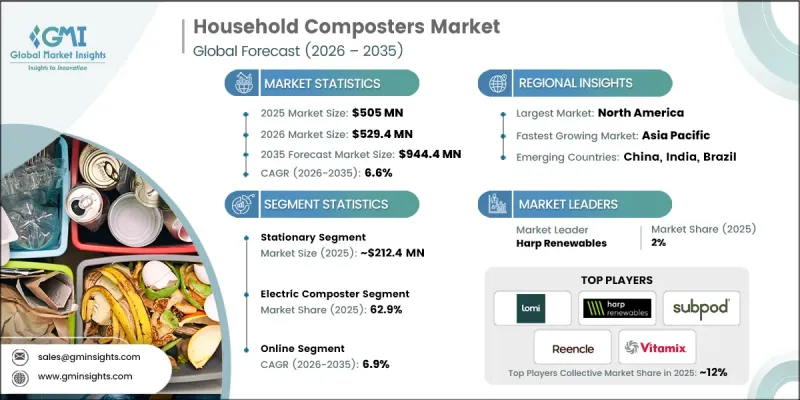
The market growth is driven by increasing government initiatives to reduce household waste and divert organic materials from landfills. Municipal programs provide financial incentives, educational campaigns, and in some cases, regulations mandating the separation of organic waste, prompting households to adopt composting solutions. Consumers are increasingly prioritizing sustainable living and environmentally responsible practices, making composting a core part of home waste management. Compact and automated composters are gaining traction because they combine convenience with compliance, allowing households to reduce their environmental footprint effortlessly. The rising concern over food waste and its impact on the environment is pushing the adoption of electric and smart composters, which simplify the process while delivering odor control, faster decomposition, and automated monitoring, aligning with the growing eco-conscious mindset of consumers.
| Market Scope | |
|---|---|
| Start Year | 2025 |
| Forecast Year | 2026-2035 |
| Start Value | $505 Million |
| Forecast Value | $944.4 Million |
| CAGR | 6.6% |
In 2025, the stationary composters segment generated USD 212.4 million and is expected to grow at a CAGR of 7% through 2035. These units remain popular due to their affordability, durability, and low maintenance, making them suitable for budget-conscious households and community users. Their modular designs fit standard green/brown composting routines, offering a low-tech "set and forget" solution without energy consumption. Stationary composters are particularly favored by users with outdoor space and those seeking biologically rich compost through natural microbial processes. Widespread retail availability and strong word-of-mouth among gardening communities sustain steady demand.
The online sales channels accounted for 52.9% share in 2025 and are projected to grow at a CAGR of 6.9% through 2035. E-commerce dominates because buyers can compare capacities, features, noise levels, and reviews before purchasing premium appliances. Online platforms provide detailed product information, instructional videos, sustainability stories, and easy return policies. Direct-to-consumer brands leverage post-purchase engagement through subscriptions, replacement parts, app integration, and educational content, boosting customer retention and advocacy.
U.S. Household Composters Market captured USD 125.4 million in 2025, fueled by the rising interest in zero-waste lifestyles and municipal organics collection mandates. Urban households, particularly in states with stricter waste management regulations, prefer electric and odor-controlled indoor composters due to limited outdoor space. Strong e-commerce infrastructure and sustainability-conscious consumer behavior support the growth of premium composting units. Convenience, automation, and odor-control features remain key factors influencing purchasing decisions.
Key players in the Global Household Composters Market include Lomi, Zeosta, GRAF, Harp Renewables, Airthereal, Vego, Subpod, Reencle, Lasso, Topmake Environment, Mantis, Vitamix, Geme, and Lotech Products. Companies in the Household Composters Market are employing several strategies to strengthen their market presence. They are focusing on developing smart, electric, and odor-controlled composting units that simplify composting while enhancing user experience. Expanding e-commerce channels and direct-to-consumer marketing help reach urban households and environmentally conscious consumers. Investment in R&D enables product differentiation with faster decomposition, automated monitoring, and app integration. Brands are leveraging sustainability storytelling, social media, and educational campaigns to build loyalty and awareness. Strategic partnerships with municipal programs, garden centers, and lifestyle brands increase market visibility. Offering post-purchase services, subscription models for consumables, and replacement parts ensures higher retention and long-term customer engagement.
Table of Contents
Chapter 1 Methodology & Scope
- 1.1 Market scope & definitions
- 1.2 Research design
- 1.2.1 Research approach
- 1.2.2 Data collection methods
- 1.3 Base estimates and calculations
- 1.3.1 Base year calculation
- 1.3.2 Market estimates & forecasts parameters
- 1.4 Forecast Model
- 1.4.1 Key trends for market estimates
- 1.4.2 Quantified market impact analysis
- 1.4.2.1 Mathematical impact of growth parameters on forecast
- 1.4.3 Scenario analysis framework
- 1.5 Primary research and validation
- 1.5.1 Some of the primary sources (but not limited to)
- 1.6 Data mining sources
- 1.6.1 Paid Sources
- 1.7 Primary research and validation
- 1.7.1 Primary sources
- 1.8 Research Trail & confidence scoring
- 1.8.1 Research trail components
- 1.8.2 Scoring components
- 1.9 Research transparency addendum
- 1.9.1 Source attribution framework
- 1.9.2 Quality assurance metrics
- 1.9.3 Our commitment to trust
- 1.10 Market Definitions
Chapter 2 Executive Summary
- 2.1 Industry 360° synopsis
- 2.2 Key market trends
- 2.2.1 Regional
- 2.2.2 Product type
- 2.2.3 Type
- 2.2.4 Capacity
- 2.2.5 Price
- 2.2.6 Application
- 2.2.7 Distribution channel
- 2.3 CXO perspectives: Strategic imperatives
- 2.3.1 Key decision points for industry executives
- 2.3.2 Critical success factors for market players
- 2.4 Future outlook and strategic recommendations
Chapter 3 Industry Insights
- 3.1 Industry ecosystem analysis
- 3.1.1 Supplier landscape
- 3.1.2 Profit margin
- 3.1.3 Value addition at each stage
- 3.1.4 Factor affecting the value chain
- 3.2 Industry impact forces
- 3.2.1 Growth drivers
- 3.2.1.1 Government regulations & waste management policies
- 3.2.1.2 Rising food waste concerns & sustainability awareness
- 3.2.1.3 Urbanization & space-constrained living driving indoor solutions
- 3.2.2 Pitfalls & Challenges
- 3.2.2.1 Misleading product claims
- 3.2.2.2 High upfront cost of electric composters
- 3.2.3 Opportunities
- 3.2.3.1 Product innovation in odor control & pest prevention
- 3.2.3.2 Wooden composter niche for eco-conscious consumers
- 3.2.1 Growth drivers
- 3.3 Growth potential analysis
- 3.4 Future market trends
- 3.5 Technology and innovation landscape
- 3.5.1 Current technological trends
- 3.5.2 Emerging technologies
- 3.6 Price trends
- 3.6.1 By region
- 3.6.2 By product
- 3.7 Regulatory landscape
- 3.7.1 Waste management regulations by region
- 3.7.2 Sustainability standards & certifications
- 3.7.3 Subsidy programs & government incentives
- 3.8 Patent landscape (driven by primary research)
- 3.8.1 Patent filing trends by technology type
- 3.8.2 Key patent holders & innovation leaders
- 3.8.3 Emerging technology patents (smart sensors, rapid composting)
- 3.9 Trade data analysis (driven by primary research) - (HS Code - 48237010)
- 3.9.1 Import/export volume & value trends
- 3.9.2 Key trade corridors & tariff impact
- 3.10 Impact of AI & Generative AI on the Market
- 3.10.1 AI-driven disruption of existing business models
- 3.10.2 GenAI use cases & adoption roadmap by segment
- 3.10.3 Risks, limitations & regulatory considerations
- 3.11 Porter's analysis
- 3.12 PESTEL analysis
- 3.13 Consumer buying behaviour analysis
- 3.13.1 Purchase decision factors
- 3.13.2 Brand awareness & influence
- 3.13.3 Environmental consciousness impact on purchasing
Chapter 4 Competitive Landscape, 2025
- 4.1 Introduction
- 4.2 Company market share analysis
- 4.2.1 By Region
- 4.2.1.1 North America
- 4.2.1.2 Europe
- 4.2.1.3 Asia Pacific
- 4.2.1.4 Latin America
- 4.2.1.5 Middle East & Africa
- 4.2.1 By Region
- 4.3 Company matrix analysis
- 4.4 Competitive analysis of major market players
- 4.5 Competitive positioning matrix
- 4.6 Key developments
- 4.6.1 Mergers & acquisitions
- 4.6.2 Partnerships & collaborations
- 4.6.3 New product launches
- 4.6.4 Expansion plans
Chapter 5 Market Estimates & Forecast, By Product Type, 2022 - 2035, (USD Million) (Thousand Units)
- 5.1 Key trends
- 5.2 Stationary
- 5.3 Tumbler
- 5.4 Others (compacting etc.)
Chapter 6 Market Estimates & Forecast, By Type, 2022 - 2035, (USD Million) (Thousand Units)
- 6.1 Key trends
- 6.2 Electric composter
- 6.2.1 Countertop electric composters
- 6.2.2 Floor-standing electric composters
- 6.3 Manual composter
- 6.3.1 Traditional manual composters
- 6.3.2 Aerobic manual composters
Chapter 7 Market Estimates & Forecast, By Capacity, 2022 - 2035, (USD Million) (Thousand Units)
- 7.1 Key trends
- 7.2 Below 10L
- 7.3 10L to 20L
- 7.4 20L to 40L
- 7.5 Above 40L
Chapter 8 Market Estimates & Forecast, By Price, 2022 - 2035, (USD Million) (Thousand Units)
- 8.1 Key trends
- 8.2 Low
- 8.3 Medium
- 8.4 High
Chapter 9 Market Estimates & Forecast, By Application, 2022 - 2035, (USD Million) (Thousand Units)
- 9.1 Key trends
- 9.2 Indoor
- 9.2.1 Kitchen countertop
- 9.2.2 Under-sink
- 9.2.3 Balcony/terrace
- 9.3 Outdoor
- 9.3.1 Backyard/garden
- 9.3.2 Patio
Chapter 10 Market Estimates & Forecast, By Distribution Channel, 2022 - 2035, (USD Million) (Thousand Units)
- 10.1 Key trends
- 10.2 Online
- 10.2.1 Company websites
- 10.2.2 E-commerce
- 10.3 Offline
- 10.3.1 Supermarket/hypermarket
- 10.3.2 Specialty store
- 10.3.3 Others (mega retail store etc.)
Chapter 11 Market Estimates & Forecast, By Region, 2022 - 2035, (USD Million) (Thousand Units)
- 11.1 Key trends
- 11.2 North America
- 11.2.1 U.S.
- 11.2.2 Canada
- 11.3 Europe
- 11.3.1 Germany
- 11.3.2 UK
- 11.3.3 France
- 11.3.4 Italy
- 11.3.5 Spain
- 11.4 Asia Pacific
- 11.4.1 China
- 11.4.2 India
- 11.4.3 Japan
- 11.4.4 South Korea
- 11.4.5 Australia
- 11.5 Latin America
- 11.5.1 Brazil
- 11.5.2 Mexico
- 11.5.3 Argentina
- 11.6 MEA
- 11.6.1 Saudi Arabia
- 11.6.2 UAE
- 11.6.3 South Africa
Chapter 12 Company Profiles
- 12.1 Airthereal
- 12.2 Beyond Green Biotech
- 12.3 Geme
- 12.4 GRAF
- 12.5 Harp Renewables
- 12.6 Lasso
- 12.7 Lomi
- 12.8 Lotech Products
- 12.9 Mantis
- 12.10 Reencle
- 12.11 Subpod
- 12.12 Topmake Environment
- 12.13 Vego
- 12.14 Vitamix
- 12.15 Zeosta

