PUBLISHER: Global Market Insights Inc. | PRODUCT CODE: 2027491

PUBLISHER: Global Market Insights Inc. | PRODUCT CODE: 2027491
Marine Transducers Market Opportunity, Growth Drivers, Industry Trend Analysis, and Forecast 2026 - 2035
The Global Marine Transducers Market was valued at USD 772.7 million in 2025 and is estimated to grow at a CAGR of 3.6% to reach USD 1.1 billion by 2035.
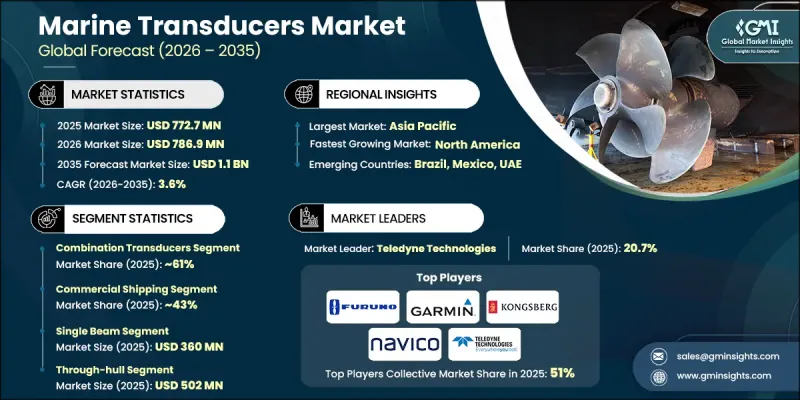
The market's growth is fueled by the rising adoption of advanced sonar systems, the increasing integration of multi-functional transducers, and the growing demand for real-time marine data and improved connectivity for commercial, naval, and research vessels. Shipbuilders, offshore operators, and marine technology providers are investing heavily in high-performance digital transducer systems and sonar platforms to enable precise navigation, environmental monitoring, and seamless integration with autonomous and connected maritime platforms. Pressure on vessel operators and naval organizations to optimize sensor deployment, improve underwater detection, and facilitate real-time data transmission is driving the transition from traditional single-function transducers to multi-functional, combination architectures. Modern transducers support centralized sonar processing, high-speed acoustic networks, real-time analytics, and cloud-enabled updates, enhancing accuracy, reducing signal latency, and improving operational efficiency. Technological innovations such as multi-beam and side-scan sonar, AI-driven signal processing, integrated environmental sensors, and software-enabled platforms are transforming marine sensing and monitoring capabilities.
| Market Scope | |
|---|---|
| Start Year | 2025 |
| Forecast Year | 2026-2035 |
| Start Value | $772.7 Million |
| Forecast Value | $1.1 Billion |
| CAGR | 3.6% |
The combination transducers segment held a 61% share in 2025 and is expected to grow at a CAGR of 3.8% from 2026 to 2035. Combination transducers remain dominant due to their ability to deliver multiple sensing functionalities such as depth, speed, and temperature within a single unit. Their growing adoption in commercial shipping, naval fleets, offshore energy, and oceanographic research underscores their importance for real-time data acquisition, multi-domain monitoring, and integration with navigation, sonar, and autonomous systems.
The commercial shipping segment accounted for 43% share in 2025 and is projected to grow at a CAGR of 3.7% through 2035. The large global fleet of cargo vessels, tankers, and bulk carriers demands high-performance marine transducers. Commercial operators are increasingly deploying multi-functional systems for navigation, real-time monitoring, and integration with onboard sonar, communication, and autonomous platforms. Standardized, modular, and software-enabled transducer solutions further reinforce this segment's market leadership across North America, Europe, and Asia Pacific.
China Marine Transducers Market held a 57% share, generating USD 212.2 million in 2025. China's leadership is supported by strong maritime trade, a large shipbuilding industry, and growing offshore exploration. Investments in commercial fleets, naval modernization, and marine research infrastructure are fueling demand for advanced sensing technologies, including combination transducers integrated with sonar and navigation platforms. Smart vessel monitoring systems and autonomous marine platforms are further driving adoption across commercial, defense, and research vessels.
Major players operating in the Global Marine Transducers Market include Furuno Electric, Airmar Technology, Teledyne Technologies, Navico, Continental, Garmin, Kongsberg Maritime, Robert Bosch, Raymarine, and Aptiv. Companies in the Marine Transducers Market are focusing on strategic investments in research and development to enhance sensor accuracy, integration capabilities, and multi-functional performance. They are expanding their product portfolios to include modular, software-driven, and AI-enabled solutions for commercial, defense, and research vessels. Partnerships with OEMs and marine integrators ensure early adoption and integration into new fleets. Firms are also targeting emerging markets with cost-effective, high-performance transducers, while strengthening after-sales support, cloud-based analytics, and service networks to enhance customer retention and maintain a competitive market foothold.
Table of Contents
Chapter 1 Methodology & Scope
- 1.1 Research approach
- 1.2 Quality Commitments
- 1.2.1 GMI AI policy & data integrity commitment
- 1.2.1.1 Source consistency protocol
- 1.2.1 GMI AI policy & data integrity commitment
- 1.3 Research Trail & Confidence Scoring
- 1.3.1 Research Trail Components
- 1.3.2 Scoring Components
- 1.4 Data Collection
- 1.4.1 Partial list of primary sources
- 1.5 Data mining sources
- 1.5.1 Paid sources
- 1.5.1.1 Sources, by region
- 1.5.1 Paid sources
- 1.6 Base estimates and calculations
- 1.6.1 Base year calculation for any one approach
- 1.7 Forecast model
- 1.7.1 Quantified market impact analysis
- 1.7.1.1 Mathematical impact of growth parameters on forecast
- 1.7.1 Quantified market impact analysis
- 1.8 Research transparency addendum
- 1.8.1 Source attribution framework
- 1.8.2 Quality assurance metrics
- 1.8.3 Our commitment to trust
Chapter 2 Executive Summary
- 2.1 Industry 360° synopsis
- 2.2 Key market trends
- 2.2.1 Regional
- 2.2.2 Type
- 2.2.3 Installation
- 2.2.4 Technology
- 2.2.5 Application
- 2.3 TAM Analysis, 2026-2035
- 2.4 CXO perspectives: Strategic imperatives
Chapter 3 Industry Insights
- 3.1 Industry ecosystem analysis
- 3.1.1 Supplier Landscape
- 3.1.2 Profit Margin
- 3.1.3 Cost structure
- 3.1.4 Value addition at each stage
- 3.1.5 Factor affecting the value chain
- 3.1.6 Disruptions
- 3.2 Industry impact forces
- 3.2.1 Growth drivers
- 3.2.1.1 Rising demand for multi-functional and combination transducers
- 3.2.1.2 Growth in commercial shipping and naval fleets
- 3.2.1.3 Technological advancements
- 3.2.1.4 Expansion of autonomous marine platforms
- 3.2.2 Industry pitfalls and challenges
- 3.2.2.1 High initial costs and installation complexity
- 3.2.2.2 Harsh marine environment challenges
- 3.2.3 Market opportunities
- 3.2.3.1 Integration with smart marine systems
- 3.2.3.2 Expansion of offshore Energy and Oceanographic Research
- 3.2.3.3 Rising adoption of autonomous and unmanned vessels
- 3.2.3.4 Technological advancements in multi-beam, side-scan, and AI-enabled transducers
- 3.2.1 Growth drivers
- 3.3 Growth potential analysis
- 3.4 Regulatory landscape
- 3.4.1 North America
- 3.4.1.1 U.S.: USCG, EPA, NMEA Standards
- 3.4.1.2 Canada: Transport Canada, CMVSS Regulation
- 3.4.2 Europe
- 3.4.2.1 Germany: BSH, CE Compliance
- 3.4.2.2 France: Ministry of Transport, Naval Safety Regulations
- 3.4.2.3 UK: MCA, CE & UKCA Standards
- 3.4.2.4 Italy: Ministry of Infrastructure & Transport, Maritime Safety
- 3.4.3 Asia Pacific
- 3.4.3.1 China: MIIT, China 6/7 Standards
- 3.4.3.2 Japan: MLIT, JIS Regulations
- 3.4.3.3 South Korea: MOLIT, KS Standards
- 3.4.3.4 India: MoRTH, BIS Standards
- 3.4.4 Latin America
- 3.4.4.1 Brazil: ANTAQ, DENATRAN & CONAMA Standards
- 3.4.4.2 Mexico: SCT, Mexican Maritime Safety Regulations
- 3.4.5 Middle East and Africa
- 3.4.5.1 UAE: RTA, ESMA Regulations
- 3.4.5.2 Saudi Arabia: Ministry of Transport, SASO Standards
- 3.4.1 North America
- 3.5 Porter’s analysis
- 3.6 PESTEL analysis
- 3.7 Technology and Innovation Landscape
- 3.7.1 Current technological trends
- 3.7.2 Emerging technologies
- 3.8 Patent analysis (Driven by Primary Research)
- 3.9 Pricing Analysis (Driven by Primary Research)
- 3.9.1 Historical Price Trend Analysis
- 3.9.2 Pricing Strategy by Player Type
- 3.10 Trade data analysis (driven by Paid Database)
- 3.10.1 Import/export volume & value trends
- 3.10.2 Key trade corridors & tariff impact
- 3.11 Capacity & production landscape (driven by Primary Research)
- 3.11.1 Installed capacity by region & key producer
- 3.11.2 Capacity utilization rates & expansion pipelines
- 3.12 Impact of AI & generative AI on the market
- 3.12.1 AI-Driven Disruption of Existing Business Models
- 3.12.2 GenAI Use Cases & Adoption Roadmap by Segment
- 3.12.3 Risks, limitations & regulatory considerations
- 3.13 Sustainability and environmental aspects
- 3.13.1 Sustainable practices
- 3.13.2 Waste reduction strategies
- 3.13.3 Energy efficiency in production
- 3.13.4 Eco-friendly initiatives
- 3.13.5 Carbon footprint considerations
- 3.14 Forecast assumptions & scenario analysis (Driven by Primary Research)
- 3.14.1 Base Case - Key Macro & Industry Variables Driving CAGR
- 3.14.2 Optimistic Scenarios - Favorable macro and industry tailwinds
- 3.14.3 Pessimistic Scenario - Macroeconomic slowdown or industry headwinds
Chapter 4 Competitive Landscape, 2025
- 4.1 Introduction
- 4.2 Company market share analysis
- 4.2.1 North America
- 4.2.2 Europe
- 4.2.3 Asia Pacific
- 4.2.4 Latin America
- 4.2.5 Middle East & Africa
- 4.3 Competitive analysis of major market players
- 4.4 Competitive positioning matrix
- 4.5 Strategic outlook matrix
- 4.6 Key developments
- 4.6.1 Mergers & acquisitions
- 4.6.2 Partnerships & collaborations
- 4.6.3 New product launches
- 4.6.4 Expansion plans and funding
- 4.7 Company Tier Benchmarking
- 4.7.1 Tier Classification Criteria & Qualifying Thresholds
- 4.7.2 Tier Positioning Matrix by Revenue, Geography & Innovation
Chapter 5 Market Estimates & Forecast, By Type, 2022 - 2035 ($Bn, Units)
- 5.1 Key trends
- 5.2 Combination transducers
- 5.3 Depth transducers
- 5.4 Speed transducers
- 5.5 Temperature transducers
Chapter 6 Market Estimates & Forecast, By Installation, 2022 - 2035 ($Bn, Units)
- 6.1 Key trends
- 6.2 Through-hull
- 6.3 In-hull
- 6.4 Transom-mount
Chapter 7 Market Estimates & Forecast, By Technology, 2022 - 2035 ($Bn, Units)
- 7.1 Key trends
- 7.2 Single beam
- 7.3 Multi-beam
- 7.4 Side-scan sonar
- 7.5 Others
Chapter 8 Market Estimates & Forecast, By Application, 2022 - 2035 ($Bn, Units)
- 8.1 Key trends
- 8.2 Commercial shipping
- 8.3 Naval defense
- 8.4 Offshore energy exploration
- 8.5 Recreational boating
- 8.6 Oceanographic research
Chapter 9 Market Estimates & Forecast, By Region, 2022 - 2035 ($Bn, Units)
- 9.1 Key trends
- 9.2 North America
- 9.2.1 US
- 9.2.2 Canada
- 9.3 Europe
- 9.3.1 UK
- 9.3.2 Germany
- 9.3.3 France
- 9.3.4 Italy
- 9.3.5 Spain
- 9.3.6 Belgium
- 9.3.7 Netherlands
- 9.3.8 Sweden
- 9.4 Asia Pacific
- 9.4.1 China
- 9.4.2 India
- 9.4.3 Japan
- 9.4.4 Australia
- 9.4.5 Singapore
- 9.4.6 South Korea
- 9.4.7 Vietnam
- 9.4.8 Indonesia
- 9.5 Latin America
- 9.5.1 Brazil
- 9.5.2 Mexico
- 9.5.3 Argentina
- 9.6 MEA
- 9.6.1 UAE
- 9.6.2 South Africa
- 9.6.3 Saudi Arabia
Chapter 10 Company Profiles
- 10.1 Global Player
- 10.1.1 Airmar Technology
- 10.1.2 Aptiv
- 10.1.3 Continental
- 10.1.4 Furuno Electric
- 10.1.5 Garmin
- 10.1.6 Kongsberg Maritime
- 10.1.7 Navico
- 10.1.8 Raymarine
- 10.1.9 Robert Bosch
- 10.1.10 Teledyne Technologies
- 10.2 Regional Player
- 10.2.1 B&G
- 10.2.2 Echopilot
- 10.2.3 Humminbird
- 10.2.4 JRC
- 10.2.5 Lowrance
- 10.2.6 Maretron
- 10.2.7 MaxSea
- 10.2.8 Navis Electronic
- 10.2.9 Nobeltec
- 10.2.10 Simrad

