PUBLISHER: Global Market Insights Inc. | PRODUCT CODE: 2019114

PUBLISHER: Global Market Insights Inc. | PRODUCT CODE: 2019114
Utility Scale Closed Loop Current Transducer Market Opportunity, Growth Drivers, Industry Trend Analysis, and Forecast 2026 - 2035
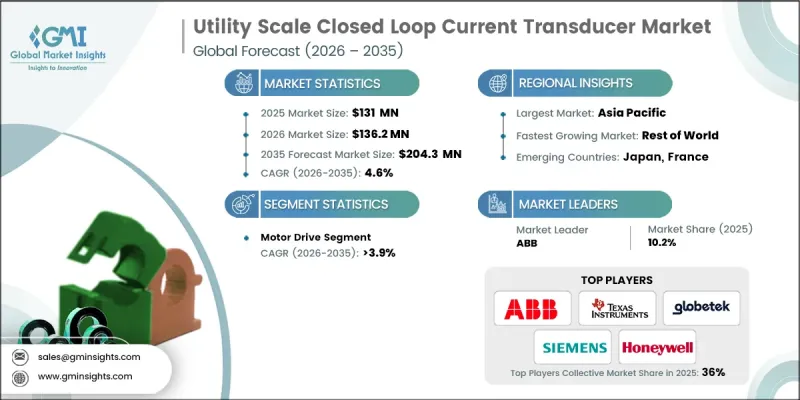
The Global Utility Scale Closed Loop Current Transducer Market was valued at USD 131 million in 2025 and is estimated to grow at a CAGR of 4.6% to reach USD 204.3 million by 2035.
The market is driven by the rapid expansion of renewable energy infrastructure, particularly large-scale solar and wind projects, which require precise current measurement for safe and efficient operation. Closed loop current transducers provide real-time monitoring and enhanced energy management, making them essential for modern power grids. The growth of smart grid networks further fuels demand, as these devices improve grid reliability, support automation, and optimize energy distribution. Increasing adoption of electric vehicle (EV) fast charging networks also boosts market growth, as these transducers manage high-power loads, protect systems, and ensure smooth power delivery. Additionally, the rise of large-scale energy storage installations is driving adoption, as accurate current sensing is crucial for maintaining operational stability, reducing faults, and enhancing overall system efficiency. Advances in sensor technologies, such as improved accuracy, extended measurement range, and better thermal management, are enabling broader applications across utilities, renewable energy plants, and industrial automation systems.
| Market Scope | |
|---|---|
| Start Year | 2025 |
| Forecast Year | 2026-2035 |
| Start Value | $131 Million |
| Forecast Value | $204.3 Million |
| CAGR | 4.6% |
The motor drive segment is projected to grow at a CAGR of 3.9% through 2035, highlighting the increasing importance of accurate current measurement in industrial automation systems. Companies across the manufacturing, chemical processing, and material handling sectors are focusing on precise energy monitoring to improve operational efficiency, lower electricity costs, and maintain consistent process outputs. Closed loop current transducers play a pivotal role in ensuring motor drives operate safely under varying loads, protecting equipment and extending machinery lifespan.
U.S. Utility Scale Closed Loop Current Transducer Market is expected to reach USD 29 million by 2035, driven by substantial investments in utility-scale wind farms, solar parks, and hybrid renewable projects. As renewable energy capacity grows, the deployment of large-scale energy storage systems becomes critical to balance intermittent generation. Accurate transducers are essential in these battery installations to monitor charge and discharge currents, prevent overloads, and optimize energy management. The integration of smart grid technologies, advanced monitoring systems, and automated control units further strengthens demand, making these sensors indispensable for reliable, efficient, and safe grid operations.
Key companies active in the Global Utility Scale Closed Loop Current Transducer Market include ABB, Infineon Technologies, Honeywell International Inc., Phoenix Contact, Asahi Kasei Microdevices Corporation, NK Technologies, FEMTO, Johnson Controls, Topstek, Luksens, ZES ZIMMER, TAMURA Corporation, Howard Butler, Globetek, CR Magnetics, Inc., CHEEMI TECHNOLOGY, Beijing TransFar Electronics Group, and Texas Instruments. Market players are adopting several strategies to strengthen their presence and expand market share. These include launching high-precision and wide-range transducer models, expanding production capacities for renewable energy and EV infrastructure, and investing in R&D for advanced sensor technologies with better thermal handling and reliability. Companies are forming partnerships with utilities, EV charging network providers, and smart grid developers to integrate transducers into large-scale systems. Strategic collaborations, acquisitions, and regional expansion efforts enhance global distribution networks and service support. Emphasis on regulatory compliance, energy-efficient solutions, and tailored products for industrial, storage, and renewable applications further strengthens their competitive positioning, enabling sustained growth and long-term market foothold.
Table of Contents
Chapter 1 Methodology & Scope
- 1.1 Research design
- 1.1.1 Research approach
- 1.1.2 Data collection methods
- 1.2 Base estimates and calculations
- 1.2.1 Base year calculation
- 1.2.2 Market estimates & forecast parameters
- 1.3 Forecast
- 1.3.1 Key trends for market estimates
- 1.3.2 Quantified market impact analysis
- 1.3.2.1 Mathematical impact of growth parameters on forecast
- 1.3.3 Scenario analysis framework
- 1.4 Primary research and validation
- 1.4.1 Some of the primary sources (but not limited to)
- 1.5 Data mining sources
- 1.5.1 Paid Sources
- 1.5.2 Sources, by region
- 1.6 Research trail & scoring components
- 1.6.1 Research trail components
- 1.6.2 Scoring components
- 1.7 Research transparency addendum
- 1.7.1 Source attribution framework
- 1.7.2 Quality assurance metrics
- 1.7.3 Our commitment to trust
- 1.8 Market definitions
Chapter 2 Executive Summary
- 2.1 Industry synopsis, 2022 - 2035
- 2.1.1 Business trends
- 2.1.2 Application trends
- 2.1.3 Regional trends
Chapter 3 Industry Insights
- 3.1 Industry ecosystem analysis
- 3.2 Regulatory landscape
- 3.3 Industry impact forces
- 3.3.1 Growth drivers
- 3.3.2 Industry pitfalls & challenges
- 3.4 Growth potential analysis
- 3.5 Porter's analysis
- 3.5.1 Bargaining power of suppliers
- 3.5.2 Bargaining power of buyers
- 3.5.3 Threat of new entrants
- 3.5.4 Threat of substitutes
- 3.6 PESTEL analysis
- 3.6.1 Political factors
- 3.6.2 Economic factors
- 3.6.3 Social factors
- 3.6.4 Technological factors
- 3.6.5 Legal factors
- 3.6.6 Environmental factors
- 3.7 Emerging opportunities & trends
- 3.8 Investment analysis & future prospects
Chapter 4 Competitive Landscape, 2025
- 4.1 Introduction
- 4.2 Company market share analysis, by country, 2025
- 4.2.1 North America
- 4.2.2 Europe
- 4.2.3 Asia Pacific
- 4.2.4 Middle East & Africa
- 4.2.5 Latin America
- 4.3 Strategic dashboard
- 4.4 Competitive benchmarking
- 4.5 Innovation & sustainability landscape
Chapter 5 Market Size and Forecast, By Application, 2022 - 2035 (USD Million)
- 5.1 Key trends
- 5.2 Motor drive
- 5.3 Converter & inverter
- 5.4 Battery management
- 5.5 UPS & SMPS
- 5.6 Others
Chapter 6 Market Size and Forecast, By Region, 2022 - 2035 (USD Million)
- 6.1 Key trends
- 6.2 North America
- 6.2.1 U.S.
- 6.2.2 Canada
- 6.3 Europe
- 6.3.1 Germany
- 6.3.2 France
- 6.3.3 Russia
- 6.3.4 UK
- 6.3.5 Italy
- 6.3.6 Spain
- 6.4 Asia Pacific
- 6.4.1 China
- 6.4.2 Japan
- 6.4.3 South Korea
- 6.4.4 India
- 6.4.5 Australia
- 6.5 Rest of World
Chapter 7 Company Profiles
- 7.1 ABB
- 7.2 Asahi Kasei Microdevices Corporation
- 7.3 Beijing TransFar Electronics Group
- 7.4 CHEEMI TECHNOLOGY
- 7.5 CR Magnetics, Inc.
- 7.6 FEMTO
- 7.7 Globetek
- 7.8 Honeywell International Inc.
- 7.9 Howard Butler
- 7.10 Infineon Technologies
- 7.11 Johnson Controls
- 7.12 Luksens
- 7.13 NK Technologies
- 7.14 Phoenix Contact
- 7.15 TAMURA Corporation
- 7.16 Texas Instruments
- 7.17 Topstek
- 7.18 ZES ZIMMER

