PUBLISHER: Global Market Insights Inc. | PRODUCT CODE: 2027495

PUBLISHER: Global Market Insights Inc. | PRODUCT CODE: 2027495
Activewear Market Opportunity, Growth Drivers, Industry Trend Analysis, and Forecast 2026 - 2035
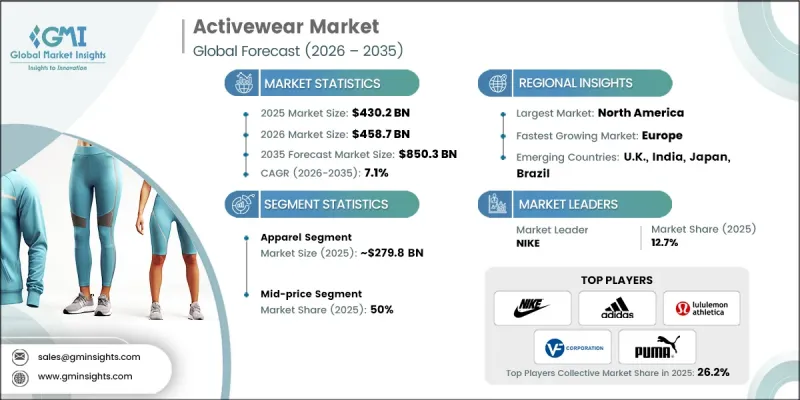
The Global Activewear Market was valued at USD 430.2 billion in 2025 and is estimated to grow at a CAGR of 7.1% to reach USD 850.3 billion by 2035.
The industry is witnessing strong expansion as consumers increasingly prioritize health, fitness, and overall well-being as part of their daily routines. Demand is particularly influenced by younger demographics who are integrating physical activity into their lifestyles, which continues to drive consistent product adoption. Growing participation in structured fitness activities, along with rising engagement in recreational and wellness-focused routines, is further accelerating market momentum. The evolution of athleisure has significantly broadened the consumer base by blending performance-driven functionality with modern fashion aesthetics, making activewear suitable for multiple occasions beyond exercise. Additionally, advancements in fabric technology, including moisture management, stretchability, and durability, are enhancing product appeal. Expanding retail accessibility through both physical and digital channels is also contributing to higher consumer reach. Increasing awareness around long-term health benefits, coupled with lifestyle shifts toward convenience and comfort, continues to strengthen the global demand outlook for activewear products across diverse consumer segments.
| Market Scope | |
|---|---|
| Start Year | 2025 |
| Forecast Year | 2026-2035 |
| Start Value | $430.2 Billion |
| Forecast Value | $850.3 Billion |
| CAGR | 7.1% |
The apparel segment generated USD 279.8 billion in 2025 and is anticipated to reach USD 554.4 billion by 2035. This segment leads the market due to its versatility, frequent purchase cycles, and widespread consumer adoption. Activewear clothing has become an integral part of everyday wardrobes, supported by rising demand for products that combine comfort, style, and performance. The continued growth of athleisure trends is further reinforcing demand, as consumers increasingly prefer apparel that can seamlessly transition across different daily activities.
The mid-price segment accounted for 50% share in 2025. This segment appeals to a wide range of consumers by offering a balanced combination of affordability and quality. Products in this category are designed to deliver durability, comfort, and contemporary styling, making them suitable for both active users and general lifestyle wear. The accessibility of mid-range pricing continues to support high-volume sales and broad market penetration.
United States Activewear Market held 75.3% share in 2025. Growth in the country is driven by a strong culture of fitness participation, increasing engagement in wellness-oriented activities, and high consumer spending capacity. The widespread adoption of digital fitness platforms and connected training ecosystems is further supporting demand for performance-oriented apparel. Strong brand visibility, ongoing product innovation, and a well-established e-commerce infrastructure are also contributing to sustained market expansion. Increasing focus on preventive health and lifestyle-driven purchasing behavior continues to encourage repeat consumption across the region.
Key companies operating in the Global Activewear Market include Nike, Adidas AG, Puma SE, Under Armour Inc., Lululemon Athletica Inc., ASICS Corporation, New Balance, Gymshark, Skechers, VF Corporation, Columbia Sportswear Company, Fila Holdings Corporation, Patagonia, ASOS PLC, Champion, and Squat Wolf. Companies in the Activewear Market are focusing on strengthening their competitive position through continuous product innovation and brand differentiation. They are investing heavily in advanced fabric technologies to enhance performance features such as breathability, flexibility, and durability. Strategic collaborations with influencers and fitness communities are being used to expand brand reach and engage younger audiences. Businesses are also prioritizing direct-to-consumer channels and digital platforms to improve customer experience and build stronger brand loyalty. Expanding product portfolios to include athleisure collections is helping companies tap into lifestyle-driven demand. Additionally, firms are emphasizing sustainability by incorporating recycled materials and responsible sourcing practices.
Table of Contents
Chapter 1 Methodology & Scope
- 1.1 Research approach
- 1.2 Quality Commitments
- 1.3 GMI AI policy & data integrity commitment
- 1.3.1 Source consistency protocol
- 1.4 Research Trail & Confidence Scoring
- 1.4.1 Research Trail Components
- 1.4.2 Scoring Components
- 1.5 Data Collection
- 1.5.1 Partial list of primary sources
- 1.6 Data mining sources
- 1.7 Paid sources
- 1.7.1 Sources, by region
- 1.8 Base estimates and calculations
- 1.8.1 Base year calculation for any one approach
- 1.9 Forecast model
- 1.9.1 Quantified market impact analysis
- 1.9.1.1 Mathematical impact of growth parameters on forecast
- 1.9.1 Quantified market impact analysis
- 1.10 Research transparency addendum
- 1.10.1 Source attribution framework
- 1.10.2 Quality assurance metrics
- 1.10.3 Our commitment to trust
Chapter 2 Executive Summary
- 2.1 Industry 360° synopsis
- 2.2 Key market trends
- 2.2.1 Regional
- 2.2.2 Product Type
- 2.2.3 Usage
- 2.2.4 Price
- 2.2.5 Consumer Group
- 2.2.6 Distribution Channel
Chapter 3 Industry Insights
- 3.1 Industry ecosystem analysis
- 3.1.1 Supplier landscape
- 3.1.2 Profit margin
- 3.1.3 Value addition at each stage
- 3.1.4 Factor affecting the value chain
- 3.2 Industry impact forces
- 3.2.1 Growth drivers
- 3.2.1.1 Rising demand for athleisure and casual wear
- 3.2.1.2 Growth of customization and personalization
- 3.2.1.3 Increased disposable income
- 3.2.2 Industry pitfalls & challenges
- 3.2.2.1 Price volatility of raw materials
- 3.2.2.2 Rapid change in consumer preference
- 3.2.3 Opportunities
- 3.2.3.1 Sustainability-driven premium solutions
- 3.2.3.2 Rising demand from younger consumers for fast fashion
- 3.2.1 Growth drivers
- 3.3 Growth potential analysis
- 3.4 Future market trends
- 3.5 Technology and innovation landscape
- 3.5.1 Current technological trends
- 3.5.2 Emerging technologies
- 3.6 Regulatory landscape
- 3.6.1 Standards and compliance requirements
- 3.6.2 Regional regulatory frameworks
- 3.6.3 Certification standards
- 3.7 Trade data analysis
- 3.7.1 Import/export volume & value trends
- 3.7.2 Key trade corridors & tariff impact
- 3.8 Impact of AI & generative AI on the market
- 3.8.1 AI-driven disruption of existing business models
- 3.8.2 Gen AI use cases & adoption roadmap by segment
- 3.8.3 Risks, limitations & regulatory considerations
- 3.9 Porter’s analysis
- 3.10 PESTEL analysis
- 3.11 Consumer behaviour analysis
- 3.11.1 Purchasing patterns
- 3.11.2 Preference analysis
- 3.11.3 Regional variations in consumer behaviour
- 3.11.4 Impact of e-commerce on buying decisions
Chapter 4 Competitive Landscape, 2025
- 4.1 Introduction
- 4.2 Company market share analysis
- 4.2.1 By region
- 4.2.1.1 North America
- 4.2.1.2 Europe
- 4.2.1.3 Asia Pacific
- 4.2.1.4 Latin America
- 4.2.1.5 Middle East and Africa
- 4.2.1 By region
- 4.3 Company matrix analysis
- 4.4 Competitive analysis of major market players
- 4.5 Competitive positioning matrix
- 4.6 Key developments
- 4.6.1 Mergers & acquisitions
- 4.6.2 Partnerships & collaborations
- 4.6.3 New product launches
- 4.6.4 Expansion plans
Chapter 5 Market Estimates & Forecast, By Product Type, 2022-2035 (USD Billion) (Million Units)
- 5.1 Key trends
- 5.2 Apparel
- 5.2.1 Top
- 5.2.1.1 T-shirts
- 5.2.1.2 Tank tops
- 5.2.1.3 Sports bras
- 5.2.1.4 Jackets
- 5.2.1.5 Sweatshirts
- 5.2.2 Others (track suits, swimmer suits)
- 5.2.2.1 Bottom
- 5.2.2.2 Leggings
- 5.2.2.3 Shorts
- 5.2.2.4 Sweatpants
- 5.2.2.5 Track pants
- 5.2.2.6 Others (yoga pants, skirts)
- 5.2.1 Top
- 5.3 Footwear
- 5.4 Accessories
- 5.4.1 Headwear
- 5.4.2 Gloves
- 5.4.3 Others (wrist bands, waist band)
Chapter 6 Market Estimates & Forecast, By Usage, 2022-2035 (USD Billion) (Million Units)
- 6.1 Key trends
- 6.2 Running
- 6.3 Outdoor sports
- 6.4 Yoga & pilates
- 6.5 Gym & fitness training
- 6.6 Recreational activities
- 6.7 Others
Chapter 7 Market Estimates & Forecast, By Price, 2022-2035 (USD Billion) (Million Units)
- 7.1 Key trends
- 7.2 Low
- 7.3 Medium
- 7.4 High
Chapter 8 Market Estimates & Forecast, By Consumer Group, 2022-2035 (USD Billion) (Million Units)
- 8.1 Key trends
- 8.2 Kids
- 8.3 Men
- 8.4 Women
Chapter 9 Market Estimates & Forecast, By Distribution Channel, 2022-2035 (USD Billion) (Million Units)
- 9.1 Key trends
- 9.2 Online
- 9.2.1 E-Commerce
- 9.2.2 Company website
- 9.3 Offline
- 9.3.1 Supermarkets/Hypermarkets
- 9.3.2 Specialty Stores
- 9.3.3 Others (Individual stores, Departmental stores, etc.)
Chapter 10 Market Estimates & Forecast, By Region, 2022-2035 (USD Billion) (Million Units)
- 10.1 Key trends
- 10.2 North America
- 10.2.1 U.S.
- 10.2.2 Canada
- 10.3 Europe
- 10.3.1 Germany
- 10.3.2 France
- 10.3.3 UK
- 10.3.4 Italy
- 10.3.5 Spain
- 10.4 Asia Pacific
- 10.4.1 China
- 10.4.2 India
- 10.4.3 Japan
- 10.4.4 South Korea
- 10.4.5 Australia
- 10.5 Latin America
- 10.5.1 Brazil
- 10.5.2 Mexico
- 10.5.3 Argentina
- 10.6 MEA
- 10.6.1 South Africa
- 10.6.2 Saudi Arabia
- 10.6.3 UAE
Chapter 11 Company Profiles
- 11.1 Adidas AG
- 11.2 ASICS Corporation
- 11.3 ASOS PLC
- 11.4 Champion
- 11.5 Columbia Sportswear Company
- 11.6 Fila Holdings Corporation
- 11.7 Gymshark
- 11.8 Lululemon Athletica Inc.
- 11.9 New Balance
- 11.10 NIKE
- 11.11 Patagonia
- 11.12 PUMA SE
- 11.13 Skechers
- 11.14 Squat Wolf
- 11.15 Under Armour Inc.
- 11.16 VF Corporation

